

Matteo Colombo
Shares of Valley National Bancorp (NASDAQ:VLY) have been a significant underperformer, losing 14% over the past year on commercial real estate fears (CRE). The company then reported a mixed first quarter, adding to fears. Back in January, I recommended investors buy Valley. This has been a poor call with shares losing over one quarter of their value in the wake of pressures at New York Community Bancorp (NYCB), which has significantly harmed sentiment towards banks with meaningful NYC real estate exposure. These concerns have far exceeded my expectations, given what I viewed as strong reserve policies from VLY. I am reducing my price target but still rating VLY a buy.
Seeking Alpha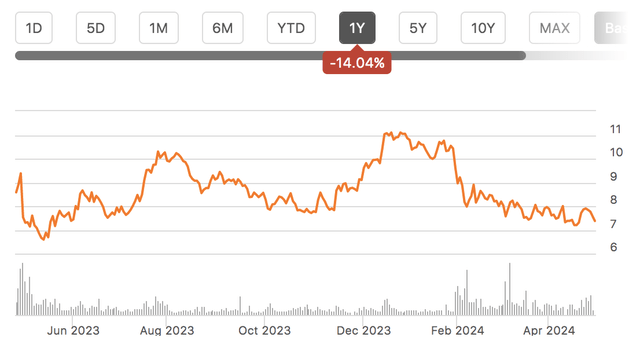
In the company’s first quarter released on April 25th, Valley earned $0.19, missing estimates by a penny. This was down from $0.22 last quarter and $0.30 a year ago. Net interest income was down 1% sequentially as net interest margin (NIM) compresses, but at a slowing rate. More notably, the company is now setting aside more to cover potential loan losses. Valley added $22 million to reserves with $487 million now set aside. Reserves stand at 0.98% of loans, up 5bp sequentially.
Before turning to credit quality and CRE, I want to touch on deposits and net interest trends. I have argued in the past that stable deposits are necessary when investing in this sector, as deposits are the lifeblood of a bank. Given the fears around NYCB and similar banks, there was a risk VLY could have seen deposit flight. Fortunately, this did not happen.
As you can see below, deposits were down just marginally during Q1, a strong result given these pressures. This is especially true because deposits can often fall during Q1 as cash tends to build in December into year-end and then decline in the new year. This is a stable performance, though we did see noninterest-bearing balances continue to fall, as customers seek to earn 5+% yields in money markets. VLY has just $11.5 billion of uninsured deposits, which is a reason why its deposit base has proven so durable. Northeast branches account for 45% of deposits from 78% in 2017, giving it greater diversity and stability in funding.
Valley National Bank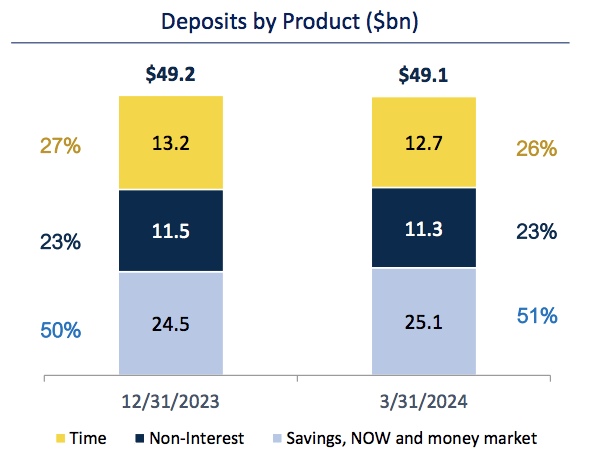
Equally important, VLY did not have to materially up rates to retain deposits. Valley’s average deposit yield of 3.16% was up just 3bp from last quarter. This was the smallest increase since 2022, and we are likely at a peak in deposit yields, barring further increases in the fed funds rate. Indeed, the company reduced deposit rates by 40bp on $10 billion of online savings and CD deposits. We should see the full quarter benefit of this in Q2. The fact VLY has been able to reduce rates and hold deposits steady is very encouraging.
Still given higher deposit costs, NIM compressed to 2.79%, down 3bp sequentially. One headwind for NIM and NII is that VLY is pulling back on lending given the pressures on commercial real estate. During the quarter, it sold $193 million of real estate and construction loans at no net loss. As a result, total loans fell by $300 million to $49.9 billion. Loan yield rose 4bp to 6.14%. New originations yield 7.7%, so reducing new lending activity is a pressure on NIM going forward as asset yields will rise more slowly. Going forward, the company seeks to diversify its loan exposure toward businesses and away from CRE to reduce share price volatility over time. Indeed, C&I lending has been growing at a 10% pace.
Because it is pulling back from lending, it has reduced growth estimates for this year with NII barely rising as it reduces loan growth. To offset this, it is pulling back on spending, and the decline in non-interest expense should offset most of the reduction in NII. The company is assuming 3 rate cuts in this guidance, but if the Fed hold rates steady, this would not materially alter guidance.
Valley National Bank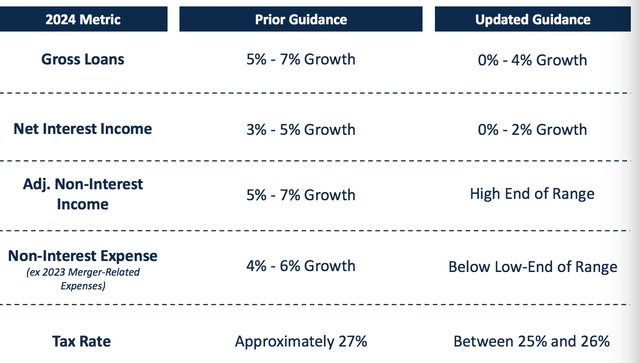
Valley is pulling back on growth to further strengthen its balance sheet. It ended Q1 with a 9.3% tier one common equity (CET1) ratio. It aims to build this toward 10% even as it boosts reserves from 0.98% to 1.1%, meaning it will have to retain all capital after its dividend and manage risk-weighted assets. That is why it deployed cash into government guaranteed mortgages yielding over 5%
Valley National Bank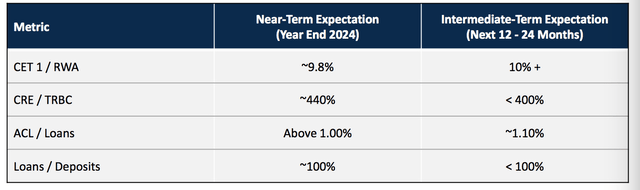
A reason profits fell sequentially was that Valley took $45 million of provisions in Q1 while its 0.19% in charge-offs were up from 0.14% last quarter, netting to a $22 million reserve build. VLY can slow the pace of reserve builds modestly from here and still reach its ACL/loan target given its current 0.98% level. VLY needs to add $60 million of reserves over the next 12-18 months, or about $12 million/quarter. Valley is building reserves given its large CRE exposure, of about 48% of loans.
Valley National Bank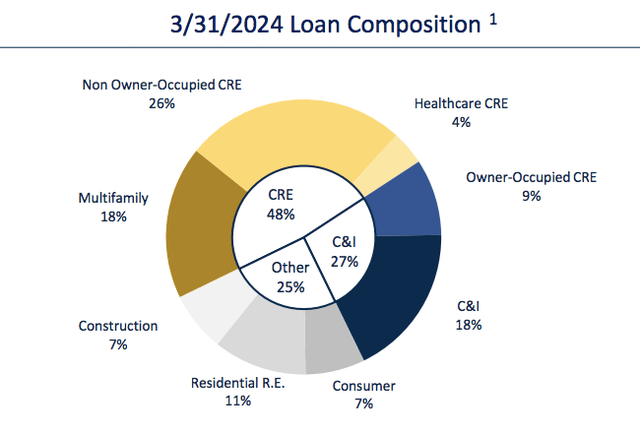
CRE, particularly office, has faced pressures, requiring banks to set aside more reserves. NYCB’s problems have led to more of a focus on that area’s banks. NY & NJ account for 51% of loans, meaning VLY has material exposure, even as it grows its loan presence in Florida. Overall, 0.58% of loans are non-accrual. This means VLY has about 1.7x coverage of nonperforming loans below my 2.5x threshold. I have felt comfortable with this because VLY’s loan portfolio is primarily asset-backed, which should lead to higher recoveries on defaulted loans. I continue to believe this is the case.
This is because VLY has a conservative underwriting standard. Its CRE loan portfolio has an average LTV of 58% with NYC at 53%. Additionally, it does have meaningful exposure outside of the tristate area, and it is diversified across sector.
Valley National Bank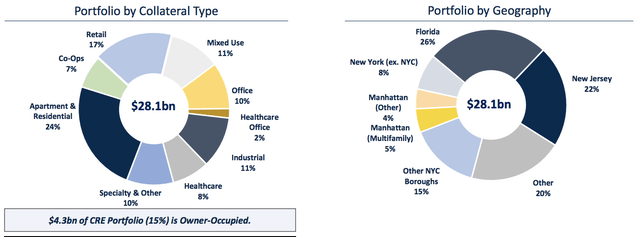
Within CRE, there are two primary problem spots. First, office is clearly challenged given more remote working arrangement. Office is a relatively small part of its loan book at 7% or $3.3 billion office. These loans have just a 53% LTV, meaning valuations could fall nearly by half before VLY faces losses. I also like that it is a granular portfolio with an average size of $3 million. This makes individual defaults manageable, rather than having outsized exposure to several large properties.
Aside from this, legislation has reduced the economic attractiveness of rent-regulated apartments in NYC, which hurt NYCB. Overall, VLY has $2.3 billion of multifamily NYC exposure; however only $500 million has 50+% rent regulated exposure. Even if 50% of these properties default and VLY took a 50% loss on each loan, both of which are very onerous assumptions, its loss would be $125 million before taxes, or $90 million after-tax. In Q1, VLY earned $92 million, so the cost is one quarter of earnings in a draconian scenario. Even losses this extreme would be manageable, especially as VLY has reserves, and losses will occur over many quarters.
Valley National Bank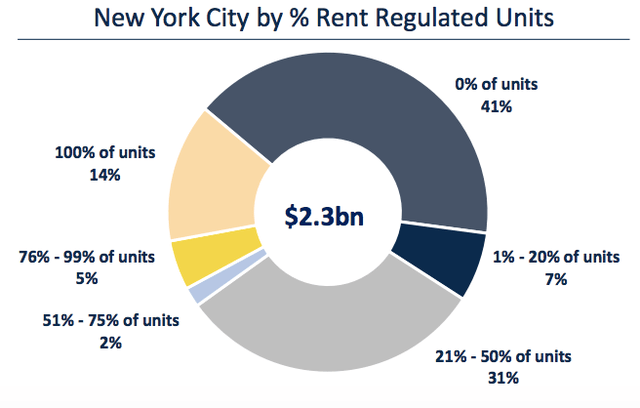
Management expressed confidence in its reserves, and while I believe building reserves is prudent, I am comfortable with Valley’s exposure. Even under severe scenarios, the challenge is reduced earnings, not solvency or net losses. As such, I believe Valley’s $8.84 tangible book value is unlikely to become impaired, and that shares should rally at least back to this level. Given reserve builds and lower NII, I now expect VLY to earn about $0.85-0.95 this year. By retaining about $0.35 of earnings after its dividend over the balance of the year, book value should migrate above $9 this year.
Given real estate concerns, I no longer see VLY trading meaningfully above book value, but as investors grow confident in its conservative underwriting and losses prove to be manageable, shares should migrate higher. VLY is not an NYCB in my opinion. Its deposit are stable, its rent-regulated exposure is modest, and its starting reserves are superior. Shares can rally about 20% towards $9 as these concerns ease, and I would be a buyer.
Credit: Source link