
Daniel Wright
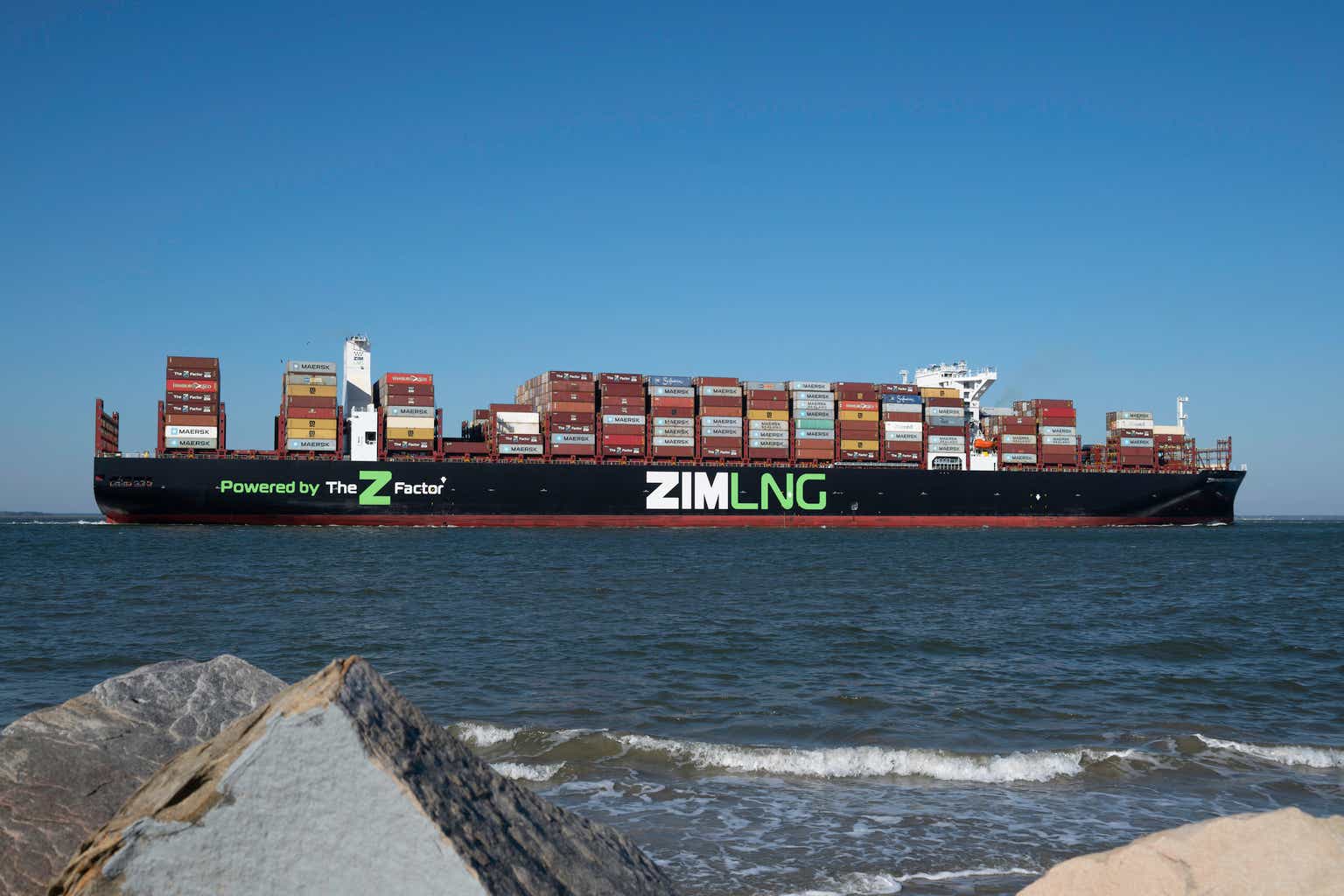
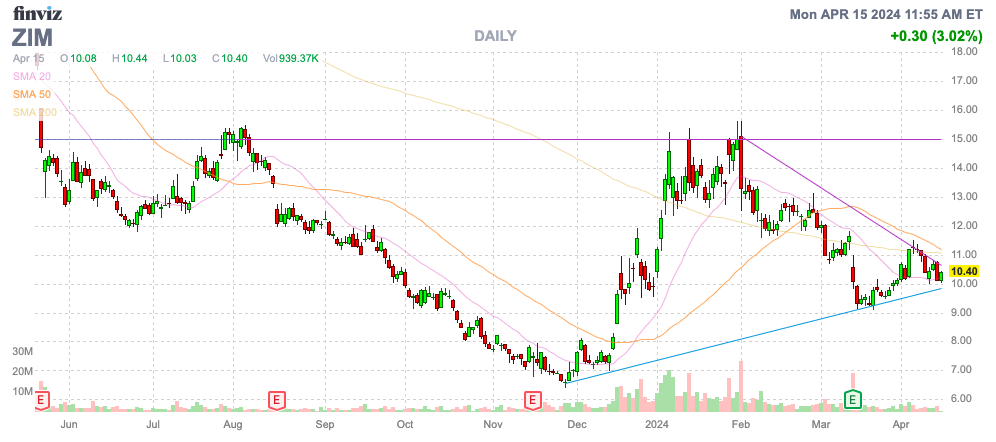
ZIM Integrated Shipping Services Ltd. (NYSE:ZIM) hasn’t even faced the ceasefire risk in the Red Sea, especially now with Iran launching missiles on Israel, yet the stock is down at $10. The container shipping company hasn’t rallied on the higher shipping rates due to the equally higher shipping costs to avoid the Red Sea. My investment thesis remains ultra Bearish on the stock…
Source: Finviz
Supply Issue
The biggest risk to the shipping story is a larger conflict in the Middle East. More shipping lanes could be impacted and global demand dented. Instead, Iran launched an attack on Israel that mostly fizzled out as ineffective.
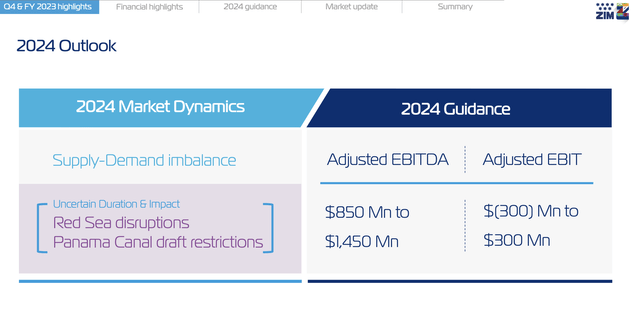
Only a month ago, ZIM offered up a 2024 outlook similar to the depressing 2023 numbers. The biggest issue remains the oversupply of new vessels while Iran and their Houthi proxy in Yemen are ineffective at attacking Western assets and the likelihood exists for a ceasefire leading to the collapse in container shipping rates back to the 2023 lows.
The container shipping company reported an adjusted EBIT loss of $422 million for 2023 and the guidance for 2024 was a nearly similar $300 million loss with upside to a $300 million profit. The wide guidance range is the unknown length of the Red Sea disruption.
Source: ZIM Q4’23 presentation
Based on the adjusted EBITDA range in comparison to the $1.0 billion gain in 2023, one can nearly assume ZIM is tilting towards the losses. The ultimate key here is that Red Sea disruptions are mostly leading to higher shipping rates and corresponding higher costs. The market still faces the same dynamic of where supply far exceeds demand as newbuilds reach the market throughout all of 2024 and 2025.
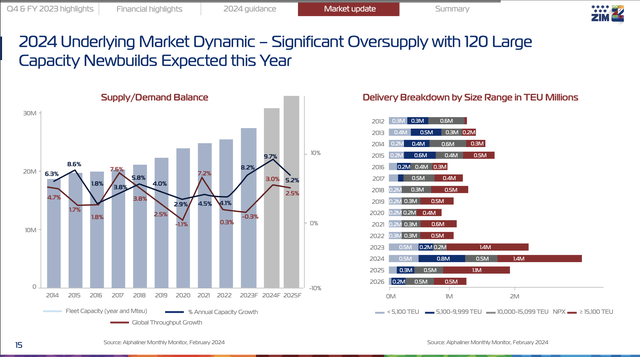
The market expects a 9.7% growth rate in supply with 120 large capacity newbuilds this year. The huge capacity addition from 2023-2025 is far outstripping the new demand, with these orders made during the booming demand growth rates in 2021.
Source: ZIM Q4’23 presentation
Inevitable Ceasefire
The biggest risk to ZIM is an ultimate ceasefire that appears inevitable. Iran launched several hundred missiles and drones at Israel and achieved minimal damage on their sworn enemy. Clearly, Iran has no interest in an escalating war the country can’t win.
Back on the Q4’23 earnings call, ZIM CEO Eli Glickman highlighted the ultimate risk to the investment story, with shipping rates set to collapse:
Once the Red Sea crisis is resolved, we will likely revert to the supply demand scenario that began to play out in ’23, setting up a more challenging third and fourth quarter of ’24 for the industry, including us. Given that market dynamics in the era will depend largely on the duration of the Red Sea disruption, we are taking a cautious approach in establishing our ’24 guidance.
Later on the earnings call, CFO Xavier Destriau highlighted the massive overcapacity situation:
The underlying supply demand balance in 2024 points to clear oversupply with over 3 million TEUs, or approximately 10% of current global capacity expected to be delivered during the year.
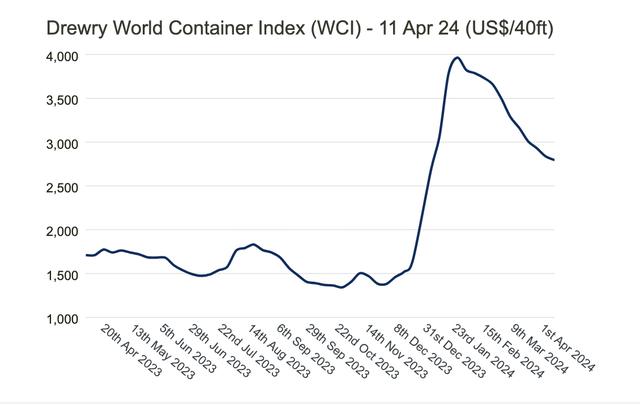
These large capacity additions are already having impacts on the shipping rates. The Drewry World Container Index has already dipped to $2,795 per 40ft container. The index reached $4,000 in late January and has already slumped ~30% due to the shipping market adjusting to the Red Sea issues.
Source: Drewry World Index
The downside risk remains a sudden resolution to the issues in the Red Sea returning the container shipping rates back to the Oct./Nov. lows when ZIM was reporting large losses. The stock is stuck at $10 due to this inevitable reality.
Iran launching missiles and drones on Israel could be the trigger for global leaders to force a ceasefire in the area. The biggest question is how to handle the likelihood that ZIM reports a solid quarter during Q1 and potentially into Q2 with shipping rates still relatively high.
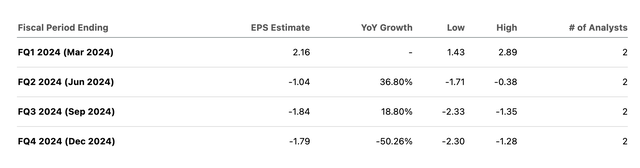
The current consensus estimates have ZIM generating a $2.16 EPS in Q1’24, but the consensus estimates have losses forecast through 2026 now. The inevitable scrapping of old vessels is just being delayed and absorbing any issues with additional shipping requirements to avoid the Red Sea.
Source: Seeking Alpha
Since the Middle East is always volatile, a protracted conflict is always possible. The possibility exists for ZIM to generate profits for an extended period versus the projected losses.
The container shipping company reported solid earnings last in Q4’22 when shipping rates were similar, if not lower than the current spot rates. The stock could rise with multiple quarters of positive income leading to the potential for a dividend, though the company wasn’t clear on the earnings call how a dividend payout would be handled based on the current guidance where a Q1’24 quarterly profit is forecast to quickly disappear throughout the year.
Our view is that global shipping demands will lead to a ceasefire in the Red Sea. If not, vessel newbuilds are likely to absorb any demand, sending shipping rates lower regardless.
Takeaway
The key investor takeaway is that ZIM Integrated Shipping is dead money for years at best. The container shipping company won’t deliver operating profits for years outside of Red Sea disruptions, and any investment decision ultimately will be based on the sustainable income of the business in normal operating times.
Investors should avoid the stock at $10 with the risk of a return to the 52-week lows near $6 and the likely best outcome being ZIM stuck at $10 for a couple of years.
Credit: Source link