













































Leon Neal/Getty Images News
Co-authored by Treading Softly
Have you ever heard someone try to throw out the phrase to you, “Price is what you pay, but value is what you get.”? We hear that a lot more when things are expensive or when we’re buying something in the stock market versus a tangible item we hold in our hands. This is often used to explain an extremely high-priced item because what they’re trying to tell you is that even though you’re paying a lot, and it may cause sticker shock, the value of what you’re receiving far exceeds what you’re paying.
There are very few instances in life where you can truly appreciate an object before owning/using it to understand what you’re getting versus what you’re paying for. Many companies charge a premium based on the brand name. A Nike shoe with a swoosh icon costs more than an unbranded shoe with similar materials and features. With the branded object, you are betting on the company’s reputation, whereas there is almost no way of knowing if the unbranded shoe will be good or bad without buying it to try.
In the financial markets, there are times when we can gauge the value of securities more easily than we can material goods. For example, with REITs – you can look at the overall value of its portfolio properties, and compare those to the company’s market price. There is also the element of quality, in the form of property diversification, tenant concentration, tenant profile, and lease terms. Part of the valuation will be based on judging the risks – there’s always a discount when the management team has a reputation of being poor decision-makers, or if their tenants aren’t financially healthy, which you must factor in.
When it comes to a CEF (Closed-End Fund) that holds equities, you can look at the value of its holdings (Net Asset Value) versus its market price. This will help you determine if you’re buying at a premium, where you pay more for less, or at a discount, where you pay less and get more.
Today, I’m going to review two investments I believe are undervalued and worth adding to your investment portfolio.
Let’s dive in!
Pick #1: HR – Yield 8.8%
Over the past few years, we’ve seen consolidation in the MOBs (Medical Office Buildings). Healthcare Realty Trust Inc. (HR) merged with HTA, which made it the largest MOB REIT, and recently, Healthpeak Properties (DOC) merged with Physicians Realty. HR focuses on outpatient buildings that are “on campus” or adjacent to hospitals. Locations that are convenient for doctors and patients can generally command a premium rent.
The bulk of HR’s properties are in larger metropolitan areas. Source
HR Q4 2023 Supplement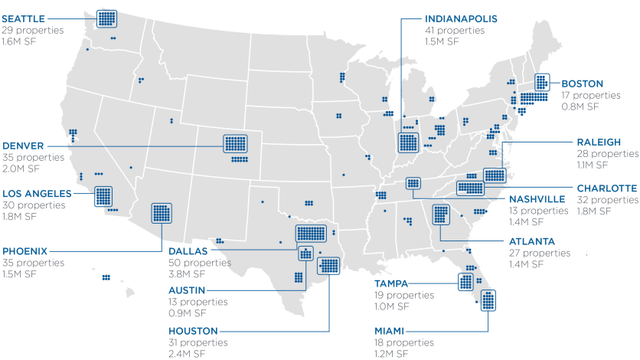
Like most REITs, rising interest rates have been a headwind to valuations. REITs use leverage, and HR is operating at a debt/EBITDA of 6.4x. It’s a common leverage level for REITs, which is why we’ve seen prices of many REITs at multi-year lows. Generally speaking, we expect share prices for REITs to respond positively as the market becomes more confident that the Fed will start cutting interest rates.
For HR in particular, it doesn’t have any fixed-rate debt maturing until 2025. Approximately $1.5 billion (about 28%) of its debt is floating-rate. HR did purchase some interest rate swaps to hedge rising rates. One of those hedges expired in January, which will cause approximately a $10 million increase in interest expense at current interest rates.
HR Q4 2023 Supplement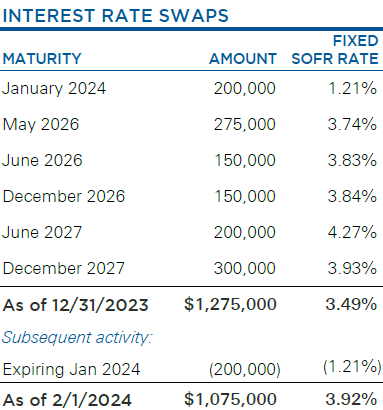
As a result, HR only has approximately $425 million in floating-rate debt that will directly benefit from declining interest rates. So we don’t expect declining interest rates will have a substantial immediate impact on HR’s finances, but it could be very beneficial to the valuation.
In conjunction with the merger, HR has been selling properties. It has focused on selling properties that were not MOBs or off-campus MOBs and those with lower-than-average escalators. Despite selling what HR sees as its less desirable properties, it was able to achieve a 6.6% cap rate on the sales.
The “cap rate” is a common measure in real estate that measures the net income a property is producing relative to the sale price. It is calculated as NOI (Net Operating Income) (at the property level) divided by the sale price. So a $1 million property that sells at a 6.6% cap rate was producing $66,000 in annual NOI. As a seller, the lower the cap rate, the better. That means you were getting a high price.
This underscores how low of a valuation HR has. HR provides us with detailed information on its assets and even goes through the effort to calculate the implied cap rate that its share price is reflecting.
HR Q4 2023 Supplement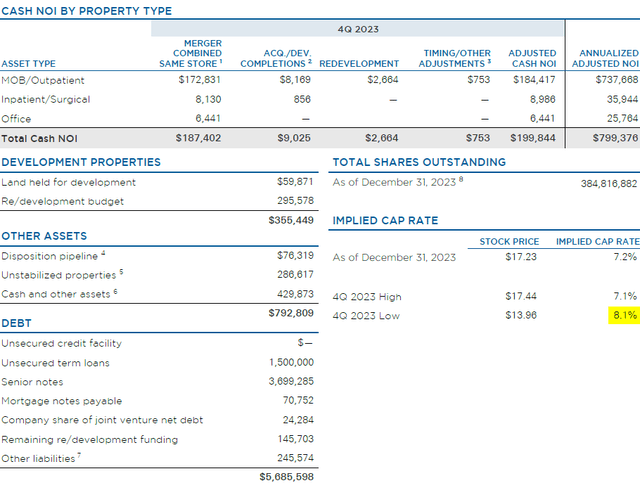
So, while HR is successfully selling its least desirable assets for a 6.6% cap rate, the equity that we can buy is selling for around an 8% cap rate. HR would be trading around $20/share at a 6.6% implied cap rate. Since the properties that HR is retaining are more valuable than the properties it sold, fair value for HR is even higher than that.
There is clearly a gap between the value that HR could receive from selling its real estate and the trading price of the public equity. These types of inefficiencies are common in a public stock market. As Ben Graham is quoted, the market is a voting machine over short periods.
Right now, the main concerns for the common shares are obvious. As discussed above, the market generally throws REITs out the window when interest rates are rising. We’ve seen it across the entire sector, and the sector is likely to recover as interest rates decline.
The second major topic that is likely on many investor’s minds is whether or not the dividend is sustainable. HR has been selling properties, the properties it sold were paying rent, and it is frowned upon to be collecting rent from properties that you no longer own!
For 2024, HR is guiding for normalized FFO (Funds From Operations) to be $1.52-$1.58.
This means that the dividend will be approximately 80% of FFO. Keep in mind that FFO does not reflect capital expenditures, TI (Tenant Improvements), and leasing commissions. After accounting for those items and removing non-cash items, HR had $451.5 million in FAD (Funds Available for Distribution), and it paid out $477.6 million in dividends. So to be comfortable with dividend coverage, the ideal would be for the payout ratio to be 65-70% of normalized FFO, which would imply about an 85-90% payout ratio based on FAD. HR has been selling off lower-performing assets and working on improving occupancy among its acquired properties. Like many things in real estate, it is like watching the grass grow – it doesn’t happen quickly. Yet HR has been trending in the right direction, incrementally increasing occupancy and NOI.
HR Q4 2023 Supplement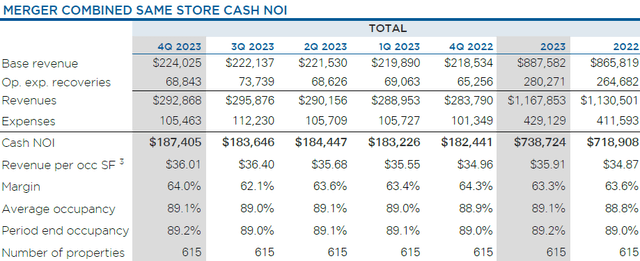
The market is skeptical and as a result, HR is trading at a steep discount to the value of its properties. This creates a set-up where we can get a much higher yield than we typically would find in this sector, collecting a healthy income while we wait for share prices to recover. The catalysts for potential upside are clear, declining rates will bring positive tailwinds for all REITs, and for HR, growing FFO to cover the dividend will provide reassurance to investors and drive the price higher.
Pick #2: BCX – Yield 6.8%
BlackRock Resources & Commodities Strategy Trust (BCX) is a CEF that focuses on physical commodities. Specifically, the fund invests in mining, energy, and agriculture. Currently, it is light on agriculture, with about equal parts mining and energy. Source
BCX Website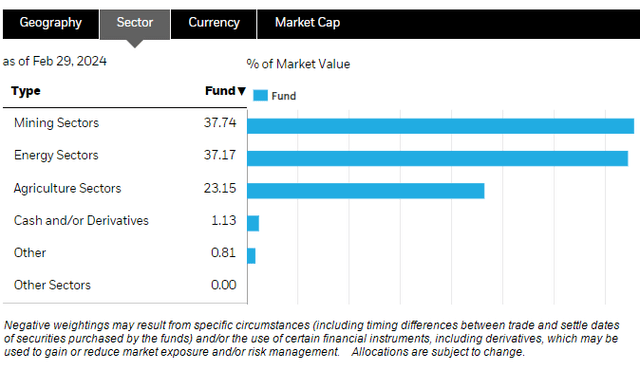
Commodities struggled in the 2010s. Low inflation and high supply conspired to bring the prices of most commodities down. As a result, the companies that produced the commodities struggled.
BCX wasn’t immune to the struggles, bottoming out in 2016 as oil prices crashed.
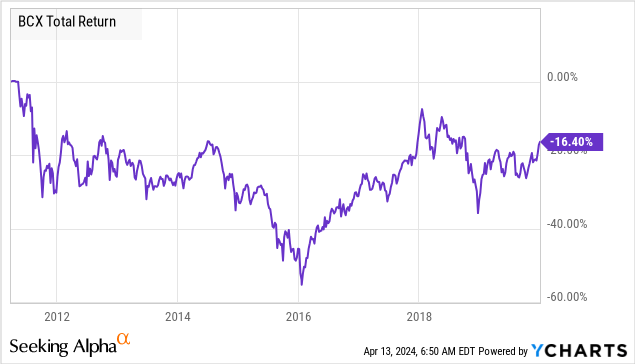
In 2020, a lot of things changed. The commodity markets were already on their way to correcting, but COVID had a material impact on the supply of numerous commodities. When combined with monetary inflation, the fundamentals shifted from weakness to strength for the companies that BCX invests in.
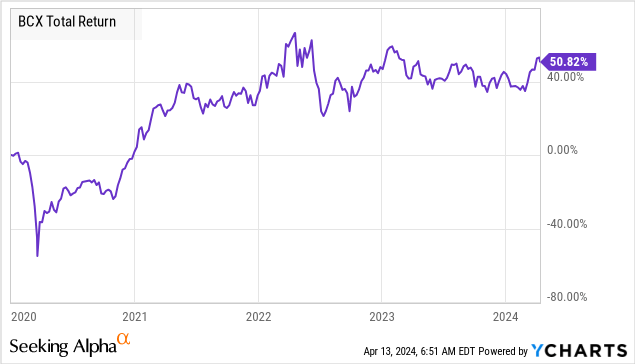
Inflation is slowing down, and I’ve been pointing out that it has slowed down more than the current numbers indicate. Yet whenever I discuss inflation slowing down, it is inevitably met with a comment about how gasoline, food, or other items are much more expensive than they used to be. Yes, they are.
Inflation is not a measure of prices; it is a measure of the change in prices. 0% inflation does not mean that everything went back to being as cheap as it was before COVID. It only means that it isn’t getting even more expensive than it was last month.
We can see the pattern in gas prices, something that immediately jumps to people’s minds.
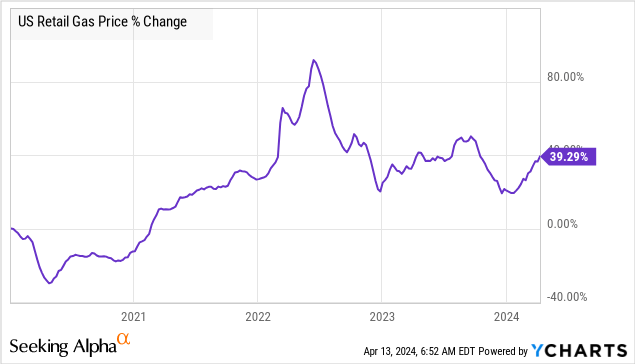
Note that prices are down a lot from the peak in 2022, but even with that, they are still 39% higher than they were on January 1st, 2020. This pattern is repeated across a wide variety of commodities. Prices are down from their peaks and might even be “deflationary” when we compare them to prices in 2022 or 2023, but compared to 2020 and earlier, they are materially higher. We adapt pretty quickly for the items that we buy regularly, but if you haven’t changed the battery in your car for say five years, be prepared for some sticker shock when you go to buy one.
Inflation is slowing down, but the “Dollar Tree” is going to remain the “$1.25 Tree” and the prices of most things are never going back to January 2020 levels. The world has changed, and companies that sell commodities are one of the winners.
The fickle traders in the market have moved on from commodities, which opens it up for income investors like us to take advantage of the cash flow from the sector.
Conclusion
Today, we looked at a REIT and a CEF that we feel are trading at bargain prices. One is trading at a wide discount to NAV. The other is trading at a wide discount to book value, we feel that the discount here is unwarranted versus the risk levels posed by the business. In our opinion, both these securities are undervalued in comparison with what you’re getting from them. These picks enable your portfolio to produce a healthy income stream into your account, allowing you to hold these for the long run and collect your dividends. The beautiful thing about being an income investor is that time is your friend. The longer you hold something, the more it has paid you and the greater your returns from it. That constant drip, drip, drip, drip of income pouring into your account will provide you with the means to live for the decades to come.
If you resolve your income needs in retirement, you can focus on so much more. If you have a roof over your head, food on your table, and your portfolio provides you with the cash you need, you are setting yourself up for a wonderful retirement. That is exactly what I want you to have.
That’s the beauty of my Income Method. That’s the beauty of income investing.
Credit: Source link










