

Monty Rakusen/DigitalVision via Getty Images
Overview
ROBO Global Robotics and Automation Index ETF (NYSEARCA:ROBO) is an exchange-traded fund (ETF) that tracks and invests in global companies involved in technologies such as Automation, AI, and robotics. By utilizing quantitative and qualitative research methods, the ETF filters global companies that generate at least part of their revenues from such technologies. Companies that fit the criteria are involved in autonomous vehicles, 3D printers, navigation systems, and robots. The goal of the ETF is therefore to capture future market leaders early on and benefit from their growth. The ETF rebalances its portfolio quarterly, and securities are weighted equally based on their segments.
The ETF was first issued by Robo Global in 2013 and currently has $1.28 billion in assets under management (AUM). Its expense ratio stands at 0.95%, representing the annual costs when investing in the ETF. With that said, ROBO ETF offers a diversified approach to investing in future technologies including robotics and automation, so it is worth exploring the characteristics of the fund and comparing it to alternative funds.
Holdings
Seeking Alpha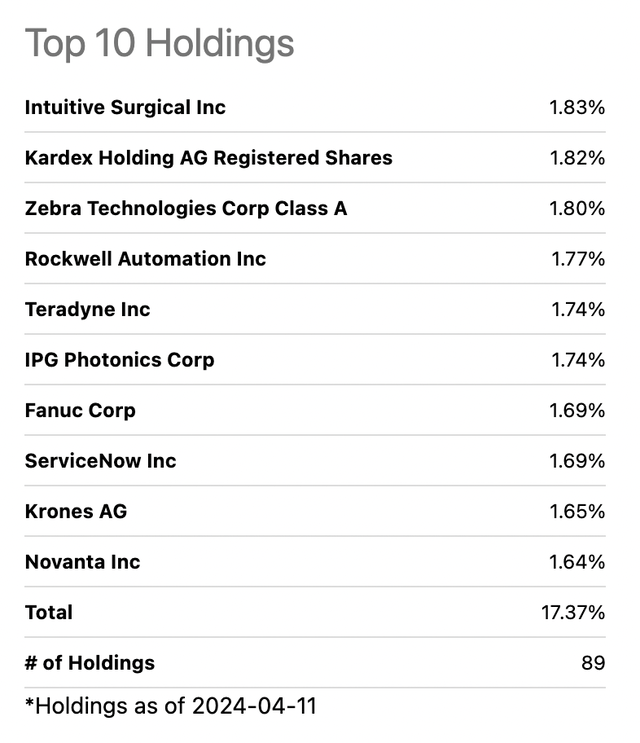
Intuitive Surgical (ISRG): As a leader in minimally invasive, the company is best known for its da Vinci Surgical System, which enables complex surgery procedures through precise automation technology. In its fourth quarter, Intuitive grew revenues by 17%, while net income nearly doubled to $606 million. As a result, shares are up 47% YoY.
Kardex Holding AG (OTCPK:KRDXF): Headquartered in Switzerland, Kardex manufactures and sells automated warehouses and handling systems for logistic centers and offices. Products include automated workflow technologies to improve order fulfillment, as well as climate-controlled storage options for transports. As revenues jumped 24% over the past year, driven by strong demand for its solutions, shares are up 17% YoY.
Zebra Technologies (ZBRA): The company manufactures and sells printers used for printing wristbands, tickets, and plastic cards which are used for personal identification and access control. As revenue fell 33% in the last quarter after a COVID boom in revenue, the stock declined 5% YoY and is still trading bell below its all-time highs.
Other holdings: ROBO is mostly focused on U.S. assets, accounting for 45% of its assets, although it also includes notable technology companies from other countries such as Japan (21%), Germany (8%) and Taiwan (6%). Here, prominent companies include Keyence Corp. (OTCPK:KYCCF), GEA Group (OTCPK:GEAGF) and Fanuc Corporation (OTCPK:FANUY). Overall, the ETF is well diversified with 89 holdings, with its largest holdings barely accounting for more than 2% of its total assets.
Performance
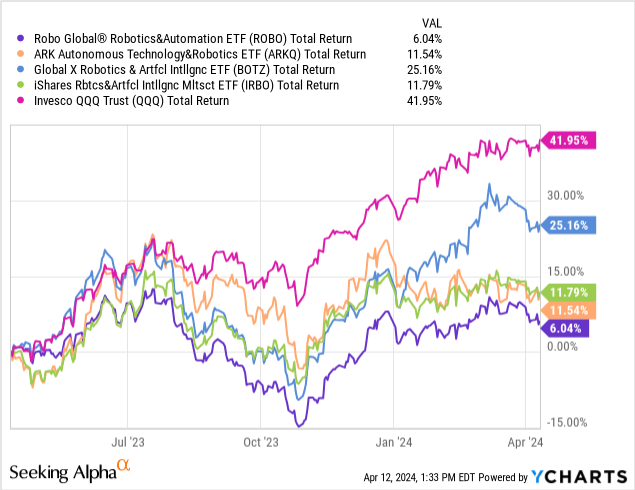
As small-cap technology names lagged behind their large peers, ROBO trails significantly behind the Nasdaq 100 Index (QQQ) on a 1-year performance view. The ETF also fell behind compared to alternative Robotic funds such as iShares Robotics and Artificial Intelligence Multisector ETF (IRBO) and ARK Autonomous Technology & Robotics ETF (ARKQ), which focus on a similar thematic strategy. However, ARKQ has a different allocation strategy, being reflected in its core holdings. Here, ARKQ includes stocks such as Archer Aviation (ACHR), which increased 63% year-over-year. Similarly, IRBO places a larger weight on well-renowned U.S. tech stocks such as NVIDIA, which has dragged up the entire fund. Out of the list shown above, BOTZ ETF outperformed all Robotic ETFs, since it places a weight of nearly 20% on NVIDIA. With an expense ratio of 0.95%, ROBO has the highest expense ratio compared to alternative funds. Here, ARKQ has an expense ratio of 0.75%, while BOTZ boasts an expense ratio of 0.68% and IRBO an expense ratio of 0.47%.
Valuations
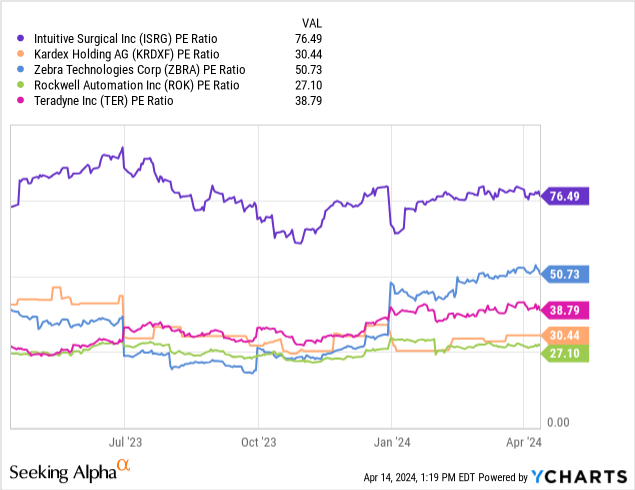
As many technology names saw their share prices surge over the past year as a result of AI optimism across the markets, valuations of the core holdings are elevated, based on traditional valuation metrics. Here, its largest holding, Intuitive Surgical trades at a Price-to-earnings ratio of 77x, compared to its 5-year average of 66 times P/E and its 5-yeat minimum of 32 times P/E. While Intuitive’s valuation is certainly high, it has been able to almost consistently grow its bottom line by double digits over the past decade. Thus, its valuation is forward-looking and likely prices in further above-average EPS growth.
Other companies included in the ETF are also pricey, based on current earnings. However, as Zebra Technologies’ earnings are highly volatile due to its cyclical nature, its PE ratio is skewed. Thus, its Price-to-sales ratio (P/S) of 3.26 is currently below its 5-year average of 3.48 after its significant sell-off in 2022. Similarly, Rockwell Automation (ROK) has lagged behind most technology names and is therefore trading at a lower valuation. Therefore, the ETF offers a diversified mix between high growth like Intuitive and more mature Tech stocks that trade at lower valuations.
Overall, the ETF trades at an average P/E ratio of 43x, compared to the Nasdaq 100 (QQQ), trading at a P/E of 34x. However, as mentioned earlier, since many of the included companies have volatile earnings, the P/E ratio is slightly skewed. Thus, ROBO has a lower average Price/Book ratio at just 2.77x, compared to QQQ at 7.47x.
Takeaways
While AI remains in the spotlight of technological development, other technologies are also experiencing substantial growth over the next decade, including Robotics and Automation. Here, ROBO offers a diversified approach to participating in companies involved in the development within this sector, in particular through smaller and less-known names. Although the ETF underperformed other Robotic ETFs, its strategy on small-cap stocks could prove superior in different market environments, for instance during times of lower interest rates. Overall, its expense ratio stands at the higher range of comparable ETFs at nearly 1%, making it less attractive for larger and longer investments. Regardless of the long-term potential of ROBO, an investment into the ETF comes with various risks, including high volatility due to its thematic approach, as well as regulations that could affect the companies included in ROBO. Nevertheless, if small-cap technology names are able to catch up to their larger peers, the ETF could potentially reward investors in the future.
Editor’s Note: This article discusses one or more securities that do not trade on a major U.S. exchange. Please be aware of the risks associated with these stocks.
Credit: Source link