

Hinterhaus Productions/DigitalVision via Getty Images
As Europe’s largest economy and a world leader in engineering, automotive, and manufacturing sectors, Germany hosts a plethora of globally recognized companies known for their innovation, quality, and resilience. Germany is an industrial powerhouse both historically and presently. One cannot consider allocating to developed international markets without paying attention to Germany’s markets given stringent corporate governance standards and a stable political environment.
If you’re bullish on global industrial activity continuing its momentum, and want to diversify against your US equity exposure, the iShares MSCI Germany ETF (NYSEARCA:EWG) is worth considering, but it’s (as always) a question of timing. This is an Exchange Traded Fund that aims to replicate the performance of the MSCI Germany Index. This index is comprised of companies from Germany, primarily focusing on large and mid-cap sectors. Launched in 1996, EWG has become a prominent vehicle for investors seeking to access the German market in a diversified manner. However, despite its popularity, it demands a comparatively high expense ratio of 0.50%, which might seem slightly steep compared to other similar ETFs.
When we look at the chart of EWG, it is still technically in a drawdown from the 2021 peak. When you combine that with the fact that Germany is likely at the start of a recession, now may not be the best time to invest in the fund. Still I believe it’s worth keeping an eye on, perhaps after a larger global correction takes place.
stockcharts.com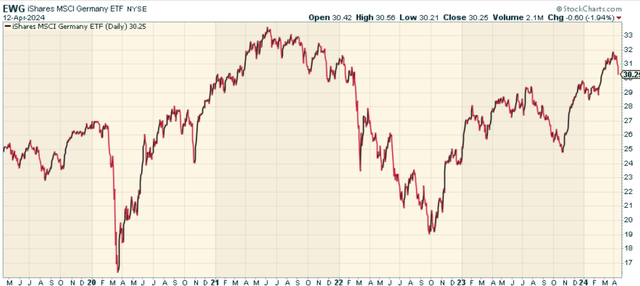
Examination of ETF Holdings
EWG’s portfolio is composed of 61 individual holdings, which are primarily concentrated in large-cap and some mid-cap companies. This concentration provides investors with a focused exposure to the German market, but it also potentially introduces the risk of over-exposure to certain sectors or companies.
The top three positions held by EWG are SAP SE (SAP) (13.42%), Siemens AG (OTCPK:SIEGY) (9.90%), and Allianz SE (OTCPK:ALIZF) (7.67%). These companies, classified as large-cap, play a significant role in the German economy. They carry a combined weight of over 31% of the ETF’s total portfolio, making the performance of these companies critical to the overall performance of the fund.
ishares.com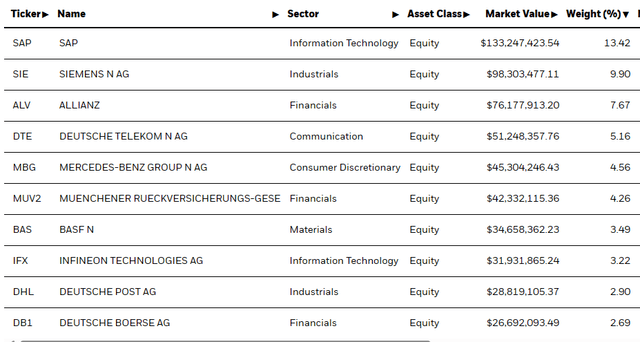
Sector Distribution and Weightings
EWG exhibits a diversified sector distribution, with Industrials (20%) followed by the Financials (19%) sector leading the pack. The Industrials side isn’t a surprise given the nature of Germany’s economy. There’s been a lot of global momentum there. The Financials sector, on the other hand, has been a drag, cancelling out some of the overall strength of Industrials and Technology in the fund.
ishares.com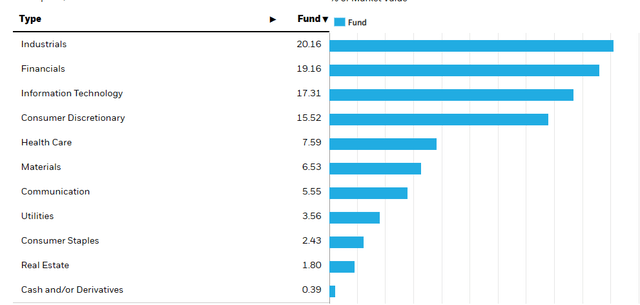
Peer Comparison
Global X has an ETF that competes against EWG – the Global X DAX Germany ETF (DAX). EWG has significantly underperformed DAX for a few years. This likely has to do with the heavier weighting DAX has in Industrials at 25%, and that’s been a relative winner.
stockcharts.com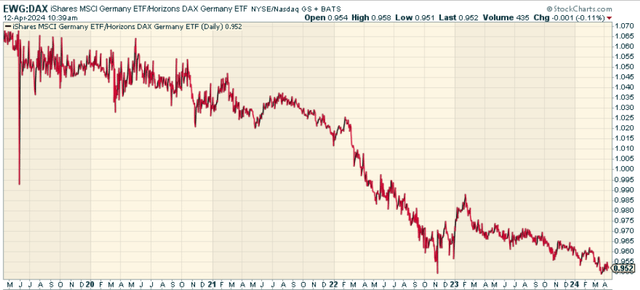
Probing into the Theme Tracked by the ETF
EWG provides exposure to the German economy, which is currently facing numerous economic challenges. High energy costs, declining competitiveness, and overwhelming bureaucracy are some of the significant issues plaguing the German market. Moreover, inflationary pressures and the looming recession further add to the country’s economic woes. All this will not just continue to negatively impact the Financials sector component, but also serve as a headwind on Industrials momentum.
On the other hand, the German economy has demonstrated resilience in the past and possesses the economic capacity to withstand these challenges. It’s also worth noting that Germany’s debt-to-GDP ratio stands at a comfortable 66.1%, which provides the country with financial durability to overcome the existing issues.
Weighing the Pros and Cons
The iShares MSCI Germany ETF offers investors an opportunity to gain exposure to the German economy in a diversified manner. However, like any investment, it comes with its share of risks and rewards.
Pros:
- The ETF is well-diversified across sectors, reducing the risk associated with overexposure to a single sector.
- It offers a modest dividend yield of over 2.07%, which can provide additional income to investors.
- EWG is the most liquid Germany ETF, making it a suitable choice for investors seeking liquidity.
Cons:
- The ETF has a relatively high expense ratio compared to its peers, which could eat into the returns for investors.
- The German economy is currently grappling with several challenges, including high inflation and a looming recession, which could negatively impact the performance of the ETF.
- The ETF is heavily concentrated in its holdings structure, which could expose investors to the risk of overexposure to certain companies.
Conclusion: To Invest or Not to Invest
Investing in EWG offers concentrated exposure to the German market, which, despite its current challenges, remains one of the largest and most influential economies in the world. However, given the economic headwinds and other factors such as relatively high expense ratio and low dividend yield compared to other stock baskets like the DAX, EWG may not be the best option to invest in right now. It’s a good fund but DAX seems like a better proxy, and aside from that, I’d rather wait until the recession gets deeper to consider it.
Credit: Source link