
Adam Gault
Welcome to another installment of our BDC Market Weekly Review, where we discuss market activity in the Business Development Company (“BDC”) sector from both the bottom-up – highlighting individual news and events – as well as the top-down – providing an overview of the broader market.
We also try to add some historical context as well as relevant themes that look to be driving the market or that investors ought to be mindful of. This update covers the period through the first week of April.
Market Action
BDCs were down on the week with most of the rest of the income space. Year-to-date, the sector is still up around 3%.
Systematic Income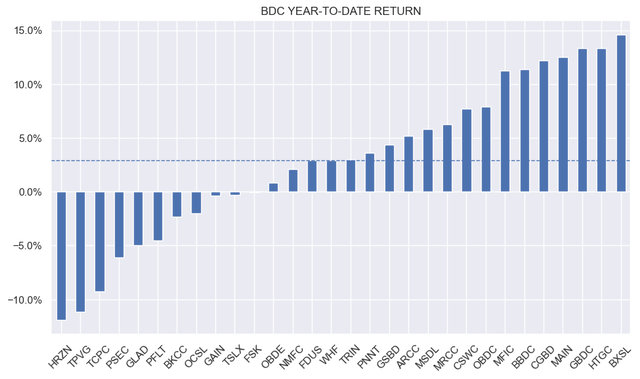
March was the best-performing month of the year so far.
Systematic Income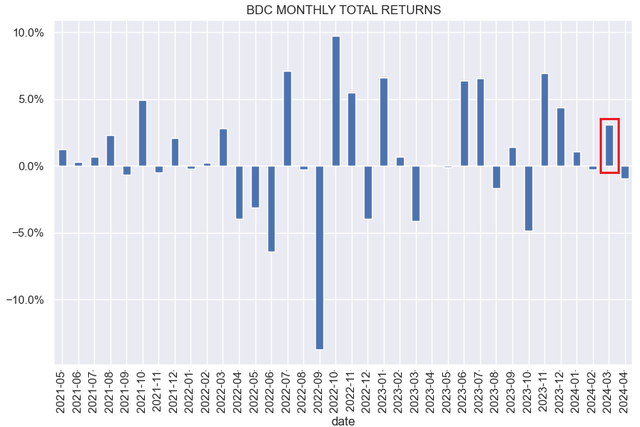
The aggregate sector valuation continues to trade in a relatively tight range since the start of the year. Current sector valuation is not far off its long-term average.
Systematic Income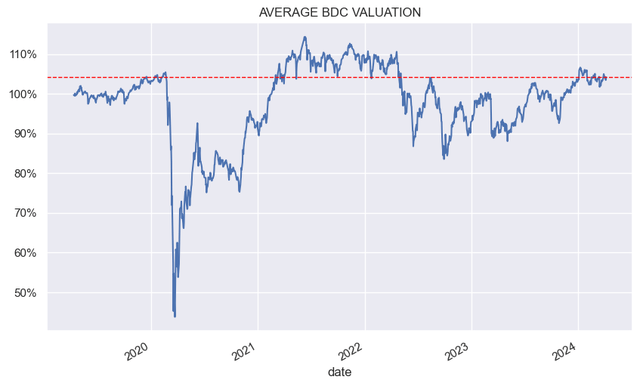
Market Themes
Gladstone Capital Corp (GLAD) announced a 1-for-2 reverse stock split, which was actioned at the end of the week. In practice, what it means is that every two common shares will be combined into one share. The stock price and distributions will double from their previous level. Investors with fractional shares will get cash.
Reverse stock splits have an air of distress about them because they are often used by companies to prop up their sagging stock price. There is nothing wrong with the GLAD price as it’s around the same level as it’s been for a decade
Instead we get a clue for the real reason in the fact that while the reverse split will reduce the number of shares outstanding from 43.5m to 21.8m, the number of authorized shares will remain unchanged at 44m. In short, the company has hit a ceiling on the number of shares it can issue and instead of asking shareholders to lift the cap on authorized shares, they just went for the reverse stock split.
Investors in “typical” companies don’t always like to see new share issuance, given its dilutive impact. This is less of an issue for a BDC, which can put new capital to work relatively quickly and avoid any real dilution.
GLAD has been a big issuer of new stock, as the following chart shows. This trend accelerated in the last year. For example, just in the last quarter, the company added 13% more shares when it issued 4.9m of new shares at a weighted-average price of $10.01 (vs. Q4 NAV of $9.61). This issuance also provided a small boost to NAV.
companiesmarketcap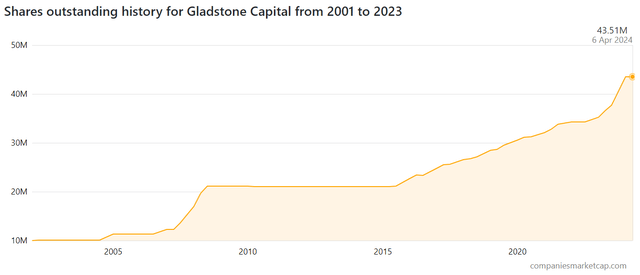
Perhaps related to the large issuance, the stock price has underperformed this year with a -5% total return. What’s interesting is that the handful of other negative return BDCs this year (see chart above) have been companies with disappointing Q4 numbers. GLAD, on the other hand, did not disappoint. In fact, it continues to deliver strong returns, particularly over the last year as shown below.
Systematic Income BDC Tool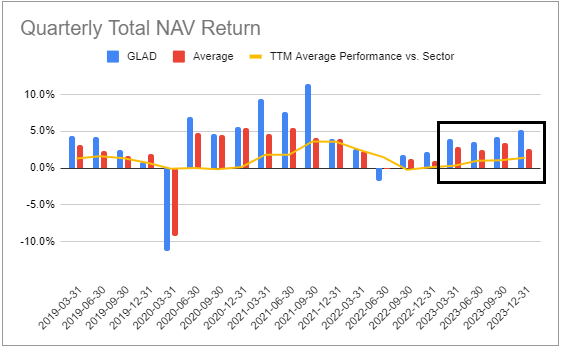
The ability of BDCs to issue stock via either public offerings or at-the-market offerings provides them with a number of advantages. Most obviously, it allows them to source capital to pursue new investments. Absent new equity capital, the company would have to rely on debt to add net new investments. However, doing so is self-limiting as it also increases leverage.
Issuing new equity can also allow BDCs to dial down their leverage and wait for a better lending environment. Finally, growing the capital base can give the BDC more flexibility to pursue larger deals as well as invest in additional capabilities, be it research, work-out or anything else given a greater capital base generates more fees. For BDCs like GLAD, that tend to trade at a premium, equity issuance also grows the NAV, providing a win-win for both management and shareholders.
Credit: Source link