
Editor’s note: Seeking Alpha is proud to welcome Theme Catcher Invest as a new contributor. It’s easy to become a Seeking Alpha contributor and earn money for your best investment ideas. Active contributors also get free access to SA Premium. Click here to find out more »
Leonhard Simon/Getty Images News
Investment Thesis
I rate BYD Company Limited (OTCPK:BYDDF) as a “Sell” as BYD’s dropping unit profit was not fully reflected in consensus estimates. My own forecast of BYD’s 2024/25 earnings are 5% and 33% lower than consensus due to lower margins. (Refer to Figure 4)
The Chinese EV sector is experiencing an intense price war, declining margins, and slowdown in growth, as many of their other manufacturing sectors, such as solar panels, construction machinery, petrochemical and others had gone through in the past decade. Those sectors all had a period of rapid profit growth, aggressive fund raising and capacity additions, followed by a long period of overcapacity and margin compression. During the period, the company usually suffered from both EPS downward revision and valuation derating, as investors rushed out of those stocks. I think this period of the Chinese EV has just begun.
On top of that, BYD’s valuation premium over its peers will also diminish in my view, as it has lagged its rivals in introducing Level 3 and above autonomous driving features, and its competitive edges in battery and hybrid technology have been narrowed.
Business Overview
BYD, an established Chinese automaker, has emerged as world’s largest EV manufacturer, surpassing Tesla shipments in 4Q23. Since 2022, BYD has shut down all its ICE production lines, and has produced only BEVs and Plug-in Hybrid. Car manufacturing accounted for 80% of revenue in 2023.
The company is recognized for its vertically integrated business model, which developed and produced all key EV components in-house, including batteries, majority of auto parts, auto electronics, and power semi. This integrated approach enables BYD to maintain greater control over the cost and have a much shorter model development cycle.
Additionally, BYD has a subsidiary, BYDE, which is providing Electronic Manufacturing Services (EMS) to consumer electronics companies, such as Apple and Xiaomi. EMS business contributed 20% of BYD’s revenue, but less than 10% of EBIT.
Figure 1 BYD Revenue Breakdown
Company annual report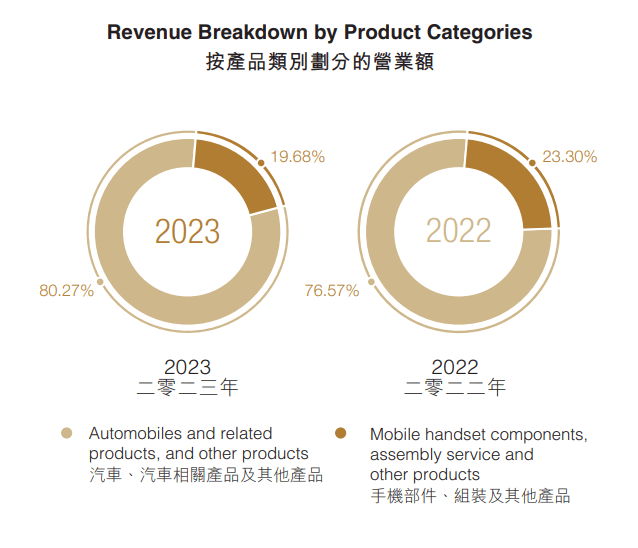
Price war in EV to sustain
BYD has reported its 2023 result on March 26th,2024, with revenue up 42% yoy on the back of 62% volume growth. Its earnings were CNY30bn (US$4.2bn), up 82% yoy. Net profit per vehicle reached CNY10,000, up 10% yoy. BYD has already pre-announced its earnings in early January, hence, the strong results was a non-event.
However, what was more concerning to me, was BYD’s sales volume was down 6% yoy in the first 2 months of 2024, compared to its volume growth of 45% in Dec 2023, and 62% yoy in 2023. For Jan-Feb combined, EV industry growth was also positive 11%, as ICE automakers, such as Chang-an, GWA, and Geely ramped up their EV sales. In response to the first two months of lukewarm sales, BYD has offered heavy price discounts on several of its best-selling models including BYD Qin (cut CNY22,000, 20%discount), BYD Han (cut CNY20,000-CNY30,000, 10-15% discount), BYD Tang (Cut CNY30,000, 10-15% discount) and BYD Seal (cut CNY23,000, 10-15% discount).
Figure 2 BYD monthly sales growth and market share (RHS)
Company data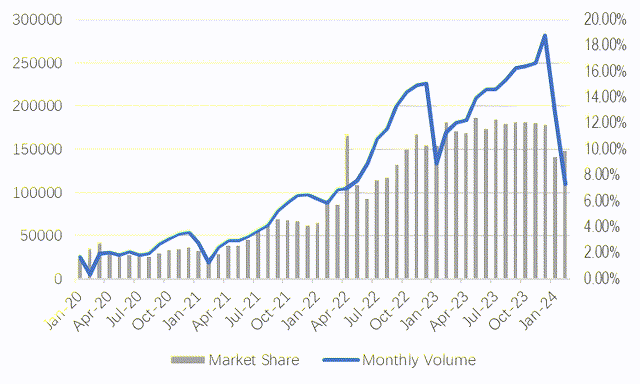
The price cut may help BYD to resume sales growth in March, as management guided its March volume growth will be back to 300K units. However, we must consider the impact on its unit profit. In 2023, BYD’s net profit/car was CNY10,000. I expect it to be down to CNY8,600 in 2024 (-13% yoy) and to CNY7,000 (-18% yoy) in 2025. BYD’s price cut was not accompanied by reductions in product features. Hence the potential offset from cost declines is very limited. I think my assumption is already very generous.
Figure 3 Forecast of BYD’s unit profit (CNY)
Company data, my own estimates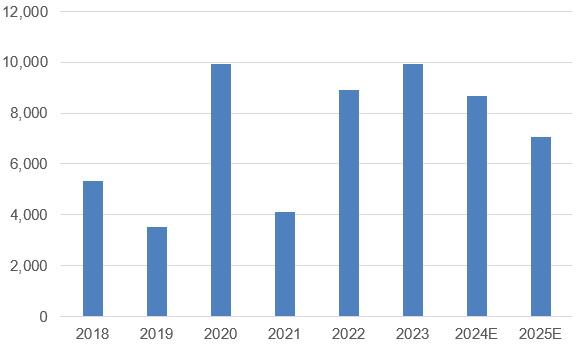
Going forward, I believe the deflationary price environment in EV industry will persist for years to come, given 1)most of BYD’s current competitors are state-owned enterprises such as SAIC and GAC, or financially robust private companies like Geely and Great Wall. As a result, these players are unlikely to easily withdraw from EV race, and even invested more to keep up with BYD. 2)government has also encouraged more SOEs to participate in the EV race. In early March 2024, the Chinese State-owned Assets Supervision and Administration Commission (SASSC) expressed concerns about large SOE automakers, such as FAW and Dongfeng for their slow transition towards EV. 3)more consumer electronic companies are entering into EV market. For example, Xiaomi introduced Su7, its first EV model, with price of CNY215,000. This will compete head to head with BYD’s Han and SEAL.
Lag behind in autonomous driving features
Given the vertical integration model, BYD is superior in making a car at low cost, and is super-fast in introducing a wide range of car models. It also led competitors in LFP blade battery, which is cheaper but much safer than NCM battery, and hybrid technologies. Hence, BYD has built a strong reputation among car buyers since 2022.
However, its competitors are also quickly narrowing the gap, in terms of battery and hybrid technology. Some of them, such as Wuling introduced Starlight EV, which is offer more attractive value for money than BYD best selling Qin Plus.
On the other hand, BYD is falling behind its peers in adopting autonomous driving features. The only BYD model that provides Level 3+ autonomous driving is its luxury model, the Yangwang U8, which is priced at CNY1mn. BYD’s mass-market cars, such as Ocean series and Dynastic series only have Level 2 ADAS. Many rivals like Chang’an, Chery, and BAC, which lack software development capability have chosen Huawei for their smart cockpits and self-driving features. Huawei offers an one-stop solutions for automakers. Customers can pick and choose which features they need for different price ranges of EVs. By combining lidar, radar, and cameras, Huawei’s Level 3+ autonomous driving package is already very advanced, which requires minimal driver intervention and can often detect danger earlier than humans.
I believe BYD can lose market share very quickly, as more and more car companies adopt Level 3 autonomous driving. The market success of Huawei’s M9 over Li Auto’s Mega model clearly reflected that buyers see Level 3+ autonomous driving as next killer app for their cars rather than anything else.
Expanding overseas will be slower than expected
BYD aims to sell 1 million cars to overseas market in 2025, up 335% from 230,000 cars in 2023. However, overseas sales will account for 20% of the total in 2025 even if that target is achieved. China’s market will continue driving the majority of BYD’s volume and earnings growth for years to come.
Rising trade barriers in the US and EU also can be potential roadblocks for BYD to grow its overseas sales, as Biden orders investigation into security risks from Chinese cars, and the EU launched anti-subsidy probe into China’s EV export. BYD is seeking to build factories in Hungary and Mexico to circumvent these trade barriers, but it will take time to complete and is still not guaranteed it can be successful in entering developed markets.
Financials
Consensus on the Simply Wall Street website is forecasting 26%/16% yoy growth in revenue for 2024/25, which implies that BYD only needs to reverse of its volume decline in the first two months, and also maintain price stable. Those assumptions are too stretched in my view. Also my margin assumptions are lower than those of consensus in that I believe the price discount will erode net margin by 0.7 percentage points each year in 2024 and 2025, while consensus are forecasting margin to expand by 0.7 and 0.6 percentage points respectively for those two years. Hence, I expect at least another 1-2 rounds of cuts of consensus earnings in coming quarterly results, which should weigh on BYD’s share price. Given my earnings estimates are on average 20% lower for 2024 and 2025, I expect there will be 20% price downside from current share price.
Figure 4 BYD’s earnings growth estimates are overoptimistic
simplywall.st, my own estimates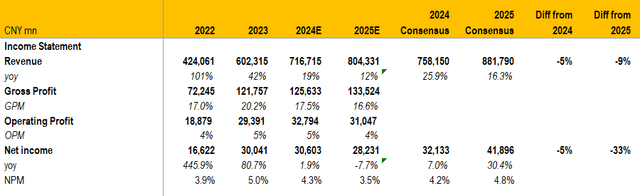
BYD share rebounded since early 2024 along with the broad China market, as turmoil in crackdown of quant trading ended. However, investors have not fully priced in the potential earnings downside as the heavy price discount introduced in late Feb and March filtered through.
Some bullish investors also argue BYD has a strong competitive edge in terms of cost, thanks to its vertical integration model and the potential from the overseas market. I agree with those views. However, those advantages can only help BYD in surviving the ongoing downcycle for the EV industry, which could take years to rebalance itself. But they are insufficient for BYD to counter the downtrend.
Seeking Alpha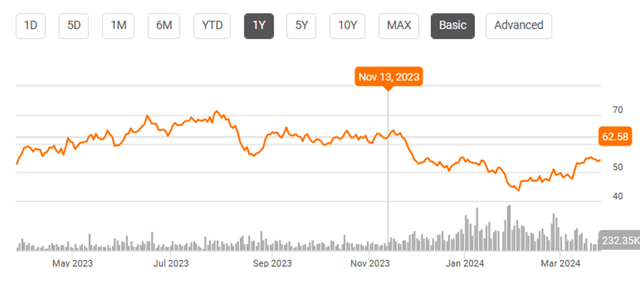
Valuation Analysis
BYD is trading at 18x FWD PE, which is higher than its Chinese auto peers, such as Geely and Great Wall, give investors pay premium for its industry leadership. This premium will narrow in my view, as BYD’s leadership is being eroded in autonomous driving era.
Compared to other Chinese EV start-ups, BYD is trading at 0.9x price-to-sales ratio (P/S), much lower than LI Auto, Nio and XPEV, but also much higher than Geely and Great Wall. I believe these start-ups are also overvalued and facing bigger challenges than BYD in the ongoing industry downturn.
Seeking Alpha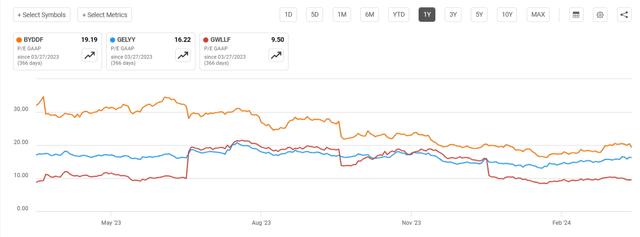
Seeking Alpha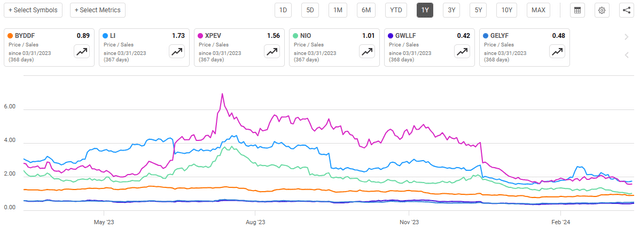
Dividend and Buyback
BYD has a very low dividend payout ratio. It was 10% of earnings between 2019 to 2021, and it will increase to 30% by the year 2023. I don’t expect BYD will raise it beyond that as a 30% payout ratio was the minimum requirement set by China’s Security Regulatory Committee for the listed company. Without meeting this requirement, BYD cannot raise equity in the market. Given that BYD is trading at 18x FWD PE, the dividend yield based on the 30% payout ratio is less than 2%.
BYD has no regular buyback program and has done very little in share buyback in the past. In 2022, it has buyback around CNY200mn worth of shares. And in March 2024, it announced another CNY400mn (0.05% of shares) buyback. It was just a gesture to help government in stabilizing stock market.
Upside Risks to My Bearish Call
I identify two potential upside risks to my bearish call on the stock
- Large-scale government subsidies to support EV sales. However, considering the current tight budget conditions in local government, I believe even there is a supportive policy for EV, is unlikely to be a direct cash subsidy.
- Partner with Huawei to develop an autonomous driving solution. I also think it is unlikely in that BYD has always emphasized self-sufficiency in key components. Also Huawei has strong bargaining power against car makers, and hence usually takes the lion’s share of profit from its EV partners, which BYD may not want to accept.
Concluding Thoughts
I rate the stock as Sell rating, and expect 20% downside in its shares driven by consensus EPS cut, throughout the year.
While BYD is one of the best automakers in the world, particularly when it comes to EV space, it is not immune to the intense competition in the China market, and has to slash its price to sustain the market share. Its long term prospect is also blurred due to its lagging in autonomous driving. I think earnings from street analysts may need to be further reduced by as much as 20%. In the near term, if BYD’s March volume has rebounded strongly after the price cut adopted in March, the stock may rebound until the April 18th Shanghai Auto Show. By then it would be a good opportunity to begin to short the stock into the interim results.
Editor’s Note: This article discusses one or more securities that do not trade on a major U.S. exchange. Please be aware of the risks associated with these stocks.
Credit: Source link