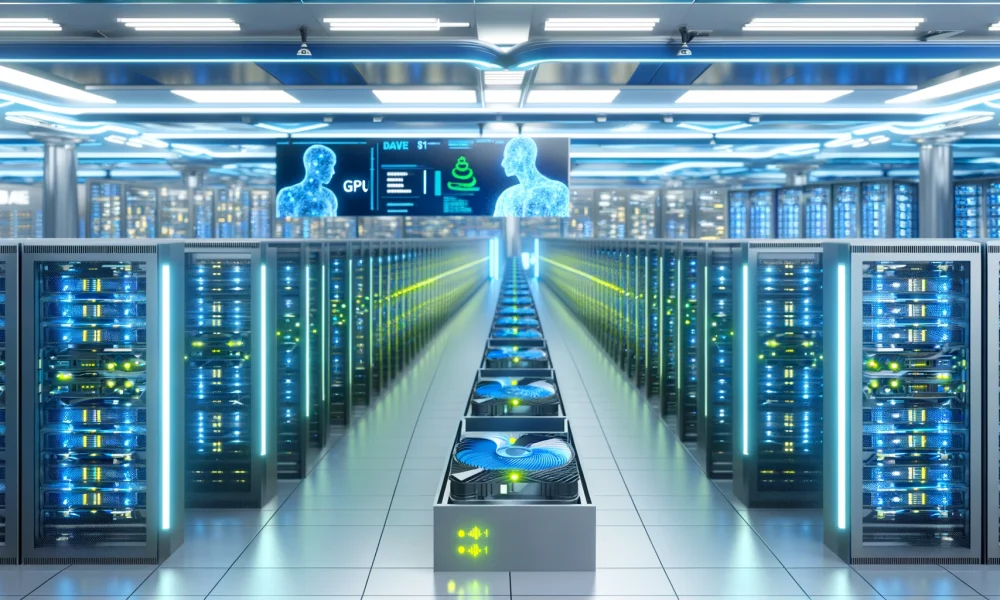

In today’s era of rapid technological advancement, Artificial Intelligence (AI) applications have become ubiquitous, profoundly impacting various aspects of human life, from natural language processing to autonomous vehicles. However, this progress has significantly increased the energy demands of data centers powering these AI workloads.
Extensive AI tasks have transformed data centers from mere storage and processing hubs into facilities for training neural networks, running simulations, and supporting real-time inference. As AI algorithms advance, the demand for computational power increases, straining existing infrastructure and posing challenges in power management and energy efficiency.
The exponential growth in AI applications strains cooling systems, which struggle to dissipate the heat generated by high-performance GPUs while electricity usage increases. Therefore, achieving a balance between technological progress and environmental responsibility is essential. As AI innovation accelerates, we must ensure that each advancement contributes to scientific growth and a sustainable future.
The Dual Influence of AI on Data Center Power and Sustainability
According to the International Energy Agency (IEA), data centers consumed approximately 460 terawatt-hours (TWh) of electricity globally in 2022 and are expected to surpass 1,000 TWh by 2026. This increase poses challenges for energy grids, highlighting the need for efficiency improvements and regulatory measures.
Recently, AI has been transforming data centers and changing how they operate. Traditionally, data centers dealt with predictable workloads, but now they handle dynamic tasks like machine learning training and real-time analytics. This requires flexibility and scalability. AI gains efficiency by predicting loads, optimizing resources, and reducing energy waste. It also helps discover new materials, optimize renewable energy, and manage energy storage systems.
To maintain the right balance, data centers must utilize AI’s potential while minimizing its energy impact. Collaboration among stakeholders is required for creating a sustainable future where AI innovation and responsible energy use go hand in hand.
The Rise of GPU Data Centers in AI Innovation
In an AI-driven era, GPU data centers play a significant role in driving progress across various industries. These specialized facilities are equipped with high-performance GPUs that excel at accelerating AI workloads through parallel processing.
Unlike traditional CPUs, GPUs have thousands of cores that simultaneously handle complex calculations. This makes them ideal for computationally intensive tasks like deep learning and neural network training. Their extraordinary parallel processing power ensures exceptional speed when training AI models on large datasets. Additionally, GPUs are adept at executing matrix operations, a fundamental requirement for many AI algorithms due to their optimized architecture for parallel matrix computations.
As AI models become more complex, GPUs offer scalability by efficiently distributing computations across their cores, ensuring effective training processes. The exponential growth of AI applications is evident, with a significant portion of data center revenue attributed to AI-related activities. Given this growth in AI adoption, robust hardware solutions like GPUs are essential to meet the escalating computational demands. GPUs play a pivotal role in model training and inference, using their parallel processing capabilities for real-time predictions and analyses.
GPU data centers are driving transformative changes across industries. In healthcare, GPUs enhance medical imaging processes, expedite drug discovery tasks, and facilitate personalized medicine initiatives.
Similarly, GPUs power risk modelling, fraud detection algorithms, and high-frequency financial trading strategies to optimize decision-making processes. Furthermore, GPUs enable real-time perception, decision-making, and navigation in autonomous vehicles, emphasizing advancements in self-driving technology.
Furthermore, the proliferation of generative AI applications adds another layer of complexity to the energy equation. Models such as Generative Adversarial Networks (GANs), utilized for content creation and design, demand extensive training cycles, driving up energy usage in data centers. The Boston Consulting Group (BCG) projects a tripling of data center electricity consumption by 2030, with generative AI applications playing a significant role in this surge.
The responsible deployment of AI technologies is important to mitigating the environmental impact of data center operations. While generative AI offers creative potential, organizations must prioritize energy efficiency and sustainability. This entails exploring optimization strategies and implementing measures to reduce energy consumption without compromising innovation.
Energy-Efficient Computing for AI
GPUs are powerful tools that save energy. They process tasks faster, which reduces overall power usage. Compared to regular CPUs, GPUs perform better per watt, especially in large-scale AI projects. These GPUs work together efficiently, minimizing energy consumption.
Specialized GPU libraries enhance energy efficiency by optimizing common AI tasks. They use GPUs’ parallel architecture, ensuring high performance without wasting energy. Although GPUs have a higher initial cost, their long-term benefits outweigh this expense. GPUs’ energy efficiency positively impacts the total cost of Ownership (TCO), including hardware and operational costs.
Additionally, GPU-based systems can scale up without significantly increasing energy use. Cloud providers offer pay-as-you-go GPU instances, allowing researchers to access these resources as needed while keeping costs low. This flexibility optimizes both performance and expenses in AI work.
Collaborative Efforts and Industry Responses
Collaborative efforts and industry responses are key to handling energy consumption challenges in data centers, particularly those related to AI workloads and grid stability.
Industry bodies like the Green Grid and the EPA promote energy-efficient practices, with initiatives like the Energy Star certification driving adherence to standards.
Likewise, leading data center operators, including Google and Microsoft, invest in renewable energy sources and collaborate with utilities to integrate clean energy into their grids.
Moreover, efforts to improve cooling systems and repurpose waste heat are ongoing and supported by initiatives like Facebook’s Open Compute Project.
In AI innovation, collaborative efforts through demand response programs are important in efficiently managing energy consumption during peak hours. Simultaneously, these initiatives promote edge computing and distributed AI processing, reducing reliance on long-distance data transmission and saving energy.
Future Insights
In the coming years, AI applications will experience significant growth across sectors like healthcare, finance, and transportation. As AI models become more complex and scalable, the demand for data center resources will rise accordingly. To address this, collaborative efforts among researchers, industry leaders, and policymakers are important for driving innovation in energy-efficient hardware and software solutions.
In addition, continued innovation in energy-efficient computing is essential to tackle the challenges of increasing data center demand. Prioritizing energy efficiency in data center operations and investing in AI-specific hardware, such as AI accelerators, will shape the future of sustainable data centers.
Moreover, balancing AI advancement with sustainable energy practices is vital. Responsible AI deployment requires collective action to minimize the environmental impact. By aligning AI progress with environmental stewardship, we can create a greener digital ecosystem that benefits society and the planet.
The Bottom Line
In conclusion, as AI continues to drive innovation across industries, the escalating energy demands of data centers pose significant challenges. However, collaborative efforts between stakeholders, investments in energy-efficient computing solutions like GPUs, and a commitment to sustainable practices offer promising pathways forward.
By prioritizing energy efficiency, embracing responsible AI deployment, and promoting collective actions, we can reasonably balance technological advancement and environmental stewardship, ensuring a sustainable digital future for future generations.

Credit: Source link