

Khanchit Khirisutchalual
Dividends make for a great way to fund a retirement for the following reasons:
- Fully covering living expenses with passive income from dividends makes for easier budgeting, since you know exactly what your investment income will be for a given period of time.
- Following this approach also can lead to enhanced peace of mind during periods of market volatility since dividend payouts are much less volatile than stock prices, reducing the sequence of returns risk.
- Focusing on the dividend passive income that stocks generate can help you avoid chasing hot stocks and way overpaying for companies that may not even be all that profitable. Instead, you are investing for the dividend income stream that a stock will provide you with for years to come, helping to guard against overpaying for a stock.
In this article, I will compare two types of dividend stocks that are very popular among dividend-focused retirees – equity (i.e., non-mortgage) REITs (VNQ) and BDCs (BIZD) – and then conclude by sharing which I think is a better investment for a retiree aspiring to live off of dividends in April 2024 along with some of my top retirement passive income picks in each sector right now.
Why REITs and BDCs Are Popular With Retirees
Before I jump into comparing these two types of businesses, I first want to discuss why they are so popular with retirees.
BDCs are popular with income-oriented retirees because:
- They tend to pay out very attractive dividend yields because they invest primarily in high-yield senior secured loans, apply a layer of leverage on top of that to further enhance their cash yield on equity, and are required to distribute at least 90% of their taxable income to shareholders as dividends to maintain their BDC status.
- They can pay out even higher dividend yields than they would otherwise because they are exempt from having to pay corporate income tax, leaving more cash flow to deliver to shareholders.
- They tend to generate stable and fairly defensive cash flows since they invest primarily in senior secured loans, have very well-diversified portfolios by sector and number of individual investments, often employ skilled underwriting and recovery teams, and can actively manage investments that become distressed.
- They invest primarily in floating-rate loans, giving a retiree’s portfolio a hedge against rising interest rates, which are often a headwind for fixed-rate bonds, preferreds, and many other forms of high-yield investments.
REITs are popular with income-oriented retirees because:
- They tend to pay out very attractive dividend yields because they invest primarily in cash-flowing real estate assets, apply a layer of leverage on top of that to further enhance their cash yield on equity, and are required to distribute at least 90% of their taxable income to shareholders as dividends to maintain their REIT status.
- They can pay out even higher dividend yields than they would otherwise because they are exempt from having to pay corporate income tax, leaving more cash flow to deliver to shareholders.
- They tend to generate stable and fairly defensive cash flows since they invest primarily in high-quality commercial real estate assets, tend to have much better-diversified portfolios of real estate than the typical individual investor could amass on their own through direct investments in real estate, often employ skilled management teams, and can actively manage their portfolios to maximize returns.
- They can often generate attractive long-term inflation-resistant growth due to their real asset nature and/or contractual rent hikes, rendering them capable of paying out both attractive current yields and delivering meaningful long-term dividend growth.
With these qualities in view, I will now compare REITs with BDCs based on their current state in April 2024 according to the four biggest factors that typically concern income-focused retirees: dividend yield, dividend safety, dividend growth, and valuation.
REITs Vs. BDCs: Dividend Yields
When it comes to dividend yields, BDCs as a whole significantly outpace REITs right now, though there are numerous exceptions to this. The reason for BDCs generally having a higher dividend yield than REITs is threefold:
- BDC yields right now are elevated in part due to the fact that short-term interest rates are also elevated. Given that the majority of BDC investments are in floating-rate loans that are linked to short-term interest rates, this has pushed their dividend yields up.
- BDCs generate their income primarily from interest and dividend cash flow, as well as realized gains from occasionally selling some of their underlying investments. Meanwhile, REITs generate their income primarily from rental income along with some appreciation realized from asset sales. However, since real estate benefits from depreciation accounting rules, whereas loans and equity investments do not, BDCs’ taxable income is often very close to what their cash flow is, whereas REITs’ taxable income is often considerably lower than what their cash flow is. As a result, REIT payout ratios are typically considerably lower than BDCs’ are.
- Last, but not least, real estate cap rates are often quite a bit lower than the yield is on middle-market senior-secured floating-rate loans. This is due to the fact that many real estate assets are considered to be lower risk than the types of loans that BDCs invest in and also have considerable long-term growth/appreciation potential, whereas loans by definition of being debt investments generally do not have growth potential.
REITs Vs. BDCs: Dividend Safety
When it comes to dividend safety, while there are obvious exceptions to this rule, in general, REIT dividends appear to be a good bit safer than BDC dividends. This is because:
- REIT payout ratios tend to be lower than BDC payout ratios (for reasons already discussed in the previous section).
- REIT cash flows tend to grow faster than BDC cash flows, providing additional safety for the dividend in the future.
- REIT balance sheets tend to enjoy higher credit ratings than BDC balance sheets do, giving them better access to capital and thereby providing greater safety for their dividends.
- REIT cash flows tend to hold up better during economic downturns since their counterparties tend to be a bit higher quality than BDCs’ are.
REITs Vs. BDCs: Dividend Growth
When it comes to dividend growth, REITs also tend to significantly outpace BDCs (though again, there are several exceptions to this) because REITs enjoy stronger cash flow growth rates on an organic (due to inflation and economic growth-driven appreciation) and inorganic (due to having more cash flows retained and reinvested in the business) basis. One of the biggest exceptions to this rule, though, is Main Street Capital (MAIN), which has an impressive dividend growth track record due in part to its successful track record of investing in middle market equity alongside its debt investments, as well as its ability to command a significant premium to NAV, thereby enabling it to raise capital accretively consistently over time:
MAIN Dividend Growth (Investor Presentation)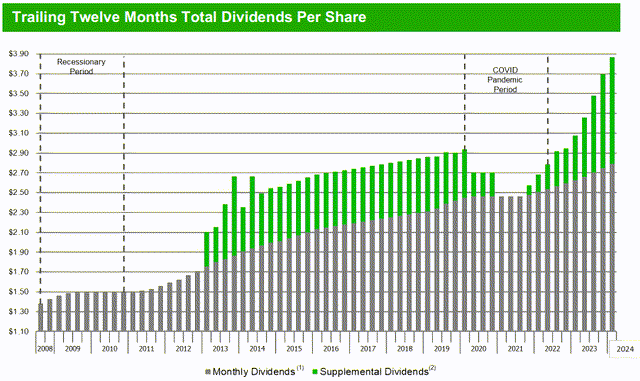
REITs Vs. BDCs: Valuation
Finally, on a valuation basis, REITs generally speaking currently look more attractively priced than BDCs do. I say this for several reasons:
- On a price-to-NAV basis, REITs in aggregate currently trade at a steep discount to NAV. In fact, even blue chip REITs like Boston Properties (BXP), Alexandria Real Estate Equities (ARE), Crown Castle (CCI), Mid-America Apartment (MAA), and Realty Income (O) all trade at discounts to NAV whereas virtually all of the blue-chip BDCs like MAIN, Ares Capital Corp (ARCC), Hercules Capital (HTGC), Sixth Street Specialty Lending (TSLX), and Blackstone Secured Lending (BXSL) trade at premiums to NAV right now.
- I also think that REIT NAVs more accurately reflect the underlying fundamentals and forward outlook for the commercial real estate industry, as NAVs in commercial real estate have been declining fairly substantially in recent years due to pressure from rising interest rates. In contrast, BDC NAVs tend to be pretty stagnant since they are largely based on floating-rate debt investments that typically remain at full value until there is financial distress and they suddenly plummet in value. Moreover, REIT NAVs are likely to benefit from rate cuts by the Fed, whereas BDCs likely will not see a similar benefit to their NAVs, and their income yields will likely decline as their floating rate loans will see their yields decline.
Investor Takeaway
Overall, BDCs still – in general – offer retirees higher dividend yields than REITs do and there are some very attractive BDC dividend stocks that I discuss in this article, including Blue Owl’s BDCs (OBDC)(OBDE), Golub Capital BDC (GBDC), and BXSL. However, in aggregate, I think that REITs are a better bet right now for retirees. In particular, I like the triple-net lease and multifamily spaces. Blue-chip triple net lease REITs like O, W. P. Carey (WPC), Agree Realty (ADC), EPR Properties (EPR), and NNN REIT (NNN) are poised to deliver attractive current yields along with very defensive and consistent dividend growth for years to come. Moreover, many of them trade at discounts to NAV at present, providing further upside potential from valuation multiple expansion over time. Meanwhile, blue-chip multifamily REITs like MAA and Camden Property Trust (CPT) have proven to be solid wealth compounders and dividend growers over time and currently trade at attractive discounts to NAV, providing retirees with the chance to buy relatively inflation-proof real estate assets that offer attractive long-term growth potential along with a decent current yield.
If you want full access to our Portfolio which has beaten the market since inception and all our current Top Picks, join us for a 2-week free trial at High Yield Investor.
We are the fastest-growing high yield-seeking investment service on Seeking Alpha with ~1,200 members on board and a perfect 5/5 rating from 166 reviews.
Our members are profiting from our high-yielding strategies and you can join them today at a compelling value.
With the 2-week free trial, you have nothing to lose and everything to gain.

Credit: Source link