
Madmaxer/iStock via Getty Images
Thesis
The ETF market has experienced a boom in the past few years, especially helped by the advent of Rule 18F-4, implemented in 2020:
The Securities and Exchange Commission on October 28, 2020 announced an enhanced regulatory framework for derivatives use by registered investment companies, including mutual funds (other than money market funds), exchange-traded funds (ETFs) and closed-end funds, as well as business development companies where derivatives exposure is greater than 10% of net assets. The proposed rule and rule changes will establish a modernized, comprehensive approach to regulating these funds’ derivatives use that meets investor protection concerns and considers decades of developments.
In a nutshell, the rule change allowed for many complex investment strategies to be run inside the ETF wrapper, a change which paved the way for many new products in the market.
One of the products which has experienced an explosive growth in the past few years is represented by call writing funds. The equity ones are the most popular, with the likes of JPMorgan Equity Premium Income ETF (JEPI) experiencing an explosive growth:
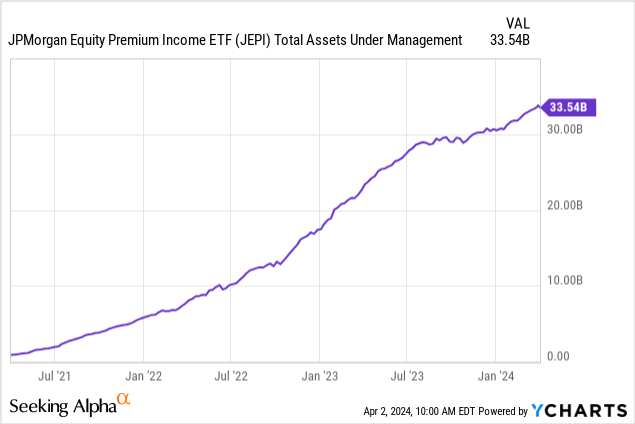
We can see from the above chart how the assets under management for the fund have moved from a few billion in 2021 to over $33 billion as we speak.
The iShares 20+ Year Treasury Bond Buy-Write Strategy ETF (BATS:TLTW) comes from the same school of thought, but the fund addresses the fixed income markets rather than equities. To be more specific, the ETF writes covered calls on the iShares 20+ Year Treasury Bond ETF (TLT), which is a long dated treasuries bond fund and an expression of 20-year rates.
We have covered this name before six months ago here, where we described the fund mechanics and our view on the name given the macro rates picture.
Given the violent move-up in long rates in the past few days, we are going to revisit TLTW to see if it has buffered any of the TLT moves, and highlight for investors why we do not think this instrument is the appropriate way to trade 20-year rates, while at the same time outlining a customized strategy.
Fund composition – layering covered calls on TLT
The fund has a very straight forward composition – it buys TLT and then layers out of the money calls on it:
Holdings (Fund Website)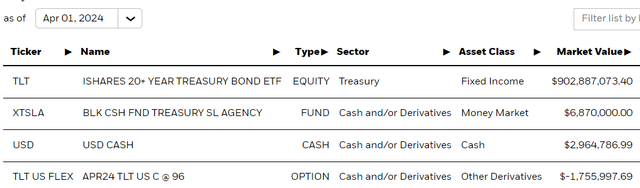
As we can see from the above table, the composition consists of cash, TLT and April 96 strike calls. To note the fund rolls one-month calls with a 2% out of the money feature:
The iShares 20+ Year Treasury Bond Buy-Write Strategy ETF seeks to track the investment results of an index that reflects a strategy of holding the iShares 20+ Year Treasury Bond ETF while writing (selling) one-month covered call options to generate income.
Are you able as an investor to replicate this strategy easily? Absolutely. Now let us see if it makes sense from a macro and financial engineering standpoint.
Covered calls work best when volatility is high
An options based strategy in terms of covered calls, works best when volatility is high. The main pricing input into options is the implied volatility factor. If implied volatility is low, the option premium is low. Conversely, investors get rewarded handsomely when implied volatility is high. The implied volatility for TLT is very low:
IV (marketchameleon)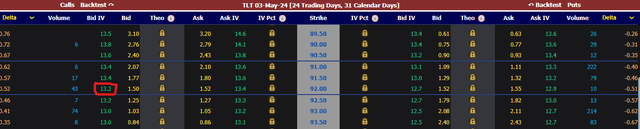
The current one month implied volatility for an at the money option on TLT is a mere 13%, a very low implied volatility from an option premium perspective. An investor should ideally see implied volatility levels in the 20s here in order for the math to make sense for a covered call strategy.
The one-month 2% OTM strategy has not worked
Since the last article came out and rates peaked, TLTW has trailed TLT by a wide margin:
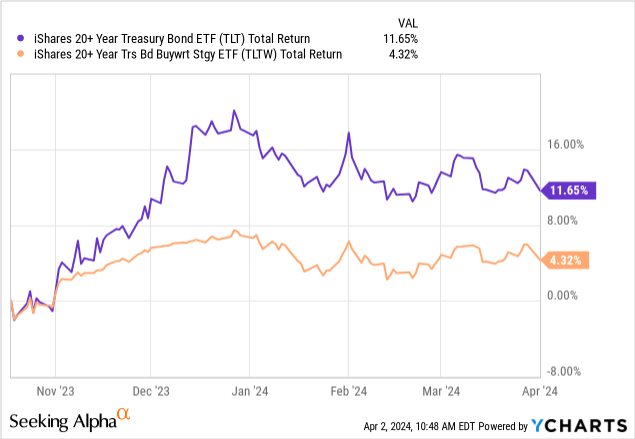
Please note the above graph is done from a total return perspective, thus including the fund’s high dividend yield.
The high dividend yield is a mirage though, being correlated with an ever decreasing price. The correct way to look at TLTW is from a total return perspective, benchmarked against TLT.
With long rates moving lower in 2024, TLT has outperformed because it is an uncapped expression of long rates. Via its 2% OTM calls, TLTW will be hampered in an environment where rates move lower. Expect this trend to continue in 2024/2025.
A better way to write covered calls on TLT
We feel a retail investor is better served by taking a customized approach in trading TLT and long rates. Rather than utilize TLTW, which represents a systematic strategy, an investor can customize positioning based on shorter term views and volatility levels.
TLT experienced a violent rally into 2024 as the market was expecting Fed cuts as soon as March 2024, with seven of them priced in. That caused TLT to rally close to the $100/share mark. Such an extreme view should have been traded via covered calls, since the fund was nearing the top of its short-term range, and $100 represents a long term support/resistance line.
Today’s market is the opposite of what happened in late 2023. Market participants are now cutting down the number of priced Fed cuts, and some are talking about 5% long rates. We have moved from one extreme to another. We do not think the Fed will hike again this year, and we do think they will cut irrespective of the inflationary target. We are set for an environment where inflation will be persistently higher, all while the national debt problem will force the Fed to move rates lower.
Right now an investor should just be long TLT rather than cap the upside via 2% out of the money calls, because we are again testing the bottom of the range. When TLT rallies again towards $100, an investor can then structure a customized tenor out of the money call that would cap the upside but also buffer some of the potential downside.
At the end of the day long rates need to be traded based on the availability of economic data and extreme market views, rather than a systematic one-month strategy based on low volatility levels.
Conclusion
As long rates moved lower from their October 2023 highs, TLT outperformed TLTW by a factor of 3x. TLTW is going to be constrained going forward by its low implied volatility, lower rates macro picture and its systematic one-month roll strategy. The fund is a poor way to trade long rates and volatility, and retail investors are best served by engaging in selling covered calls themselves by taking into account extreme moves in TLT and views on Fed cuts. While we experienced such a move in late 2023 when high delta covered calls should have been sold, today we are at the opposite side of the spectrum. We are now trading again the bottom of the TLT range, and an investor should take an uncapped position directly rather than utilize TLTW.
Credit: Source link