

Phillip Spears/DigitalVision via Getty Images
Last week, I explained why I stopped buying real estate to buy real estate investment trusts, or REITs, instead.
I recommend that you read the whole article, but in short, REITs (VNQ) are today a lot cheaper than private real estate. They also give you the benefits of leverage with lower interest rates because they have locked their rates for years to come.
So why would you pay a premium valuation and higher interest rates for a private property that’s illiquid, concentrated, and work-intensive?
It just doesn’t make sense to buy private real estate today because REITs are so much more attractive. This explains why even the big private equity players like Blackstone (BX) have been buying a lot of REITs instead of private real estate in recent years.
But the article received some interesting pushback points from different real estate investors and I want to address those in today’s follow-up article.
There were three main pushback points:
- REITs must pay salaries to their managers.
- REITs are not as tax-efficient.
- REITs are more volatile.
Let’s address each of them one by one:
REITs must pay salaries to their managers
Yes, it is true that REITs pay millions of dollars to their top executives, but this does not mean that they are less cost-efficient.
On the contrary, studies show that REITs are far more cost-efficient than private real estate investments:
NAREIT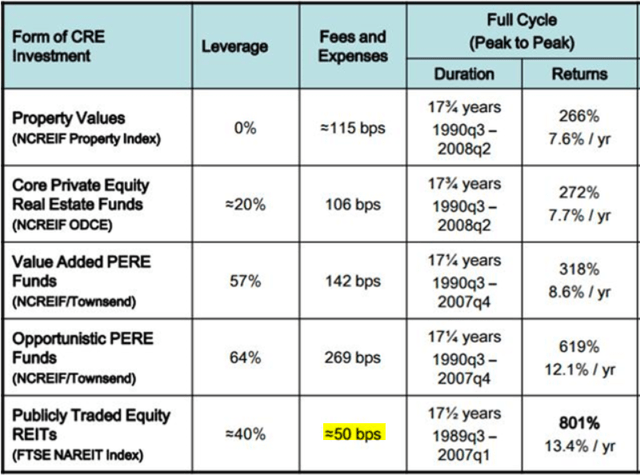
This is because of scale.
REITs will typically own billions or even $10s of billions worth of properties and enjoy significant economies of scale in their management and in other expenses.
If you own billions of dollars’ worth of real estate, you will be able to afford hiring the best real estate talent, pay them generously, and still enjoy a very low management cost as a percentage of your total asset volume.
To give you an example, Realty Income (O) paid over $10 million to its CEO last year, and yet, its management cost as a percentage of assets is just 30 basis points:
Realty Income 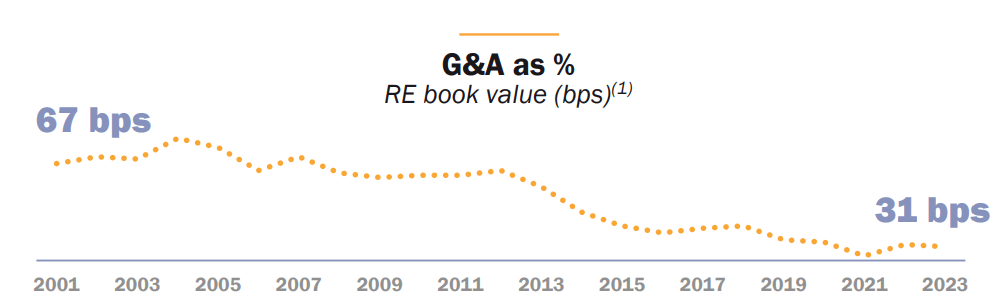
Now compare that to private real estate.
If you bought a property and handed it over to a property manager, you would likely pay him/her 10-12% of the monthly revenue, which would likely work out to about ~1.5-2% of the total asset value. That’s simply because the property manager won’t enjoy the same scale and he/she also has a different profit motive.
And if you did the management yourself, it would be even worse. You have no scale whatsoever, you are not a professional, you don’t have the resources, and so you will be highly inefficient. If you valued your time at $30 per hour and spent 2 hours per week on average working on your rental business, that would cost you $240 per month, which would likely amount to closer to 15-20% of your rental income. Before you tell me that 2 hours per week is too much, keep in mind that this is on average. It includes all the time that you spent upfront to find the deal, negotiate it, finance it, renovate it, market it to a tenant, etc. 2 hours is very conservative in my opinion.
So no, REITs are not worse investments because of their management cost.
It is the opposite. REITs enjoy significant economies of scale in their management, resulting in lower costs in an apple-to-apple comparison.
I would add here that REITs also enjoy lower costs for everything else because of their scale. To give you a few examples:
- 1) REITs will hire their own in-house lawyers to work full-time for the REIT and challenge property tax increases.
- 2) REITs will make deals with contractors for bulk renovations, reducing the average cost per unit.
- Etc.
The point here is that real estate is a low-margin business so scale matters and REITs are a lot more cost efficient for this reason.
REITs are not as tax-efficient
This is yet another misconception.
Yes, it is true that private real estate investments can be tax-efficient.
But so are REITs.
Investors will often point out that the dividend income of REITs is classified as “ordinary income” and that therefore, they are not tax efficient but this is very shortsighted.
Here is why REITs are actually very tax-efficient:
- REITs give you the limited liability protection of a corporation but they do not pay any corporate taxes.
- REITs will typically retain ~30% of their cash flow to reinvest in growth and this retained income is not taxed.
- REITs will typically classify a portion of the dividend income as “return of capital” which is not taxed either. Some classify 100% of it as “return of capital.”
- As I mentioned earlier, REITs are often able to reduce property taxes.
- REITs focus more on lower-yielding, faster-growing/appreciating properties such as e-commerce warehouses (PLD), data centers (DLR), etc. All the appreciation is also tax deferred.
- Finally, you could simply put your REITs in a tax-deferred account if you want to fully defer all taxes.
In the end, I pay less taxes investing in REITs than in rental properties. Rental properties have the advantage of being able to reduce taxation by depreciating their property, but this also has downsides. Once you have depreciated your property, you are stuck with it because you would be hit with a huge tax bill if you sold it someday. You could do a 1031 exchange, but you remain stuck with real estate even if it becomes a poor investment.
This loss in flexibility has significant indirect costs. With REITs, you can simply sell and reinvest elsewhere if real estate becomes less attractive.
REITs are more volatile
The final push back from the point of view of many private landlords is that REITs are riskier because they are more volatile.
They agree that REITs may present a better opportunity and offer higher returns at this point, but they still believe that private real estate is a better investment because of the stability that it offers.
But again here, we are dealing with a misconception.
In reality, REITs are much less volatile than private real estate.
The only reason why investors think that private real estate isn’t volatile is because they are ignoring the volatility. They are not getting a daily quote or even attempting to estimate their property value. But just because you don’t have the information does not mean that your property is stable in value.
On the contrary, private real estate investments are very volatile.
These are private, illiquid, concentrated investments with high capex requirements, a social component, and liability risk. Moreover, investors will typically buy them with up to 80% leverage, and the value of the property is tied to local market dynamics and interest rates.
This means that a 5-10% drop in property value would result in a 25-50% drop in your equity value.
What you see traded in the public stock market is the equity value and this is why REITs seem so volatile, but in reality, a leveraged private property is far more volatile.
Closing Note
REITs are today heavily discounted and I expect them to generate materially higher returns than private real estate in the coming years as they recover.
On top of that, REITs are also safer, less volatile, and just as tax-efficient.
Therefore, I see no point in investing in private real estate today.
Editor’s Note: This article discusses one or more securities that do not trade on a major U.S. exchange. Please be aware of the risks associated with these stocks.
Credit: Source link