

Justin Paget
Dear readers,
Broadstone Net Lease (NYSE:BNL) is a diversified net lease REIT with roughly 800 properties spread across 44 states and 4 Canadian provinces. The REIT is relatively small with a market cap of under $3 Billion, and having IPOed in 2020, it is also relatively young (at least in the context of public markets – prior to going public, it operated as a private company since 2007). But what the REIT lacks in size and age it makes up for in extremely good operating metrics (more on this later).
I’ve covered this promising (and somewhat lesser known) REIT before, most recently with a BUY rating here. My bullish thesis was based on outstanding lease terms with a long 10+ year WAULT, near perfect occupancy and collections, high rent coverage of over 3x and solid rent escalators. These metrics were good enough to rival some of the best in the net lease sector, including W. P. Carey (WPC) and Realty Income (O). Moreover, a high 7.9% dividend yield and a very appealing valuation with an implied cap rate 400 bps above 10-year treasury yields at the time, vastly outweighed the two main criticisms of BNL – the fact that the REIT lacks a clear focus and a 6% exposure to the troubled office sector. I felt strongly about BNL when I wrote the article back in early November, but admittedly the stock has underperformed since, with an RoR of 5% vs a 20% return of the S&P 500 (SPX) index.
The REIT released their full year 2023 results in February showing lots of positives. In the meantime, the REIT remains undervalued relative to peers and trades with a wide margin of safety which leads me to reiterate my BUY rating here at $15.40 per share. Today I publish an update to my thesis.
Exceptional operating metrics
I’ve said it before and I’ll say it again. BNL has some of the best operating metrics I’ve seen in the net lease sector. Their portfolio, which consists predominantly of industrial space (52%), followed by healthcare (18%), restaurants (13%), retail (11%), and office (6%), has a near perfect occupancy of 99.4% with only 2 vacant properties and rent collections of 99.2%.
These metrics, along with a 10+ year WAULT, minimal near-term lease expirations, and high 3.1x rent coverage, make for very predictable cash flows. But as with most net lease REITs, this predictability comes at a cost. In particular, the ability to quickly raise rents in an inflationary environment. BNL has built-in fixed rent escalators on 85% of its leases that average 2% per year. The remaining 15% of leases have CPI-linked indexation, but it’s mostly capped at 3%. As a result, BNL’s internal growth is capped at around 2%.
BNL IR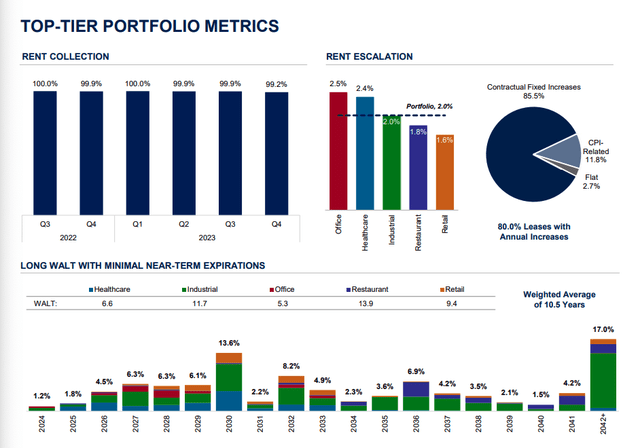
External growth and capital recycling
Historically, BNL has pursued an aggressive acquisition and capital recycling strategy to increase their growth. But last year, acquisition volume decreased compared to prior years with only 4 new properties being acquired for a total of $166 Million, at an average cap rate of 7.2%. For 2024, management guides towards acquisition volume of $350-700 Million, of which roughly $200 Million has already been secured ($100 Million of investment under contract and $100 Million commitment to fund developments).
BNL IR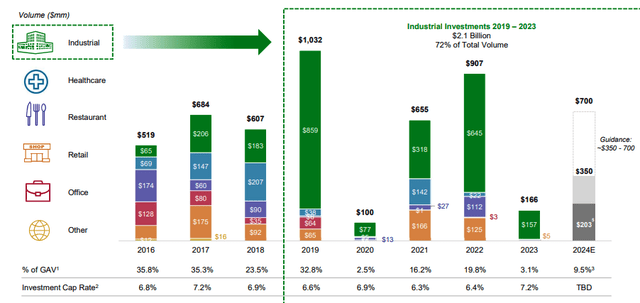
To balance this, the REIT has disposed of 14 properties last year for a total of $140 Million, at an average cap rate of 6% – significantly below the average cap rate on acquisitions.
For 2024, as part of the capital recycling program, management has recently made a decision to exit clinically-oriented healthcare properties to stream line their focus on core lease assets.
I like this decision, because clinically-oriented healthcare, which includes clinical, surgical and traditional medical office buildings, rely on third party management which increases the potential for leakage. Moreover, this asset class accounted for the majority of near-term CAPEX and had, on average, worse lease terms than the rest of the portfolio with a WAULT of just 6.2 years. Therefore selling these assets should result in a better portfolio. About half of these properties (cca 5% of ABR) are already under contract to be sold by March. And the remainder is expected to be sold over the course of this year. The exit is expected to generate $250 Million in proceeds and increase BNL’s WAULT to 11 years. This liquidity can be used entirely to buy new properties, because the REIT has no debt maturities to worry about until 2026.
BNL IR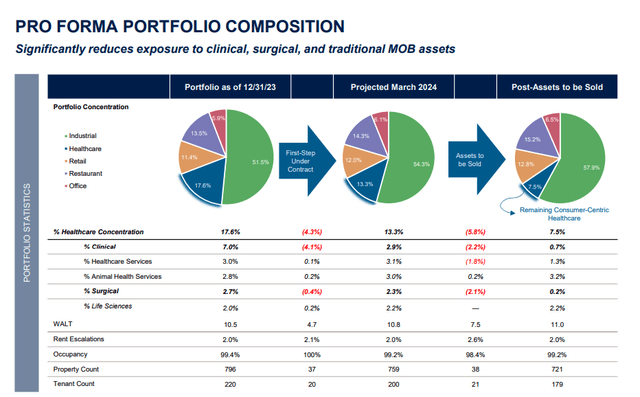
Risks
Before we talk about valuation and the margin of safety, let’s consider key risks. I’ve already touched on the fact that BNL’s cash flow has a long duration and the REIT is unable to raise rents quickly, because only a very small of lease expires in the near-term. As a result, the investment is likely to do quite poorly in a prolonged inflationary environment with high interest rates.
Moreover, there’s a possibility that BNL’s exceptional operating metrics will deteriorate over time. As their properties age and the first generation of leases expire, tenants may choose to move to newer premises, unless BNL commits to invest in renovation or provides other attractive incentives. This presents a potential occupancy risk which is higher than usual for BNL given its young age and many properties with first generation leases.
In BNL still a BUY?
Because of the aforementioned sale of healthcare assets that account for about 10% of ABR, near-term FFO growth per share isn’t expected to be significant. In fact, the general consensus is for flat FFO per share over the next two years.
Seeking Alpha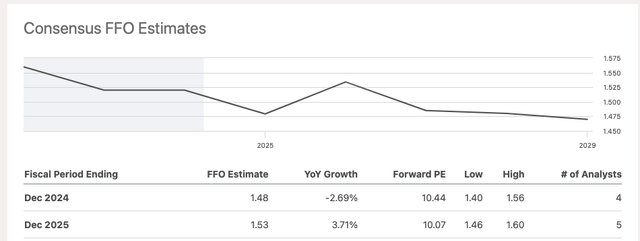
Luckily, we don’t need much growth to make BNL a worthwhile investment. The REIT pays a 7.5% dividend yield which is well covered with a payout ratio of 75%.
Moreover, it trades at a cheap valuation of 11x FFO, in line with the valuation of WPC. At an implied cap rate of 7.9%, the stock trades 370 bps above 10-year treasuries, which is a significant margin of safety, given how predictable BNL’s cash flow is and given its reasonable 5x net debt/EBITDA and a BBB balance sheet rating.
Personally, I see BNL re-rating to a 250 bps spread to long-term yields, once the healthcare exit is finalized eliminating part of the “jack of all trades” discount and once, given its young age, the REIT gains investors’ trust. My timeline for this re-rating is roughly two years. Other things being equal, such re-rating should result in upside of 26% and correspond to a price target of $20 per share. And that’s before any sort of a decline in yields, which is also a likely outcome over the next few years.
For these reasons I believe that BNL deserves a BUY rating here.
Credit: Source link