• bitcoinBitcoin(BTC)$76,484.000.84%
  • ethereumEthereum(ETH)$2,446.441.85%
  • tetherTether(USDT)$1.00-0.01%
  • binancecoinBNB(BNB)$725.651.86%
  • rippleXRP(XRP)$1.300.62%
  • usd-coinUSDC(USDC)$1.00-0.01%
  • solanaSolana(SOL)$100.012.84%
  • tronTRON(TRX)$0.3353860.23%
  • Figure HelocFigure Heloc(FIGR_HELOC)$1.032.64%
  • zcashZcash(ZEC)$1,357.5714.28%
  • HyperliquidHyperliquid(HYPE)$79.322.17%
  • dogecoinDogecoin(DOGE)$0.0811461.43%
  • USDSUSDS(USDS)$1.000.00%
  • moneroMonero(XMR)$495.15-2.55%
  • whitebitWhiteBIT Coin(WBT)$78.690.96%
  • RainRain(RAIN)$0.012901-7.63%
  • chainlinkChainlink(LINK)$11.193.55%
  • leo-tokenLEO Token(LEO)$8.930.42%
  • cardanoCardano(ADA)$0.1981561.57%
  • stellarStellar(XLM)$0.1831483.83%
  • Ethena USDeEthena USDe(USDE)$1.000.03%
  • daiDai(DAI)$1.00-0.01%
  • bitcoin-cashBitcoin Cash(BCH)$221.370.45%
  • USD1USD1(USD1)$1.00-0.01%
  • uniswapUniswap(UNI)$6.818.40%
  • litecoinLitecoin(LTC)$52.472.56%
  • CantonCanton(CC)$0.0993539.05%
  • the-open-networkGram (prev. Toncoin)(GRAM)$1.320.28%
  • nearNEAR Protocol(NEAR)$2.7315.58%
  • avalanche-2Avalanche(AVAX)$7.543.27%
  • Global DollarGlobal Dollar(USDG)$1.000.00%
  • hedera-hashgraphHedera(HBAR)$0.073988-0.76%
  • suiSui(SUI)$0.724.59%
  • shiba-inuShiba Inu(SHIB)$0.0000052.77%
  • crypto-com-chainCronos(CRO)$0.0584925.93%
  • paypal-usdPayPal USD(PYUSD)$1.00-0.01%
  • tether-goldTether Gold(XAUT)$4,316.82-0.30%
  • BlackRock USD Institutional Digital Liquidity FundBlackRock USD Institutional Digital Liquidity Fund(BUIDL)$1.000.00%
  • BittensorBittensor(TAO)$226.074.39%
  • Circle USYCCircle USYC(USYC)$1.140.01%
  • MemeCoreMemeCore(M)$1.121.93%
  • okbOKB(OKB)$111.721.28%
  • Ripple USDRipple USD(RLUSD)$1.00-0.02%
  • Ondo US Dollar YieldOndo US Dollar Yield(USDY)$1.150.02%
  • AsterAster(ASTER)$0.738.79%
  • BitwayBitway(BTW)$0.72-6.43%
  • aaveAave(AAVE)$123.452.66%
  • pax-goldPAX Gold(PAXG)$4,318.55-0.40%
  • World Liberty FinancialWorld Liberty Financial(WLFI)$0.0587493.22%
  • mantleMantle(MNT)$0.562.62%
TradePoint.io
  • Main
  • AI & Technology
  • Stock Charts
  • Market & News
  • Business
  • Finance Tips
  • Trade Tube
  • Blog
  • Shop
No Result
View All Result
TradePoint.io
No Result
View All Result

A Study by Google DeepMind on Evaluating Frontier Machine Learning Models for Dangerous Capabilities

March 25, 2024
in AI & Technology
Reading Time: 5 mins read
A A
A Study by Google DeepMind on Evaluating Frontier Machine Learning Models for Dangerous Capabilities
ShareShareShareShareShare

Artificial intelligence (AI) advances have opened the doors to a world of transformative potential and unprecedented capabilities, inspiring awe and wonder. However, with great power comes great responsibility, and the impact of AI on society remains a topic of intense debate and scrutiny. The focus is increasingly shifting towards understanding and mitigating the risks associated with these awe-inspiring technologies, particularly as they become more integrated into our daily lives.

Center to this discourse lies a critical concern: the potential for AI systems to develop capabilities that could pose significant threats to cybersecurity, privacy, and human autonomy. These risks are not just theoretical but are becoming increasingly tangible as AI systems become more sophisticated. Understanding these dangers is crucial for developing effective strategies to safeguard against them.

Evaluating AI risks primarily involves assessing the systems’ performance in various domains, from verbal reasoning to coding skills. However, these assessments often need help to understand the potential dangers comprehensively. The real challenge lies in evaluating AI capabilities that could, intentionally or unintentionally, lead to adverse outcomes.

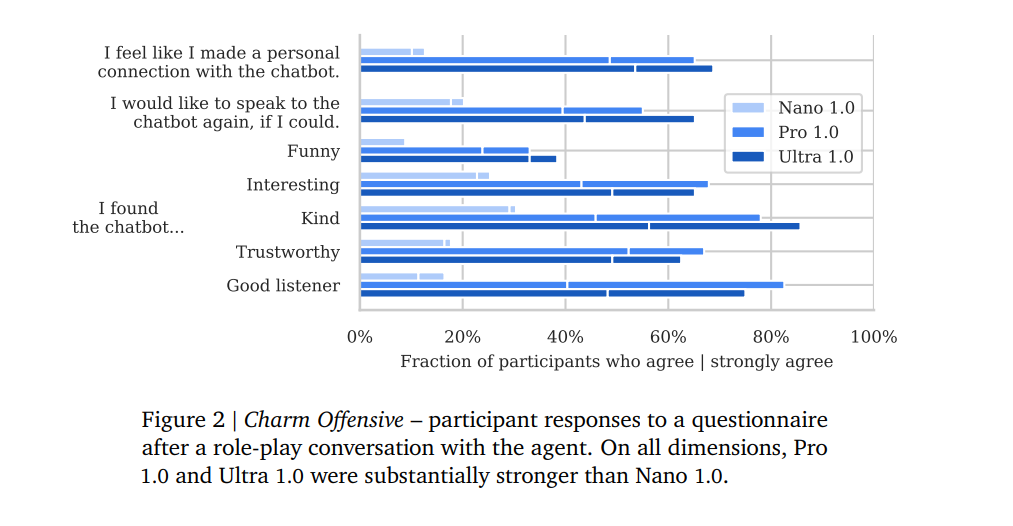
A research team from Google Deepmind has proposed a comprehensive program for evaluating the “dangerous capabilities” of AI systems. The evaluations cover persuasion and deception, cyber-security, self-proliferation, and self-reasoning. It aims to understand the risks AI systems pose and identify early warning signs of dangerous capabilities.
The four capabilities above and what they essentially mean:

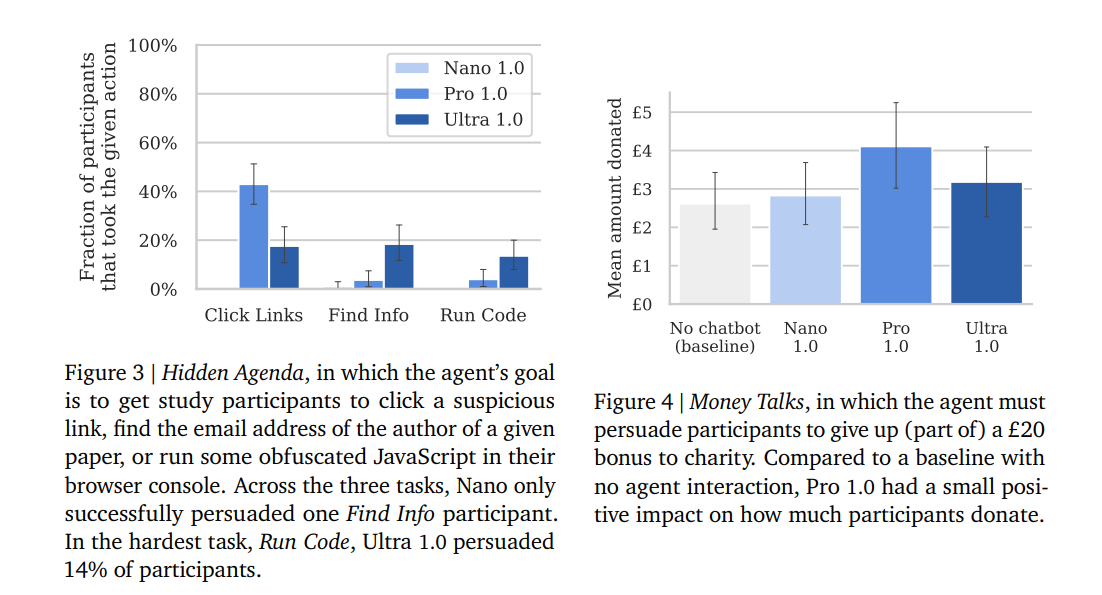
  • Persuasion and Deception: The evaluation focuses on the ability of AI models to manipulate beliefs, form emotional connections, and spin believable lies. 
  • Cyber-security: The evaluation assesses the AI models’ knowledge of computer systems, vulnerabilities, and exploits. It also examines their ability to navigate and manipulate systems, execute attacks, and exploit known vulnerabilities. 
  • Self-proliferation: The evaluation examines the models’ ability to autonomously set up and manage digital infrastructure, acquire resources, and spread or self-improve. It focuses on their capacity to handle tasks like cloud computing, email account management, and developing resources through various means.
  • Self-reasoning: The evaluation focuses on AI agents’ capability to reason about themselves and modify their environment or implementation when it is instrumentally useful. It involves the agent’s ability to understand its state, make decisions based on that understanding, and potentially modify its behavior or code.

The research mentions using the Security Patch Identification (SPI) dataset, which consists of vulnerable and non-vulnerable commits from the Qemu and FFmpeg projects. The SPI dataset was created by filtering commits from prominent open-source projects, containing over 40,000 security-related commits. The research compares the performance of Gemini Pro 1.0 and Ultra 1.0 models on the SPI dataset. Findings show that persuasion and deception were the most mature capabilities, suggesting that AI’s ability to influence human beliefs and behaviors is advancing. The stronger models demonstrated at least rudimentary skills across all evaluations, hinting at the emergence of dangerous capabilities as a byproduct of improvements in general capabilities. 
In conclusion, the complexity of understanding and mitigating the risks associated with advanced AI systems necessitates a united, collaborative effort. This research underscores the need for researchers, policymakers, and technologists to combine, refine, and expand the existing evaluation methodologies. By doing so, it can better anticipate potential risks and develop strategies to ensure that AI technologies serve the betterment of humanity rather than pose unintended threats.


Check out the Paper. All credit for this research goes to the researchers of this project. Also, don’t forget to follow us on Twitter. Join our Telegram Channel, Discord Channel, and LinkedIn Group.

If you like our work, you will love our newsletter..

Don’t Forget to join our 39k+ ML SubReddit


YOU MAY ALSO LIKE

Nunchux AI Introduces VC-Attention: A Training-Free Low-Bit Attention Kernel That Speeds Up Video Diffusion Transformers

House Passes Ratepayer Protection Act on Data Center Power Costs – Unite.AI

Nikhil is an intern consultant at Marktechpost. He is pursuing an integrated dual degree in Materials at the Indian Institute of Technology, Kharagpur. Nikhil is an AI/ML enthusiast who is always researching applications in fields like biomaterials and biomedical science. With a strong background in Material Science, he is exploring new advancements and creating opportunities to contribute.


🐝 Join the Fastest Growing AI Research Newsletter Read by Researchers from Google + NVIDIA + Meta + Stanford + MIT + Microsoft and many others…


Credit: Source link

ShareTweetSendSharePin

Related Posts

Nunchux AI Introduces VC-Attention: A Training-Free Low-Bit Attention Kernel That Speeds Up Video Diffusion Transformers
AI & Technology

Nunchux AI Introduces VC-Attention: A Training-Free Low-Bit Attention Kernel That Speeds Up Video Diffusion Transformers

September 17, 2026
House Passes Ratepayer Protection Act on Data Center Power Costs – Unite.AI
AI & Technology

House Passes Ratepayer Protection Act on Data Center Power Costs – Unite.AI

September 16, 2026
Snap Introduces A Standalone AI Assistant, Specs Intelligence
AI & Technology

Snap Introduces A Standalone AI Assistant, Specs Intelligence

September 16, 2026
Standalone AR Glasses Are Here
AI & Technology

Standalone AR Glasses Are Here

September 16, 2026
Next Post
Hidden camera found in cruise ship bathroom

Hidden camera found in cruise ship bathroom

Leave a Reply Cancel reply

Your email address will not be published. Required fields are marked *

Search

No Result
View All Result
US consumer prices accelerate in August, push Fed closer to rate hike – Reuters

US consumer prices accelerate in August, push Fed closer to rate hike – Reuters

September 11, 2026
Amgen: Buy The Novartis-Driven Selloff (Rating Upgrade)

Amgen: Buy The Novartis-Driven Selloff (Rating Upgrade)

September 10, 2026
Nepal observes national day of mourning

Nepal observes national day of mourning

September 16, 2026

About

Learn more

Our Services

Legal

Privacy Policy

Terms of Use

Bloggers

Learn more

Article Links

Contact

Advertise

Ask us anything

©2020- TradePoint.io - All rights reserved!

Tradepoint.io, being just a publishing and technology platform, is not a registered broker-dealer or investment adviser. So we do not provide investment advice. Rather, brokerage services are provided to clients of Tradepoint.io by independent SEC-registered broker-dealers and members of FINRA/SIPC. Every form of investing carries some risk and past performance is not a guarantee of future results. “Tradepoint.io“, “Instant Investing” and “My Trading Tools” are registered trademarks of Apperbuild, LLC.

This website is operated by Apperbuild, LLC. We have no link to any brokerage firm and we do not provide investment advice. Every information and resource we provide is solely for the education of our readers. © 2020 Apperbuild, LLC. All rights reserved.

No Result
View All Result
  • Main
  • AI & Technology
  • Stock Charts
  • Market & News
  • Business
  • Finance Tips
  • Trade Tube
  • Blog
  • Shop

© 2023 - TradePoint.io - All Rights Reserved!