
ojos de hojalata/iStock via Getty Images
Cal-Maine Foods (NASDAQ:CALM) is the largest producer of shell eggs in the United States. After a recently rally pushed it over $60 per share, the stock is some of the highest it’s ever been priced.
CALM Price Last 6M (Seeking Alpha)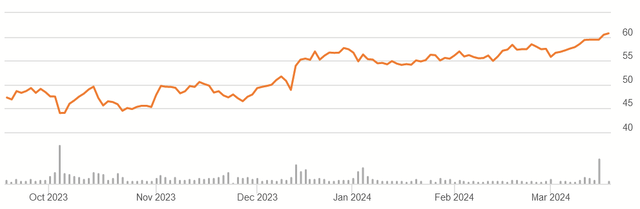
I decided to take a look and see if I felt there were still an opportunity to own shares, at a discount, of a dominant player in a durable consumer good.
Business Model
Cal-Maine’s product is “shell eggs,” eggs laid by chickens. It is the largest producer in the United States, with sales in 38 states.
Q2 2024 Investor Presentation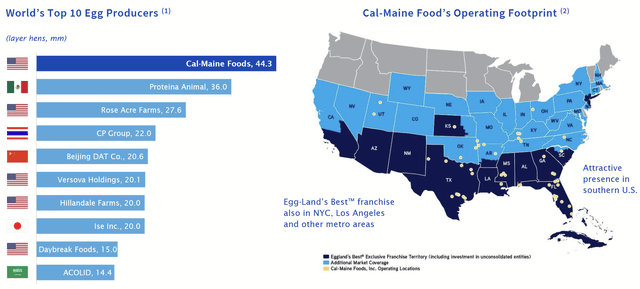
The company produces its eggs under a vertical model. This includes, hatching, raising flocks, laying, breeding, cleaning, and distributing eggs. These eggs they break into two broad categories: Conventional and Specialty. The latter refers to eggs from cage-free, free-roam chickens.
Q2 2024 Company Presentation 2023 Form 10K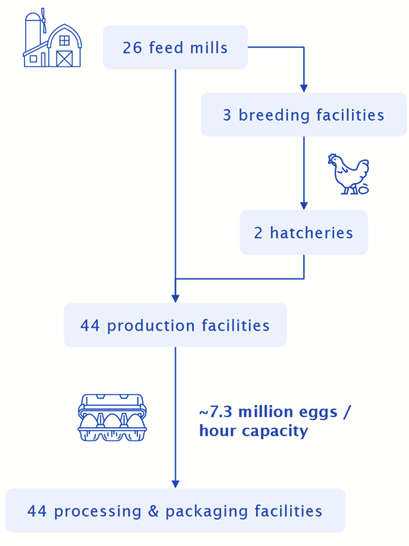
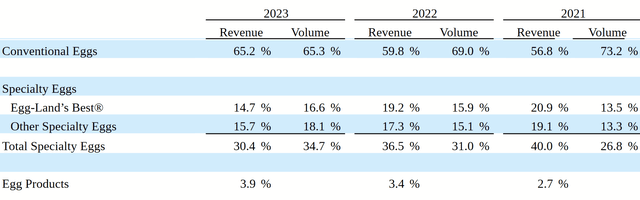
The table above shows that a majority of their volume comes from Conventional, while Specialty has been on the rise. In most cases, Specialty eggs have a higher cost to produce, while also selling for a higher price.
Q2 2024 Company Presentation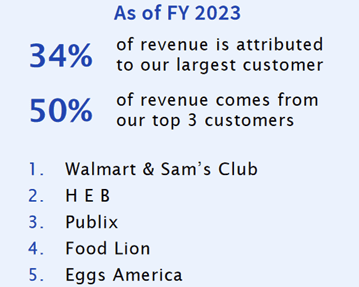
A significant portion of their revenue is concentrated among a few customers. A third of this is from Wal-Mart. Considering they are the largest grocer, while Cal-Maine is the largest egg producer, this isn’t too surprising.
When selling to customers, Conventional eggs are priced according to formulas that take into account factors that measure market demand for such eggs, as well as fluctuations in productions costs. Specialty eggs, meanwhile, are less volatile because those prices are based on contracts negotiated directly with customers and because, as the premium egg product, its customers are generally willing to pay more for it anyway.
Q2 2024 Form 10Q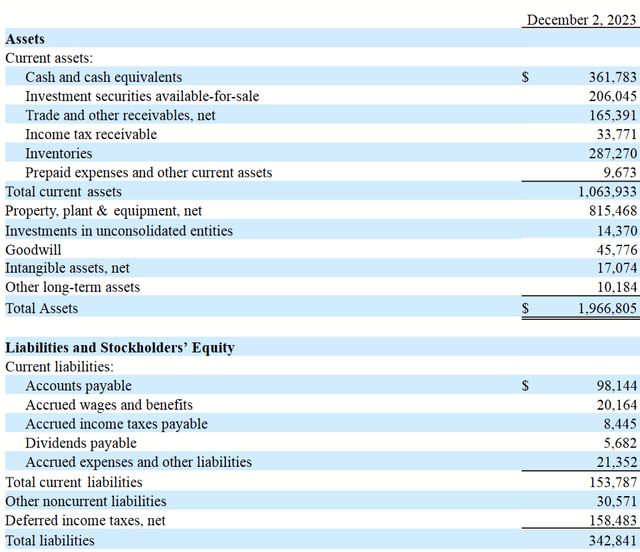
As their latest quarterly results show, the company has a very strong balance sheet, with very few liabilities, no long-term debt, and about $362M in cash.
Financial History
Over the past decade, the company has grown but not by much. (Keep in mind financial results end in June of each year.)
Author’s display of 10K data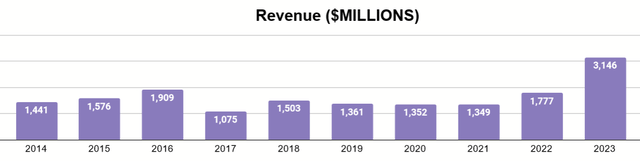
The large jump in revenues was caused by the outbreak of the HPAI virus in 2022. These killed many flocks of chickens across the country, reducing egg production and driving up prices. The impact to free cash flow for 2023 was much greater.
Author’s display of 10K data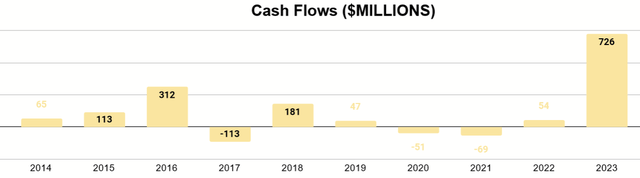
What these results do show is that Cal-Maine’s business is very cyclical. Since their only operating segment is egg production, and since they are the largest such producer in the country, their financial results have been influenced by the macro-fluctuations of their costs and egg prices. In their 2023 Form 10K (pg. 5), the company noted:
Feed is a primary cost component in the production of shell eggs and represented 63.1% of our fiscal 2023 farm production costs.
Whatever the squeeze or spread is on that margin, that is free cash flow for the year. Consequently, the company has adopted the following dividend policy:
…Cal-Maine pays a dividend to shareholders of its Common Stock and Class A Common Stock on a quarterly basis for each quarter for which the Company reports net income attributable to Cal-Maine Foods, Inc. computed in accordance with GAAP in an amount equal to one-third (1/3) of such quarterly income…Following a quarter for which the Company does not report net income attributable to Cal-Maine Foods, Inc., the Company will not pay a dividend for a subsequent profitable quarter until the Company is profitable on a cumulative basis computed from the date of the last quarter for which a dividend was paid.
This has had the following impact on the company’s dividend:
Dividend History (Seeking Alpha)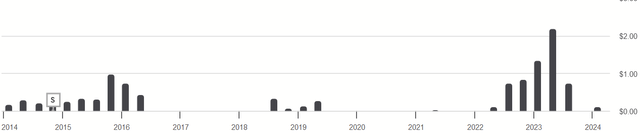
Long periods can and do go by without any distributions, while windfall years result in substantial distributions.
Q2 2024 Form 10Q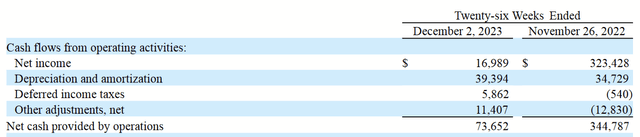
Cash from operations shows that the cash flow situation is returning to a more normal level, as production levels have recovered after the recent Avian flu outbreak.
A Look to the Future
Being well-capitalized, I believe Cal-Maine is here to stay and is unlikely to be victim of a major crisis. Nevertheless, while the riskiness of the business is not high, we also need to have a practical idea of the growth ahead.
Consumer Demand
I believe that consumer demand is unlikely to grow significantly over time but that it will grow steadily. The company itself highlighted in its 10K (pg. 4):
Given historical consumption trends, we believe that general demand for eggs in the U.S. increases basically in line with the overall U.S. population growth…
At the same time, history has shown that per capita consumption of eggs in the U.S. has been increasing, even with a few bumps along the way.
Per Capita Egg Consumption (Statista)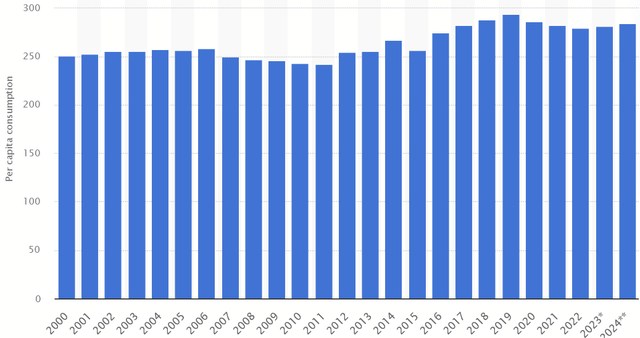
Neither population growth nor this trend are lightning-fast rates of growth, but they do suggest there will be an ongoing interest in eggs as a source of protein.
Acquisitions And Specialty Eggs
With its strong balance sheet, the company has an appetite for acquisitions, such as Fassio last October or a site from Tyson just this month. The goal here is to expand their Specialty egg capacity.
Q2 2024 Company Presentation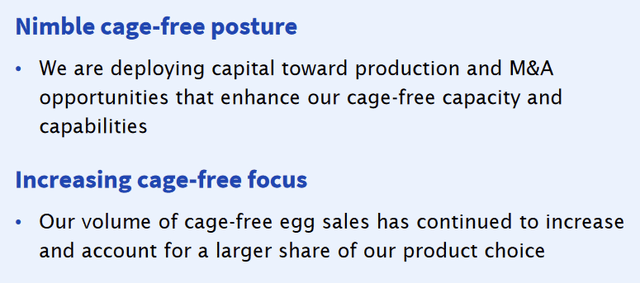
The company is aware that consumer preferences, along with regulations, are gravitating toward more ethical treatment of flocks in egg production. As such I expect the company to continue to see revenue to growth, for this growth to be attributable more so to their Specialty product, and for this to change the cyclical nature of this business over time, as Specialty eggs aren’t as exposed to those pressures.
Q2 2024 Company Presentation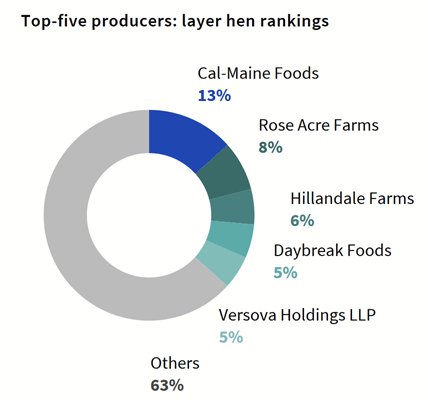
Additionally, while Cal-Maine is the largest producer, the industry is fragmented, and there is a lot of room for consolidation in this market, thus more room for growth.
Main Risks
Given the financial health of the company, the main two things that could hurt the investment are a decline in demand for eggs and increase in costs, namely corn and soybeans (their main feed for their flocks). The latter, I think, is more likely unless veganism really takes off.
Cal-Maine does not source any of their feed internationally, but many other producers do. Ukraine was a major supplier of grain, and the war over there created global price increases in grain that caused price increases for many U.S. food producers. Similarly, even if feed itself is not disrupted, a sharp rise in shipping rates could still increase those prices and thus costs for Cal-Maine.
Valuation
With the information we have, we can do a valuation with Discounted Cash Flow. We’ll use the following assumptions
- $127M as baseline FCF
- 2.65% annual growth
- Terminal multiple of 5
$127M is the average FCF over the past decade, which we will use to smooth out the cyclicality over time for the estimate. From 2014 to 2022 (before the HPAI spike), the company’s revenues had a CAGR of 2.65%, and that seems to reflect the minor potential from population growth and increases in per capita egg consumption. Since it seems unlikely to take off rapidly, I am only pricing a multiple of 5 at the end of this period.
Author’s calculation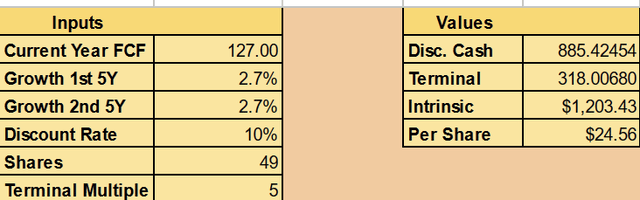
These assumptions give us an intrinsic value of about $1.2 billion for the business and about $24.56 per share. With their cash position, there is also a net cash per share of $7.38.
Conclusion
While Cal-Maine is a steady, safe business, it is also highly cyclical and does not show signs of exciting growth. Instead, it seems like it will plod along as it transitions to a model of free-roam flocks for its eggs, making acquisitions along the way and paying semi-regular dividends depending on the phase of the cycle.
Long-term investors would do well to follow this cycle well and buy when the shares have declined significantly. Given their current price near their historical highs and above my own valuation, it’s probably best to wait for a better entry. As Q3 2024 results approach, investors will want to keep their eyes peeled for an opportunity.
Credit: Source link