

Sunil Yadav/iStock Editorial via Getty Images
By Robert Carnell
Strong growth should continue
The playbook for strong growth in India in 2023 drove off a supportive Union Budget, with ambitious capital investment and infrastructure plans that, rather than crowding out private investment, have created the conditions for private investment to thrive.
The fourth quarter of 2023 showed the economy growing at an astounding 8.4% year-on-year, leaving full-year growth at 7.7%, beating even our above-consensus forecast for a 7.2% outcome and smashing the consensus call for a slowdown to 6.4%.
Looking at what drove growth in 2023, the most consistent contributor was capital expenditure. And so long as this capital expenditure is adding to the economy’s productive capacity, it is neither particularly inflationary nor likely to reverse in the coming quarters.
Contribution to YoY% GDP growth (%)
Source: CEIC, ING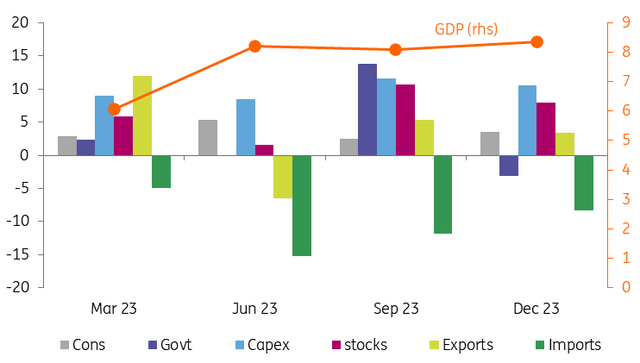
Infrastructure spending is creating a virtuous circle
The government’s funnelling of resources towards infrastructure in the 2023/24 Union Budget helped. Better transport and logistics are making a big difference to India’s growth potential and that, in turn, is having a positive spillover into private investment.
Improvement in infrastructure 2015-2022
Source: Indian Ministry of Finance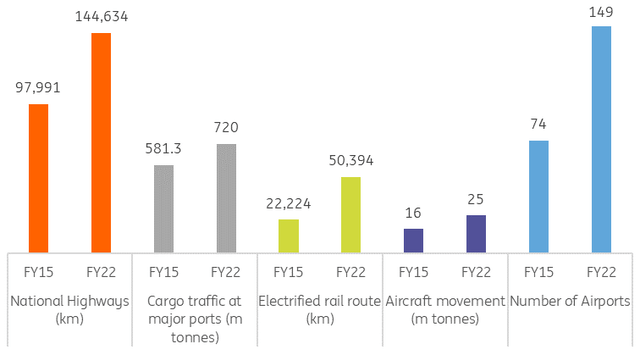
That infrastructure push continued in the 2024/25 Union Budget passed in February, with another double-digit increase in government capex, so it looks a decent bet that this virtuous circle keeps rolling in 2024/25. And while we have trimmed our forecast for growth in 2024 to 6.7% from 7.7% in 2023, this will still be a solid growth performance if achieved.
There is one small caveat that bears watching. Alongside the GDP release, the sectoral output measure of GDP (or more precisely GVA – gross value added) did indeed show a decline in 4Q23 as the consensus had expected for GDP. Even then, full-year GVA for India clocked up a 7.2% growth rate for the full year. The difference between the two series may be a reflection of the strong stock-building that we saw in the second half of the year, and it wouldn’t be too surprising to see this unwind in 2024 and bring the two series back in line.
Contributions to gross value added (GVA) YoY% (PP)
Source: CEIC, ING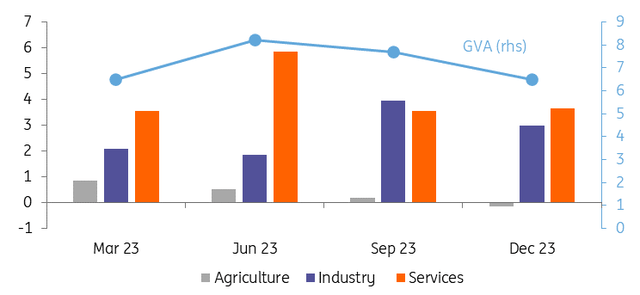
Government finances on an improving path
As well as putting support behind further capital expenditure, the latest Union Budget also continued the process of bringing the fiscal deficit lower. The 2023/24 deficit target was 6.4% (% GDP equivalent), which we believe will be beaten subject to the outcome of the last month of the fiscal year, as outturns have generally been better than needed to achieve that target. So even with an even lower target deficit of 5.9% in 2024/25, we think this should be achievable, if not beatable.
If so, we will see another year in which the debt-to-GDP ratio declines. At the mid-80% level, India’s debt-to-GDP ratio is high, and perhaps too high for an economy at its stage of development. Steady improvements in this ratio will free up resources for more productive purposes, as debt service is still the single largest item on the budget each year, roughly equivalent to the sum of defence and transport spending combined.
It is probably too early to start talking about sovereign rating upgrades for India from the current BBB- (S&P and Fitch) and Baa3 (Moody’s), all with stable outlooks, but further improvements, and this may well become a more serious discussion.
Fiscal deficit evolution 2023/24 (INR tr)
Source: CEIC, ING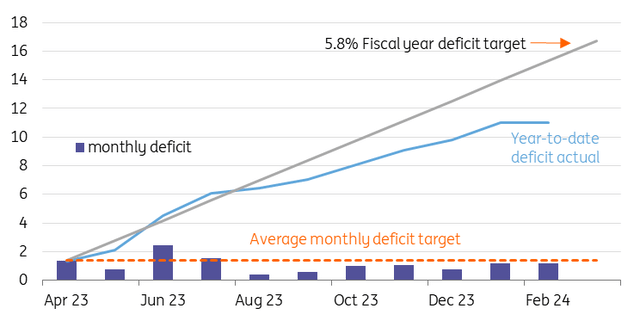
What does bond inclusion mean for the economy and financial markets
The other big story for the year ahead will be the inclusion of Indian government debt into the JPMorgan Global bond index in June.
Estimates of what this would mean in terms of capital inflows to India average around $25bn, and we might expect to see some evidence of this already in the financial account of the balance of payments.
In the following chart, we show the main components of India’s financial account, smoothed over two quarters to lessen the volatility. What we can see is that inflows of portfolio investment (PI) did indeed increase over the second half of the year, as expectations of the bond inclusion grew and were then confirmed. Net portfolio investment for the full year was just under USD24bn – pretty close to the estimates of what analysts estimates of the capital inflows would be. Net inward direct investment (DI) remained very modest.
India’s financial account (2Qma – USDm)
Source: CEIC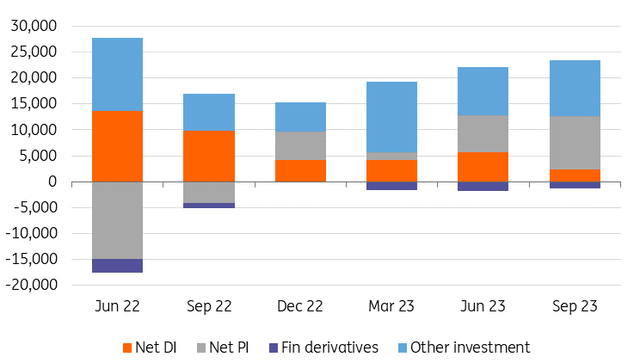
A more detailed look at these inflows, however, shows that most of the portfolio investment increase was due to equity investments, not debt securities, and that may suggest that there is still a pipeline of inward debt security investment yet to come ahead of the June data for index inclusion, which could help pressure the rupee stronger.
In previous years, India’s equity market has been buoyed by a strong pipeline of IPOs, some of which are listed overseas, and which dominate the “other investment” part of the financial account which is predominantly American and global depositary receipts.
This has led to a buoyant stock market which, in turn, may have driven further equity capital raising and more inflows. The last quarter of 2023 saw 23 IPOs in India, more than at any time in the last decade. Many of these have achieved hefty premiums compared to the list price and most were heavily oversubscribed.
The stock market continues to run hot, and in 2023, rose 18% and is slightly up for the year so far. This is a much stronger performance than Chinese stocks, which fell during 2023, though have rallied a little more recently. The market has fewer qualms about buying Indian stocks. The Sensex index has a PE ratio of 24 and a price-to-book ratio of 3.7 compared with the Hang Seng index which has a PE ratio of 8.7 and a price-to-book ratio of 0.94. Expensive stocks do not necessarily mean a sell-off is coming, at least so long as the positive macro story continues, but the high valuations suggest that we ought to be mindful of things that could change this situation.
Will the Reserve Bank continue to shield the INR?
Since October last year, the Reserve Bank of India (RBI) has maintained a very tight grip on the Indian rupee (INR), keeping it close to USD/INR 83.0. The RBI has not provided any justification for this approach, though it started at a time when the US dollar was confounding expectations for some weakening, and instead putting emerging market currencies under weakening pressure.
More recently, the RBI has seemed to allow a little asymmetric flexibility into its currency management, letting the INR appreciate very slightly when the USD showed some signs of weakness, but providing support at times when the USD rallied and put the INR under depreciation pressure.
This currency stabilisation will have a cost in terms of FX reserves, which will have to be expended to prevent INR depreciation. At the moment, there seems to be no issue with this policy continuing, as India’s FX reserves, measured in terms of months of import cover, are not only ample but increasing slightly. For the time being, we anticipate the policy continuing until at least after the June bond inclusion has passed without incident. That might also take us closer to a point where the Federal Reserve is easing, or looking closer to doing so, which may provide the INR with some natural support anyway and reduce the need for such tight FX management.
Foreign exchange reserve import cover (months)
Source: CEIC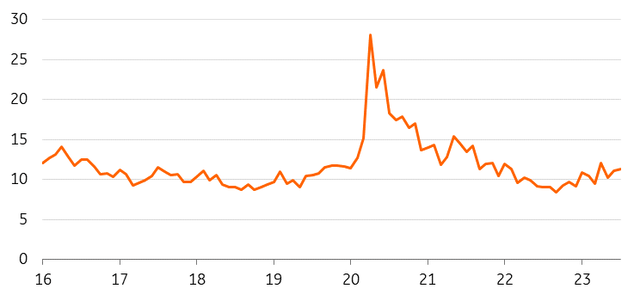
What can we expect in terms of rate policy from the RBI?
Like most of the region’s central banks, we don’t believe there is any prospect of unilateral policy easing by the RBI ahead of the US Federal Reserve’s first cut. But of all the central banks in the region, the RBI has some of the most room to move once the Fed eventually does decide to start cutting.
At 6.5%, the RBI’s policy rate is one of the highest in the region, together with the central banks of the Philippines and Indonesia. Inflation in India is a little higher than in those countries, but we expect it to stay in the 4-5% range for most of the year, subject to the usual volatility in seasonal food prices. That means that it has around a 150bp real policy rate, measured as the gap between nominal policy rates and current inflation. There is certainly room to lower this gap, and we can see 50bp of easing this year, with a further 50bp of easing in 2025 if inflation remains well-behaved.
Such easing should have a modest impact on local currency bond yields, though probably not much more than 40-50bp plus maybe a little more in 2025 before yields begin to move higher again.
Real policy rates
Source: CEIC, ING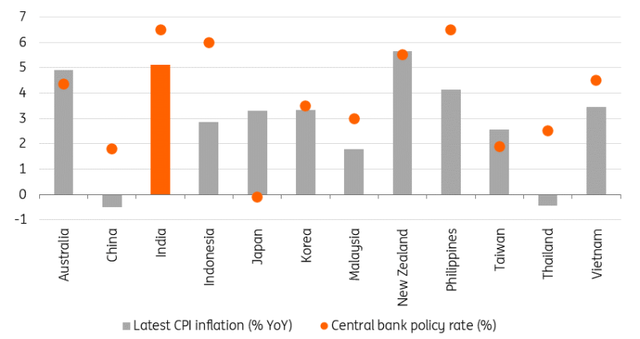
Political cycle should not cause much disruption
In conclusion, it would be remiss of us not to note that this is an election year and therefore subject to more potential distortions than a normal year and that could result in a greater than usual prospect for forecasting error.
However, most political pundits suggest a continuation of the Modi BJP government, and if that is correct, then we will likely see greater continuity in terms of policies than we would with a government change.
Our forecasts for growth remain very positive, and we are not particularly worried about the inflation backdrop and are still constructive on financial markets and the currency. Given the global backdrop is rather lacklustre right now, India is likely to remain one of the few bright spots.
Forecast summary table
Source: ING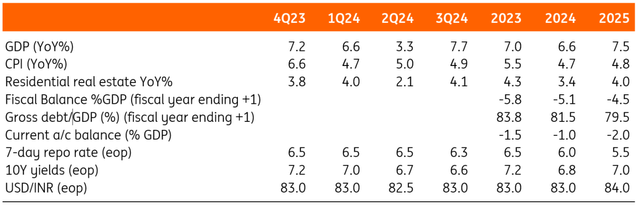
Content Disclaimer
This publication has been prepared by ING solely for information purposes irrespective of a particular user’s means, financial situation or investment objectives. The information does not constitute investment recommendation, and nor is it investment, legal or tax advice or an offer or solicitation to purchase or sell any financial instrument. Read more
Original Post
Credit: Source link