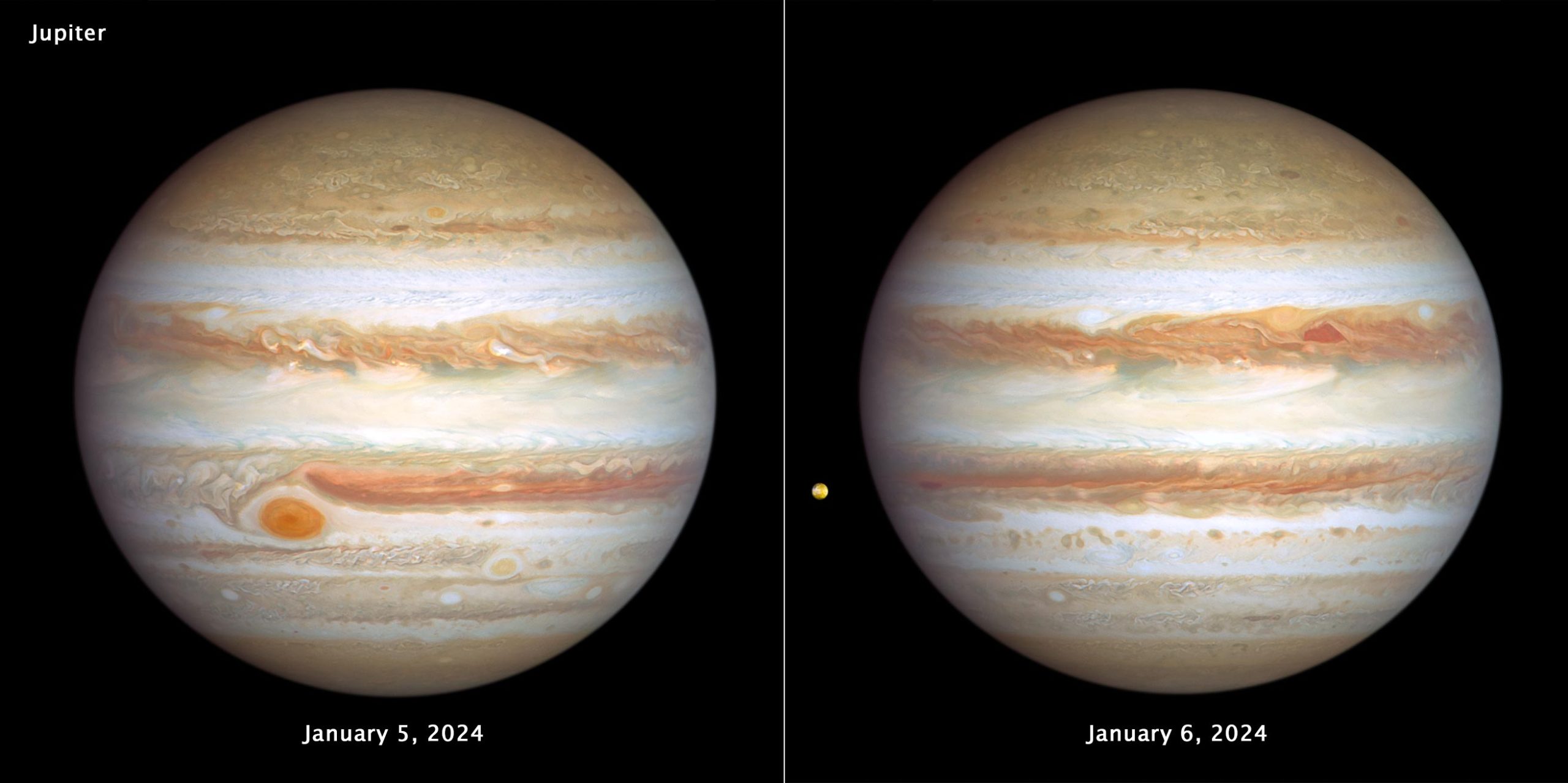

NASA’s Hubble Space Telescope captured new images of Jupiter on January 5-6, 2024, revealing dynamic weather patterns and notable storms like the Great Red Spot and Red Spot Jr. The observations are part of the annual Outer Planet Atmospheres Legacy program, which also highlighted Io’s volcanic activity and surface features. Credit: NASA, ESA, STScI, Amy Simon (NASA-GSFC)
Cyclones, Wind Shear, Violent Storms Churn in Jupiter’s Atmosphere
The largest and nearest of the giant outer planets, Jupiter’s colorful clouds present an ever-changing kaleidoscope of shapes and colors. This is a planet where there is always stormy weather: cyclones, anticyclones, wind shear, and the largest storm in the solar system, the Great Red Spot.
Jupiter has no solid surface and is perpetually covered with largely ammonia ice-crystal clouds that are only about 30 miles thick in an atmosphere that’s tens of thousands of miles deep and give the planet its banded appearance.
The bands are produced by air flowing in different directions at various latitudes with speeds approaching 350 miles per hour. Lighter-hued areas where the atmosphere rises are called zones. Darker regions where air falls are called belts. When these opposing flows interact, storms and turbulence appear.
Hubble tracks these dynamic changes every year with unprecedented clarity, and there are always new surprises. The many large storms and small white clouds seen in Hubble’s latest images are evidence for a lot of activity going on in Jupiter’s atmosphere right now.
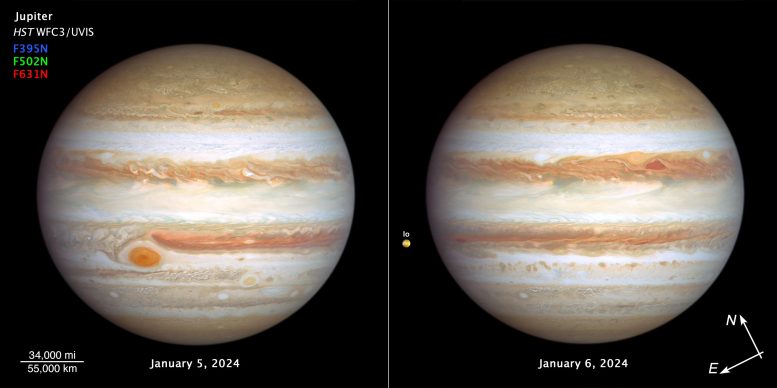
Jupiter is banded in stripes of brownish orange, light gray, soft yellow, and shades of cream. Many large storms and small white clouds punctuate the planet. The largest storm, the Great Red Spot, is the most prominent feature in the left bottom third of this view. To its lower right is a smaller reddish anticyclone, Red Spot Jr. Another small red anticyclone appears near the top center of the image. At upper right of center on the right image, a pair of storms appear next to each other: a deep-red, triangle-shaped cyclone and a reddish anticyclone. Toward the far-left edge of the image is Jupiter’s tiny moon Io. The variegated orange color is where volcanic outflow deposits are seen on Io’s surface. Credit: NASA, ESA, Amy Simon (NASA-GSFC)
Hubble Space Telescope Tracks Jupiter’s Stormy Weather
The giant planet Jupiter, in all its banded glory, is revisited by NASA’s Hubble Space Telescope in these latest images, taken on January 5-6, 2024, capturing both sides of the planet. Hubble monitors Jupiter and the other outer solar system planets every year under the Outer Planet Atmospheres Legacy program (OPAL). This is because these large worlds are shrouded in clouds and hazes stirred up by violent winds, causing a kaleidoscope of ever-changing weather patterns.
[left image] – Big enough to swallow Earth, the classic Great Red Spot stands out prominently in Jupiter’s atmosphere. To its lower right, at a more southerly latitude, is a feature sometimes dubbed Red Spot Jr. This anticyclone was the result of storms merging in 1998 and 2000, and it first appeared red in 2006 before returning to a pale beige in subsequent years. This year it is somewhat redder again. The source of the red coloration is unknown but may involve a range of chemical compounds: sulfur, phosphorus or organic material. Staying in their lanes, but moving in opposite directions, Red Spot Jr. passes the Great Red Spot about every two years. Another small red anticyclone appears in the far north.
[right image] – Storm activity also appears in the opposite hemisphere. A pair of storms, a deep red cyclone and a reddish anticyclone, appear next to each other at right of center. They look so red that at first glance, it looks like Jupiter skinned a knee. These storms are rotating in opposite directions, indicating an alternating pattern of high- and low-pressure systems. For the cyclone, there’s an upwelling on the edges with clouds descending in the middle, causing a clearing in the atmospheric haze.
Credit: NASA’s Goddard Space Flight Center, Lead Producer: Paul Morris
The storms are expected to bounce past each other because their opposing clockwise and counterclockwise rotation makes them repel each other. “The many large storms and small white clouds are a hallmark of a lot of activity going on in Jupiter’s atmosphere right now,” said OPAL project lead Amy Simon of NASA’s Goddard Space Flight Center in Greenbelt, Maryland.
Toward the left edge of the image is the innermost Galilean moon, Io – the most volcanically active body in the solar system, despite its small size (only slightly larger than Earth’s moon). Hubble resolves volcanic outflow deposits on the surface. Hubble’s sensitivity to blue and violet wavelengths clearly reveals interesting surface features. In 1979 NASA’s Voyager 1 spacecraft discovered Io’s pizza-like appearance and volcanism, to the surprise of planetary scientists because it is such a small moon. Hubble picked up where Voyager left off by keeping an eye on restless Io year by year.
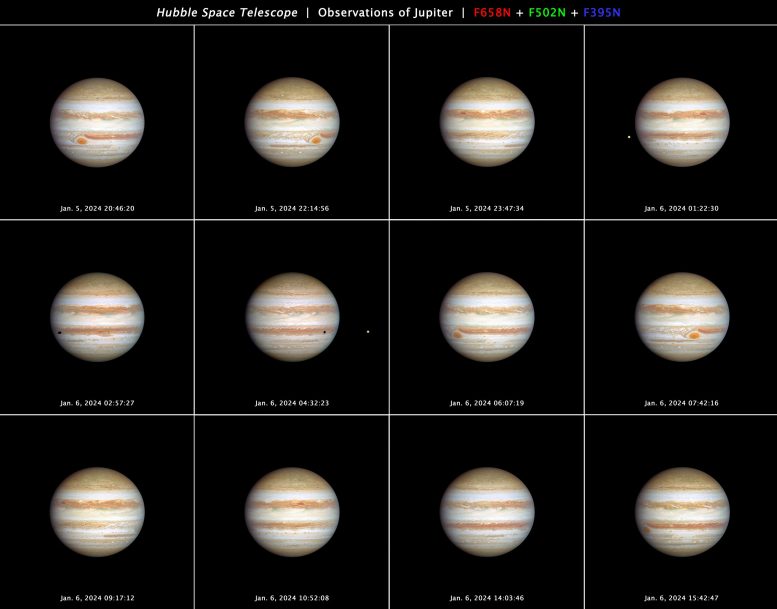
This 12-panel series of Hubble Space Telescope images, taken January 5-6, 2024, presents snapshots of a full rotation of the giant planet Jupiter. The Great Red Spot can be used to measure the planet’s real rotation rate of nearly 10 hours. The innermost Galilean satellite, Io is seen in several frames, along with its shadow crossing over Jupiter’s cloud tops. Hubble monitors Jupiter and the other outer solar system planets every year under the Outer Planet Atmospheres Legacy program (OPAL). Credit: Amy Simon (NASA-GSFC)
The Hubble Space Telescope has been operating for over three decades and continues to make ground-breaking discoveries that shape our fundamental understanding of the universe. Hubble is a project of international cooperation between NASA and ESA (European Space Agency). NASA’s Goddard Space Flight Center in Greenbelt, Maryland, manages the telescope. Goddard also conducts mission operations with Lockheed Martin Space in Denver, Colorado. The Space Telescope Science Institute (STScI) in Baltimore, Maryland, conducts Hubble and Webb science operations for NASA. STScI is operated for NASA by the Association of Universities for Research in Astronomy, in Washington, D.C.
Credit: Source link