

A smiling man holding $100 U.S. banknotes. Deagreez/iStock via Getty Images
For my money, there’s nothing quite like cold, hard, consistent, and growing passive income. As a dividend growth investor, it’s the name of the game for me and my primary investment objective.
My thought process is that when a company’s dividend steadily grows over time, it becomes more valuable as well. This is what can help to drive market-beating total returns over the long run.
Main Street Capital Q4 2023 Investor Presentation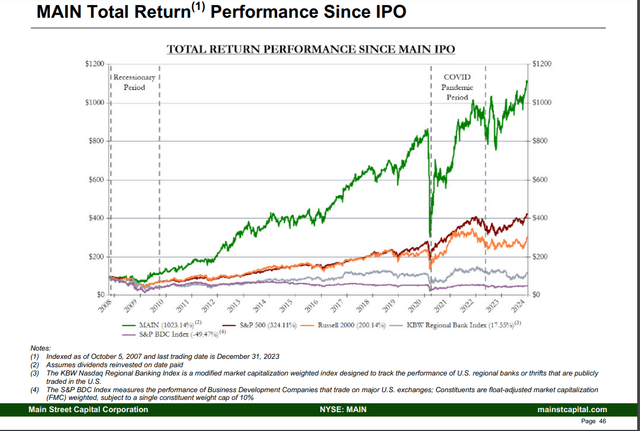
One of my favorite companies within my portfolio that perfectly illustrates this point is Main Street Capital (NYSE:MAIN). Since its IPO in October 2007, the BDC has proven itself to be a wonderful compounder. A $10,000 investment in the company made at the IPO in October 2007 would have grown to more than $110,000 with dividends reinvested through December 2023. For context, that’s almost 3x the $42,000 that the same investment in the S&P 500 index (SP500) would have grown to during that time. It’s also well ahead of the halving of the $10,000 investment amount that the S&P BDC Index would have been worth through December 2023 with dividends reinvested.
This illustrious track record of enriching shareholders is why I initiated coverage with a buy rating in September 2023 and reiterated that buy rating in December 2023. Since I last covered MAIN, the company shared consensus-surpassing financial results late last month for the fourth quarter that ended Dec. 31.
Today, I will be revisiting the BDC’s fundamentals and valuation to explain why I’m once again maintaining my buy rating.
Dividend Kings Zen Research Terminal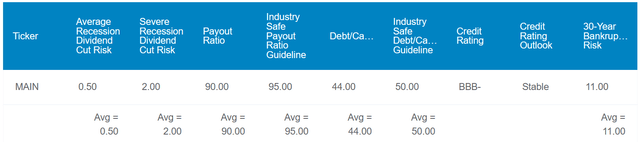
MAIN’s 6.2% dividend yield (not including special dividends) is approximately 200 basis points higher than the 4.2% yield of 10-year U.S. Treasury notes. This is a narrower investment spread than the 280 basis point spread when I last covered the stock, but it’s arguably still enticing. This is well above the financial sector median yield of 3.5%, which is why Seeking Alpha’s Quant System awards an A- grade on dividend yield to MAIN.
MAIN’s dividend also appears to be relatively safe for a BDC. The company’s 90% payout ratio is better than the 95% payout ratio that rating agencies believe is safe for BDCs. Note that this payout ratio also includes the company’s generous special dividends.
MAIN’s financial health is also respectable. The company’s 44% debt-to-capital ratio is below the 50% that rating agencies like to see from BDCs. That is why the BDC possesses an investment-grade, BBB- credit rating on a stable outlook from S&P. That suggests the likelihood of MAIN going out of business in the next 30 years is 11%.
Thanks to its sustainable payout ratios and sound corporate finances, the probability of MAIN cutting its dividend in the next average recession is estimated at 0.5%. In the next severe recession, the chance remains at just 2%. For perspective, these values are the lowest possible in the Zen Research Terminal.
Dividend Kings Zen Research Terminal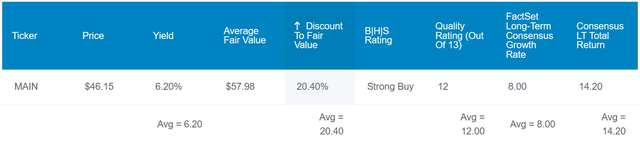
Even after rallying 7% since my most recent article as the S&P rallied 9%, shares of MAIN look at least somewhat undervalued. The current-year price-to-investment-income valuation multiple of 11.2 is well below the 10-year normal valuation multiple of 14.5, which suggests a $58 fair value per share. Since MAIN’s fundamentals seem to be intact based on its recent operating results, I believe a reversion to a multiple closer to this 10-year normal could be largely justified.
My analysis of MAIN using the dividend discount model also shows shares to be discounted: For the sake of conservatism, I will be using a $2.88 annualized dividend per share (the current monthly regular dividend amount of $0.24 annualized). I’ll also assume a 10% discount rate and a 4% annual dividend growth rate. That gives me a fair value estimate of $48 a share.
Lastly, the current price-to-book ratio of nearly 1.6 is substantially elevated versus the financial sector median of just above 1 per Seeking Alpha. The company’s quality has always commanded a hefty premium, however. Relative to its five-year average, shares of MAIN are about 1% undervalued and could be worth $47 a share based on this average.
Averaging out these fair values, the BDC could be fairly valued at around $51 a share. Compared to the current $46 share price (as of March 13, 2024), that would represent a 10% discount to fair value.
If MAIN returned to fair value and grew as anticipated, here are the total returns that could be in store for the next 10 years:
- 6.2% yield + 8% FactSet Research annual growth consensus + 1% annual valuation multiple expansion = 15.2% annual total return potential or a 312% 10-year cumulative total return versus the 10% annual total return potential of the S&P or a 159% 10-year cumulative total return
Another Quarter Of Strong Results
Main Street Capital Q4 2023 Earnings Press Release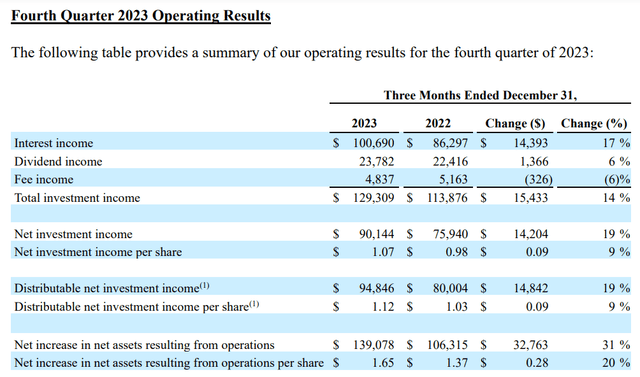
MAIN put on a clinic in the fourth quarter ended Dec. 31. The company’s total investment income surged 13.6% higher over the year-ago period to $129.3 million during the quarter. This came in $1.8 million ahead of the analyst consensus per Seeking Alpha.
MAIN’s business model benefited from meaningful tailwinds for the fourth quarter. A supermajority (66%) of the company’s debt investments bore interest at floating rates. In the ongoing environment of two years of rising/high and stable interest rates, that is what powered interest income higher by 16.7% year-over-year to $100.7 million in the quarter.
Ahead of the eventual interest rate cutting cycle, it’s worth noting that MAIN’s exposure to floating rate investments is down a bit from 70% when I last covered the company. This suggests that the BDC is taking action to shield itself from the upcoming headwind of lower rates.
As a BDC, MAIN regularly issues shares to fund additional investments within its $5.5 billion internally managed portfolio. A major advantage that the company has is that it issues these shares well above book value. Thus, the company’s share count rose by 8.5% over the year-ago period to 84.4 million during the fourth quarter.
That also helps explain why distributable net investment income per share climbed by 8.7% to $1.12 for the fourth quarter. This was $0.05 better than the analyst consensus according to Seeking Alpha data.
MAIN’s net investment income per share is likely going to be down slightly for at least the next couple of years. Per the FAST Graphs analyst consensus, NII per share is going to drop from $4.14 in 2023 to $4.05 in 2024 and to $3.91 in 2025.
CME Fed Watch Tool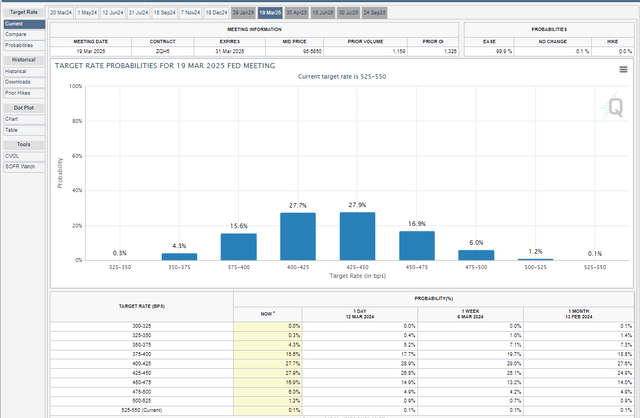
Keep in mind that MAIN anticipates that for every 100 basis point drop in the Fed Funds rate, an $0.18 decrease in NII per share would be the result. Between now and next March, 30-day Fed Funds futures data suggests that there is an 88.1% probability that interest rates will be 75 to 150 basis points lower than the current target rate of 5.25% to 5.50%. That would be a $0.135 to $0.27 per share headwind.
As MAIN adjusts to rate decreases and works to recover its investment spreads as rates stabilize, this will weigh on the company’s results. Fortunately, MAIN’s incremental investments in opportunities that it sees as attractive will help to partially counter these headwinds in the quarters to come. This is supported by the fact that the company completed $160.4 million in total private loan portfolio investments in the fourth quarter. These investments were at 400 to 425 basis point interest spreads, which should be accretive to net investment income (unless otherwise noted or hyperlinked, all details were sourced from MAIN’s Q4 2023 Earnings Press Release and MAIN’s Q4 2023 Investor Presentation).
Financially, MAIN is also on solid ground. According to CFO and COO Jesse Morris’ opening remarks during the Q4 2023 Earnings Call, the company’s regulatory debt-to-equity leverage ratio was 0.59. Morris went on to point out that is less than its long-term target range of 0.8x to 0.9x. This further backs up the argument that MAIN is a well-capitalized business.
There Could Be More Dividend Growth To Come
In the last five years, MAIN’s regular monthly dividend per share has cumulatively compounded by 23.1% to the current rate of $0.24. That works out to a nearly 4.3% compound annual growth rate.
Assuming the monthly dividend per share stays at $0.24, MAIN’s regular dividends per share paid in 2024 would be $2.88. Against the analyst consensus of $4.05 in net investment income per share for 2024, that’s a 71.1% payout ratio. This demonstrates just how much flexibility the company has to marginally up its regular monthly dividend per share and/or keep doling out generous special dividends.
Risks To Consider
MAIN is a quality BDC, but risks to the investment thesis exist just as they do for all businesses.
Thanks to the company’s hedging noted earlier, the impact of rate cuts is slightly diminished ($0.18 hit for every 100 basis points versus $0.19 prior). The risk of substantial rate cuts does remain worth monitoring, however.
Another risk to MAIN is the potential for its information systems to fail. If this happened, the company’s operations (including accounting and data processing) could be in limbo. That could harm MAIN’s operating fundamentals and the investment thesis. If such a failure was the result of a cyber-attack, this could subject the BDC to litigation and impair its reputation.
Summary: I May Buy More Of This Core Holding Soon
FAST Graphs, FactSet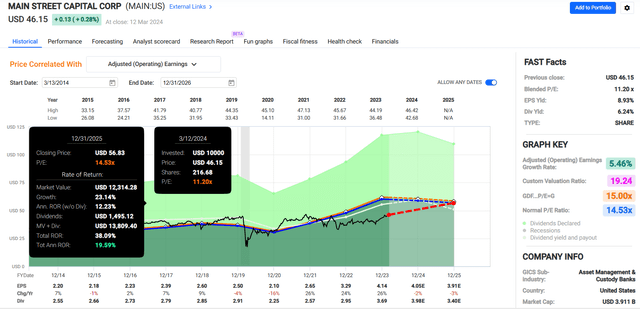
MAIN is a well-run BDC with management that is aligned with shareholders (management owned $152 million of common stock as of Dec. 31). If that wasn’t enough, the balance sheet is positioned well for the future and investment grade.
Clinching the buy case, shares are cheaper than the norm over the last 10 years. Skeptics may point out that earnings power is artificially inflated by high rates. Even adjusting for 200 basis points of interest rate declines or a $0.36 net investment income per share impact over 2023, the company’s valuation multiple would remain interesting at a valuation multiple of 12.2. MAIN is already my portfolio’s 27th largest holding and 1.2% of my portfolio. Yet, I’m considering adding a bit more to my portfolio in the coming days/weeks.
Credit: Source link