
Sergio Delle Vedove
Danske Bank A/S (OTCPK:DNSKF) is offering a high-dividend yield that is sustainable over the long term and is trading at a discount to its closest peers, making it one of the most attractive plays in the European banking sector.
As I’ve covered in previous articles, Danske is one of the European banks with stronger fundamentals, but this doesn’t seem to be reflected in its valuation due to legacy issues related to weak anti-money laundering controls in its Estonian unit, which are fixed and have been settled with several authorities.
Despite that, Danske’s valuation has slowly recovered over the past year to levels closer to its peers and its own historical ‘normal’ level, leading to an overperformance compared to the market since my July 2023 article on Danske.
Article performance (Seeking Alpha)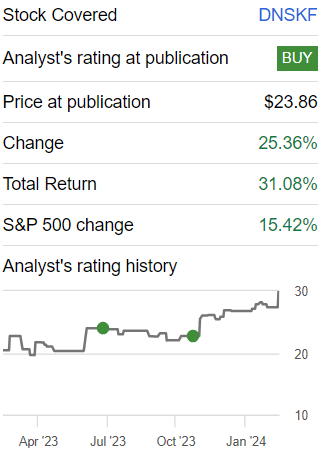
As I’ve not covered Danske for some time, in this article I analyze its most recent earnings and update its investment case, to see if it remains a compelling play within the European banking sector.
Earnings Analysis
Danske has reported a very positive operating performance over the past few quarters, supported by higher interest rates across Nordic markets. As the bank is highly geared to retail and commercial banking, its business is quite exposed to higher rates, even though the bank’s strategy during the low interest rate environment was to grow its fee-related business.
Nevertheless, in 2023, Danske’s net interest income (NII) amounted to $5.1 billion, an increase of 39% YoY. This was a very strong performance and shows that Danske is well geared to rates, even though its NII weight on total revenues was about 67% over the last year, a lower level than other European banks that have an NII contribution between 75-80% and are therefore more geared to rates.
Also, the positive for the bank’s revenue growth was better capital markets in recent quarters, which led to a strong rebound in trading income and insurance profits.
Revenue (Danske)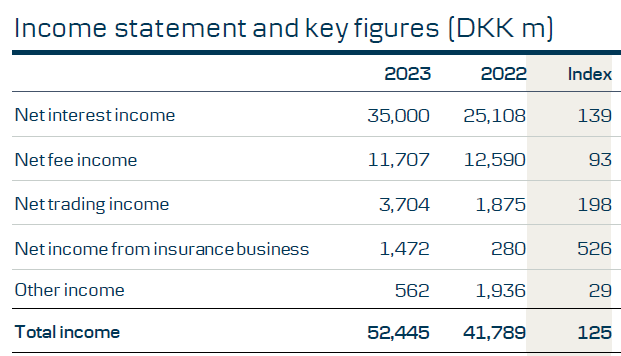
On the other hand, while fees and commissions were an important revenue growth driver some years ago, this has changed recently, and its fees declined by 8% YoY over the last year, to $1.7 billion. This is explained by lower housing market activity and subdued demand from corporates for new loans, leading to lower fees from new loan originations. Overall, Danske’s revenue increased by 25% YoY to $7.7 billion, mainly supported by higher NII.
Despite these positive developments, the bank’s guidance for 2024 is much more conservative, only expecting some revenue growth. Considering that rates probably have already reached their peak and rate cuts may happen in the coming months, NII could become a headwind for revenue growth in the coming quarters.
Indeed, in its most important market (Denmark), current economic forecasts suggest interest rates should start coming down this quarter and maintain a downward trajectory over the next year, which will have a negative impact on the bank’s NII momentum.
Economic Forecasts (Bloomberg)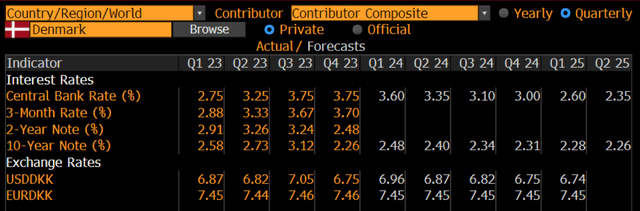
While the bank may be able to offset to some extent this headwind from positive loan growth, it’s quite likely that overall NII will decline in the next few quarters and Q4 2023 was likely the peak.
Regarding costs, the bank reported total expenses of $3.7 billion in 2023, a decline of 4% YoY, mainly driven by a lower number of employees. This is a very positive outcome considering the inflationary environment in recent quarters, justified by operating efficiencies that were more than enough to offset inflationary pressures. Its cost-to-income ratio, a key measure of efficiency in the banking sector, was 48% last year, already below its medium-term target of mid-50%. This means that Danske’s efficiency is at a very good level and the bank is not under pressure to cut costs in the near term, allowing it to continue to invest in digitalization and automation to improve efficiency over the long term.
Regarding credit quality, this maintained at very good levels, considering that its loan impairment charges were only $38 million in 2023, and the bank reported provision reversals in Q4. This shows that credit quality remains at healthy levels despite higher rates and inflation, which could theoretically put pressure on household incomes and corporate finances and lead to higher loan defaults.
Loan provisions (Danske)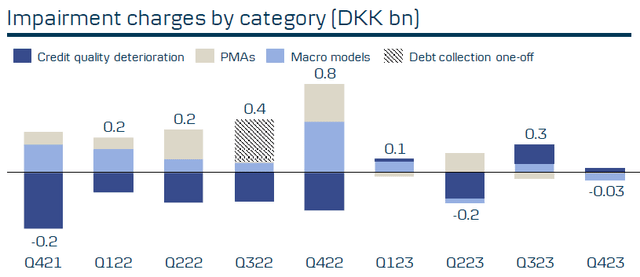
So far, this has not happened, and Danske expects its loan loss provisions to remain quite low over the next few years, at about 8 basis points of overall loans. Thus, it’s not expected that credit losses will have a significant impact on its bottom line.
Its net profit for the year increased to $3.9 billion, more than double its net profit in 2022 when adjusted for the one-off cost related to the ALM issue in Estonia. Its return on equity (ROE) ratio, a key measure of profitability in the banking sector, was 13% and way above its own target of 8.5-9%.
While Danske had a very good year, its guidance is quite conservative reflecting that rates are expected to come down and there aren’t many ways to grow profits organically, given that loan growth across Nordic markets is relatively low, the bank is already quite efficient, and loan losses are near zero. Therefore, it’s not surprising that Danske’s net profit guidance for 2024 is to be between $2.9-$3.2 billion, representing a decline of about 20% YoY at the middle of its range.
Regarding its capitalization, Danske has a very strong position given that its CET1 ratio was 18.8% at the end of 2023, one of the strongest levels in Europe. This level is comfortably above its capital requirements of 14.2%, leaving plenty of room to distribute excess capital to shareholders.
Due to the ALM issue, the bank’s dividend policy was somewhat on hold for some years, but related to 2023 earnings it returned again to focus on capital returns. Its current policy is to distribute 40-60% of annual earnings through dividends and is also pursuing share buybacks.
Related to 2023 earnings, Danske distributed an interim dividend last July and has announced a final payment of DKK 7.50 per share ($1.10) to be paid on March 26. This means its total dividend related to 2023 earnings is DKK 14.5 per share ($2.13), which at its current share price, leads to a dividend yield of about 7.1%
This is an attractive dividend yield and, according to analysts’ estimates, its dividend is likely to grow gradually over the next few years, making Danske quite interesting for income investors. Moreover, while a high-dividend yield can be a warning sign of questionable dividend sustainability, this is not Danske’s case because its dividend payout ratio was 59%, which is a very reasonable level, and the bank has a superior capital position and profitability, allowing it to return capital to shareholders in a sustainable way over the next few years.
Conclusion
Danske is one of the European banks with stronger fundamentals, but the ALM issue led to somewhat negative investor sentiment towards it, leading to a lower valuation than its peers. Indeed, the bank is currently trading at 1x book value, while the average of its Nordic peers is around 1.23x. I think this discount is no longer justified and therefore Danske seems to be one of the most interesting plays in the European banking sector right now, due to its combination of a high-dividend yield and cheap valuation.
Editor’s Note: This article discusses one or more securities that do not trade on a major U.S. exchange. Please be aware of the risks associated with these stocks.
Credit: Source link