

ArLawKa AungTun/iStock via Getty Images
Recent History (Real Estate In the Post ZIRP era)
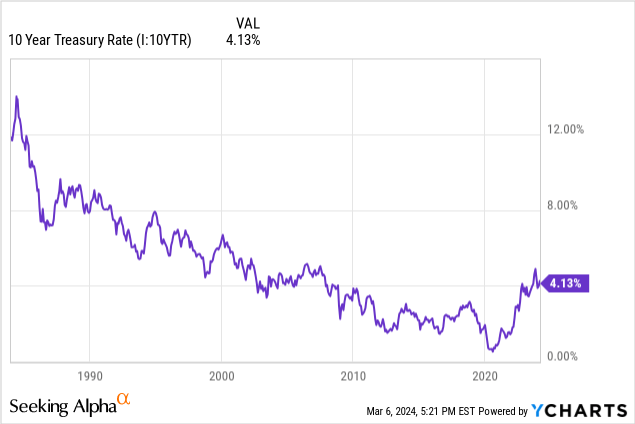
REITs have been beaten down by rising interest rates over the past two years. As the ten year reaches a normalized yield, share prices across the industry have been crushed as yields are forced to adjust to an elevating ten year treasury. Real estate (VNQ) has benefitted from extraordinary long term tailwinds, including a long term decline in the ten year treasury yield. Below is the yield of a ten-year treasury since January 1, 1984. The past four decades have exhibited a clear trend which has since reversed. Simply put, almost nobody currently working in the industry has likely encountered this situation before.
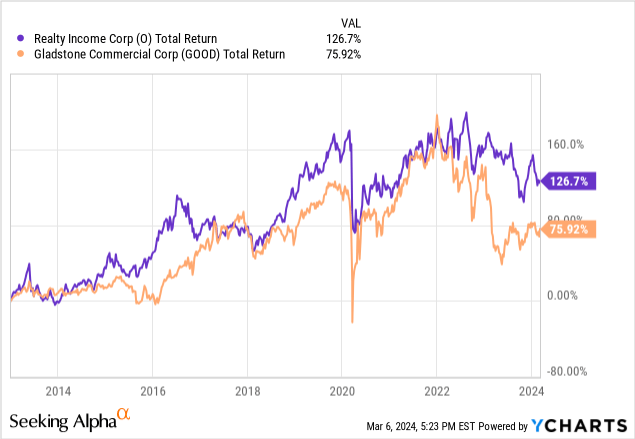
The falling yield floated property values as capitalization rates are generally attached to the ten year’s yield. As a result, REITs performed well over that period regardless of the quality of management at the operational level. Top historical performers were in line with those of questionable quality… until recently. Take two net lease REITs, Realty Income (O) and Gladstone Commercial (GOOD) for example. Two vastly different businesses followed a similar long term trajectory for the better part of the past decade.
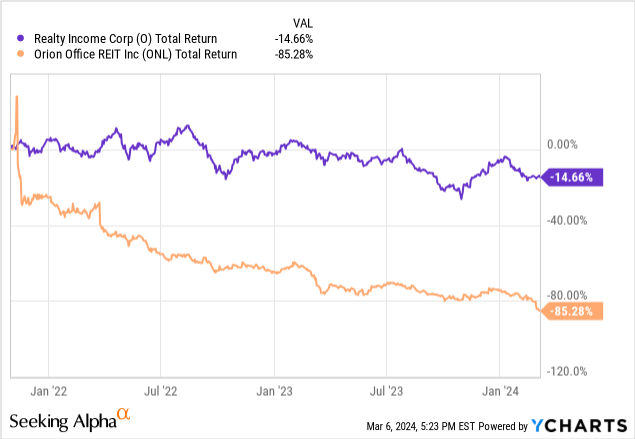
Note a clear divergence in performance between O and GOOD beginning in 2022. High quality REITs are proactive in managing their portfolios when challenges emerge. For example, Realty Income spun off their challenged office assets into a public REIT called Orion Office REIT (ONL). ONL has since collapsed, a clear indicator of why O likely decided to dispose of those assets in the first place. Why would the most acquisitive REIT on the planet choose to dispose of assets?
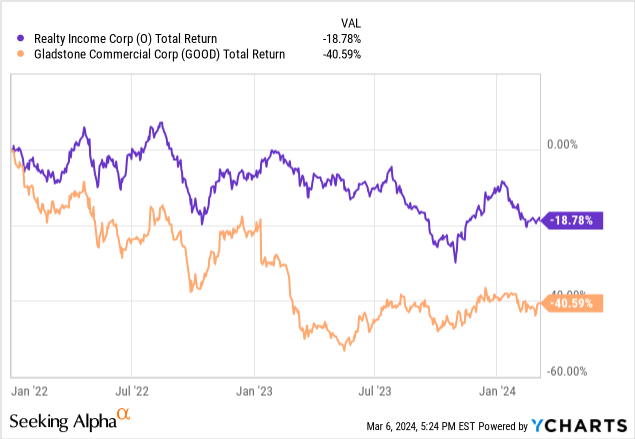
In contrast, Gladstone Commercial retained their office assets and held a significant portion of their leverage in floating rate debt. GOOD failed to proactively manage their portfolio. As a result, continuing down the path of the prior decade proved a poor strategy. GOOD cut its dividend in 2022 and has since performed poorly.
The end of the “goldilocks era” saw tailwinds die down and a more challenging era of investing emerge. Increasing borrowing costs stopped new investment, meaning REITs could no longer use new acquisitions to drown out other operational issues. Inflation challenged development assumptions and projections around labor and material costs. Investors reallocated capital as bond yields surged and offered an opportunity for a higher return with less risk, causing private REITs to lock up. For example, after several years of illiquidity, Blackstone Real Estate Income Trust only recently returned to full redemptions.
Greed Is Good
Investors are notoriously short sighted. The REIT market is priced based on near term shifts in sentiment and monetary policy. Currently, real estate is trying to guess how quickly the Federal Reserve is moving to cut rates. Seen below is the dot plot from the Federal Reserve, projecting movements to the federal funds rate from a variety of sources. The consensus points towards rate cuts over the next several years, landing at 2.5% thereafter.
FOMC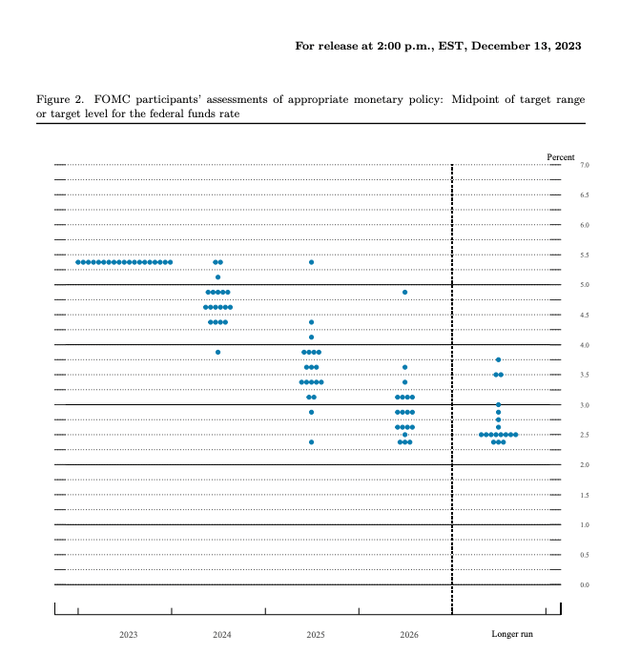
The market continues digesting this information and trying to price REITs appropriately. Initially, commentary pointed to rate cuts in Q1, however that chance has come and gone. Investors are becoming impatient and the REIT rally has faded. The likelihood of a near term rate cut appears to be waning. What factors might lead to the Federal Reserve keeping the federal funds rate above 5%?
Why Would The Fed Not Cut Rates?
Inflation remains the most important metric in determining the Federal Reserve’s monetary policy. Given the highly visible and political nature of inflation, it remains a key marker of success for government and the public at large. Inflation is an easy metric to understand and helps quantify if monetary policy is working. The approach is incredibly simplistic.
In January, the Core Personal Consumption Expenditures Price Index increased at the fastest monthly rate in nearly a year. While inflation is still cooling on an annualized basis, any short term uptick will land on the radar of the Federal Reserve. Cutting rates too soon remains a primary concern for policymakers at the federal reserve:
“The sentiments expressed in Wednesday’s minutes help explain the Fed’s decision last month to signal that its policymakers would need more confidence that inflation was in check before cutting their key rate. At the January meeting, the Fed decided to keep its key rate unchanged at about 5.4%, the highest level in 22 years, after 11 rate hikes beginning in March 2022.
At a news conference after the meeting, Chair Jerome Powell disappointed Wall Street by indicating that the Fed was not inclined to cut rates at its next meeting in March, as some investors and economists had hoped. Rate cuts by the Fed typically lower a wide range of borrowing costs, including for homes, cars and credit card purchases, as well as for business loans.”
The primary reason that the Federal Reserve may not cut interest rates would be reignited inflation. Recent commentary from BlackRock’s global chief investment strategist, Wei Li, indicated that the firm believes inflation could move higher before year end. Declining prices helped inflation cool to 3.1% in January, moving closer to the long term target rate of 2%. However, wages and hourly earning increased 4.5% in January, the largest bump since March 2022. Wage inflation is one of the most important markets for the Federal Reserve.
Should inflation remain elevated, it’s unlikely that the Federal Reserve will begin cutting borrowing costs.
What If Interest Rates Are Not Cut?
Most investors would agree that REITs generally underperform when interest rates increase. It’s simple gravity given the opportunity to move into safer assets with a comparable yield. However, historical record suggests that this assertion could be incorrect when looking through a moderate to long term lens. While interest rates undeniably impact real estate prices and the performance of landlords such as REITs, rising interest rates do not necessarily lead directly to poor returns for shareholders.
It’s undeniable that rising interest rates pose challenges for REITs. All other factors held equal, higher interest rates decrease the value of assets and increase borrowing costs. Even still, there are other factors which can balance these impacts over the long term. For example, inflation generally leads to increasing rents across asset classes. Rents generally stay around their watermark, so periods of inflation can permanently move rents higher. This means strong leasing spreads for landlords. Additionally, strong economic growth tends to translate into greater demand for real estate, higher transaction volumes, and higher occupancy rates, supporting REIT fundamentals.
Some headwinds cannot be ignored. The increasing borrowing costs pose a significant financial risk to REITs across the board. However, the impact of rising rates will not land uniformly across the sector. Let’s explore why.
Who Is Most Exposed?
It’s a bold assertion that REIT performance is not impacted by interest rate movements over a long time horizon. Rates cause short term disruption in the real estate market, which translates very clearly to disruption for REITs. However, quality REITs remain strong at a fundamental level.
As we constantly reiterate, not all REITs are created equal. Every business is unique and each will digest interest rate movements differently. So, which REITs are most exposed to rising interest rates? It’s a complex question with plenty of variables. Today, we are going to dive into one such variable.
REITs typically finance their acquisitions, developments, and redevelopments with a combination of debt and equity. The debt issued by high quality REITs is generally long term, fixed rate, unsecured debt. Over the past 15 years, the federal funds rate has been minimized, marking a unique historical period for real estate.
Capitalization rates and development funding rates have declined over the long term, fueling progressively more aggressive underwriting. At the time, the math penciled as new investments still earned the appropriate spread over the landlord’s WACC. However, as interest rates have now increased, these REITs are required to refinance the long term, fixed rate bonds that financed those acquisitions over the past 15 years. Some of those acquisition capitalization rates are below the current ten year treasury yield. See below for a Q4 2021 capitalization rate survey from brokerage, B+E.
B+E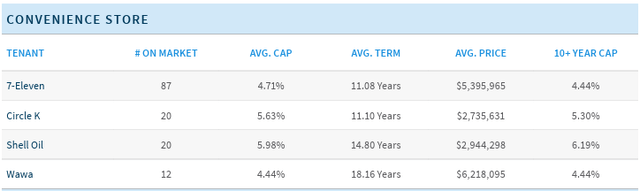
Less than three years ago, the acquisition capitalization rate for a long term 7-Eleven or Wawa asset was below 4.50%. The ten year treasury is currently yielding above 4.00%. Refinancing unsecured debt at higher interest rates becomes more significant against properties acquired at such a low capitalization rate.
Some of the most highly impacted REITs are those with significant near term debt maturities. Refinancing maturing debt in a higher interest rate environment is costly and difficult. Many REITs are turning to interest rate swaps or international markets to stave off the impacts of rising rates. Even still, refinancing today is less desirable than most of the past five years. Let’s explore two REITs that will be refinancing a significant portion of their debt in the near term.
Case Study #1: W.P. Carey (WPC)
W. P. Carey is one of the largest net lease REITs with a portfolio of high quality, single tenant net lease commercial real estate. The portfolio includes 1,424 net lease properties covering 172.7 million square feet as of year end. WPC focuses on single tenant retail and industrial assets. Notably, WPC has a larger percentage of leases linked to CPI than most net lease REITs at 56%.
WPC’s favor among the Seeking Alpha community has turned over the past twelve months. Previously touted as one of the best REITs, WPC unexpectedly announced a series of portfolio changes which many retail investors disliked. Such developments included the spinoff/disposition of all office assets. The least desirable assets landed in a public REIT called Net Lease Office Properties (NLOP). Additionally, U-Haul (UHAL), the firm’s largest tenant representing 2.9% of ABR, announced the repurchase of their assets. WPC was also forced to provide a restructuring package for a master lease with Hellweg, their fifth largest tenant, including a rent abatement and rent reduction. Other updates include the disposition of hotel properties. As a shareholder of WPC, none of these are particularly positive from the outside looking in.
On a positive note, the changes help WPC align with pure play STNL competitors such as Realty Income (O) or Agree Realty (ADC). On a negative note, WPC cut the dividend, a nearly unforgivable sin for a net lease REIT.
However, WPC faces a series of more complex headwinds that will get in the way of success in the coming years. One such headwind is the significance of debt maturities over the next three years. Even with a tenuous belief that rate cuts are in the near future, REITs will almost certainly be refinancing at higher interest rates.
WPC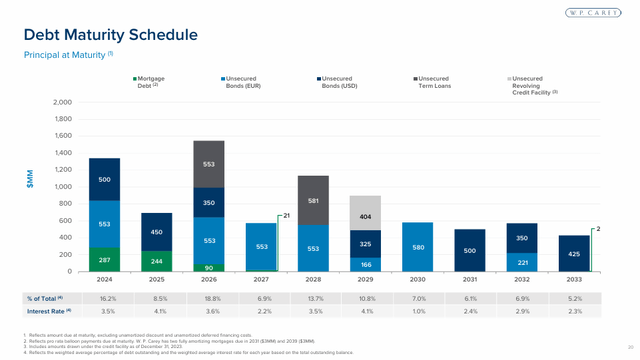
WPC will be refinancing 43.5% of outstanding debt over the next three years. The weighted average interest rate on this debt is 3.7%. 16.2% of outstanding debt will be refinanced in the next twelve months. The average interest rate on this debt is 3.5%.
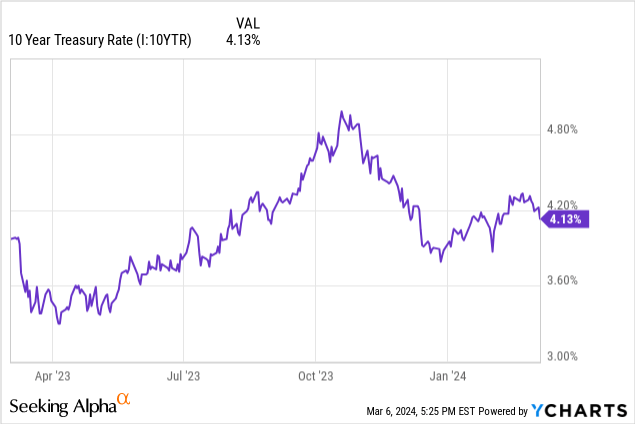
The weighted average interest rate of 3.7% is substantially below the current risk free rate. WPC will likely be refinancing their debt at a spread of 200-300 basis points over the current interest rate, meaning a significant increase in interest expense. With nearly half of the company’s debt coming due in the next three years, refinancing presents a significant financial headwind which is unavoidable without substantial near term rate cuts. If we are to believe the dot plot, refinancing over the next three years will result in a higher interest rate, assuming the Federal Reserve guides towards their long term goal of a 2.5% federal funds rate.
Case Study #2: Mid-America Apartment Communities, Inc. (MAA)
MAA is a multifamily REIT focused on developing and acquiring large scale apartment communities. MAA is an S&P 500 company and invests primarily in the Southeast, Southwest, and Mid-Atlantic. As of year end, MAA owned over 100,000 apartment units. MAA is one of the most respected multifamily owners and developers operating a diverse portfolio across the United States. However, even MAA finds itself in a potential interest rate crunch like WPC.
MAA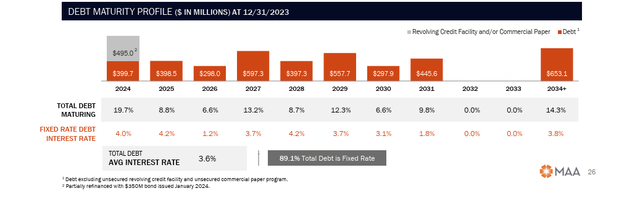
Over the next four years, 48.3% of outstanding debt will be refinanced. A large portion of this is renegotiating a revolving line of credit, but around 37% is fixed rate, unsecured debt. Bear in mind, the weighted average interest rate on this debt is 3.9%, below the ten year treasury once again. As MAA moves to refinance this debt in a higher interest rate environment, it will present a financial headwind. MAA will likely refinance at an interest rate 100-300 basis points higher for fixed rate debt maturing in the next year.
For an apartment owner like MAA, this headwind is compounded by slowing rent growth and a drop in new development starts. In the most recent investor presentation, MAA notes the slowing rental rates.
MAA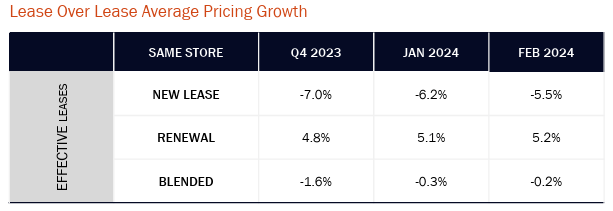
Conclusion
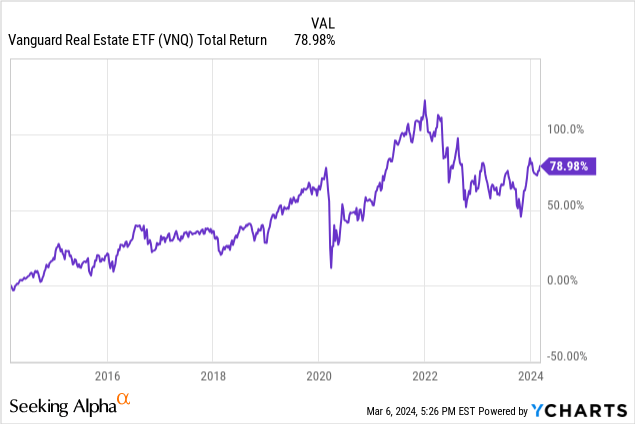
REITs find themselves in a precarious position as it relates to interest rates. On one hand, data suggests that rising interest rates have little impact on REIT performance over the long term. The headwinds generated by rising rates can ultimately act as a tailwind once the tide reverses. On the other hand, it is clear that rising rates place a financial burden on landlords in the near term. Perhaps this is an example of short term pain generating long term gain.
However, one thing remains clear. Following a period of sharply rising rates, investors were extraordinarily optimistic that rates would be cut. However, the optimism is quickly losing steam as Federal Reserve commentary and data suggests rate cuts may not be imminent. Should rates remain higher for longer, it will present a more significant headwind for REITs. Specifically, the performance of REITs will begin to diverge based on balance sheet structure. Given rates have only remained elevated for a short period, we have only received a preview of the impacts. The next twelve months is a crucial period for real estate.
Credit: Source link