
Allkindza
The Only Shocking Thing Was How Much The Guidance Improved
When I wrote about Constellation Energy (NASDAQ:CEG) last quarter, I thought that despite the great prospects for the company and nuclear power in general, the stock was getting close to fair value. At that time, I rated the stock a Hold, with the advice “Don’t Get Shocked“. Since then, the stock traded sideways for a couple months, but started climbing during the month of February. It then shot up over 16% to around $155 on the day of the 4Q earnings release for a total gain of over 25% since my last article. Clearly, a Buy would have been more appropriate.
Seeking Alpha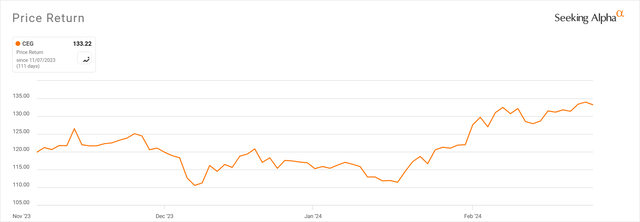
This price spike was not due so much to the quarterly and full year results, although those also exceeded expectations. The company earned $4.025 billion adjusted EBITDA for the year, up over 50% from $2.667 billion in 2022 and above the company guidance which had already been raised twice since the start of 2023. Constellation continued to be a best-in-class operator, achieving a capacity factor over 95% on its nuclear plants in 4Q 2023, above its 2021-22 performance and over 4 percentage points above the industry average.
Constellation Energy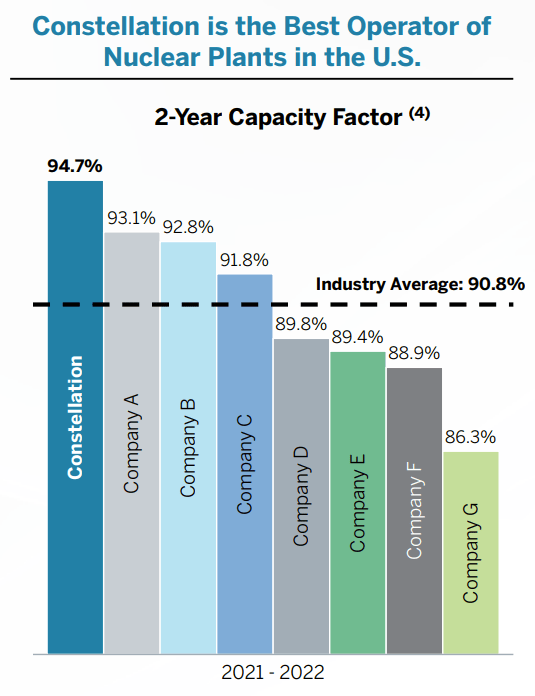
The real performance booster for the stock, however, was the forward guidance of continued strong growth, along with much more clarity on how it will be achieved. The key drivers of this forward guidance are:
- Base earnings growing 10% per year, supported by demand growth, appetite for nuclear as a clean energy source, and nuclear Production Tax Credits (PTCs) which set a floor on power prices that grows with inflation.
- Enhanced earnings, captured when power prices and generation margins are above average, further supported by opportunistic trading and hedging.
- A switch from Adjusted EBITDA to non-GAAP EPS as the financial performance metric.
- Differentiation from its independent power producer peer companies and even fully regulated T&D utilities that make Constellation deserving of a premium valuation.
Let’s look at each of these drivers to see why Constellation Energy shares are still worth holding even after this big run.
Growth Drivers
Base Earnings Growth
Demand for electricity in the US was roughly flat in the 2010s. In the current decade, it has shifted into growth mode with the increase in usage from data centers. A study by Boston Consulting Group shown in Constellation’s 4Q slides found that data center demand would grow from 126 TWh in 2022 to 320 TWh in 2030. (from 2.5% to 6% of total US electricity consumption) A follow-up estimate suggests that the AI boom could push this usage to 335-390 TWh in 2030. At the same time, base load coal generated power is decreasing and being replaced with intermittent renewable sources like wind and solar. These sources have capacity factors in the range of 20-40%, compared to 95% for Constellation’s nuclear plants. The company also notes that existing nuclear plants have a longer remaining lifespan than wind and solar installations, even new ones. Nuclear plants also consume less land and generate less CO2 per kWh over their life cycle from mining the raw materials through decommissioning.
Constellation Energy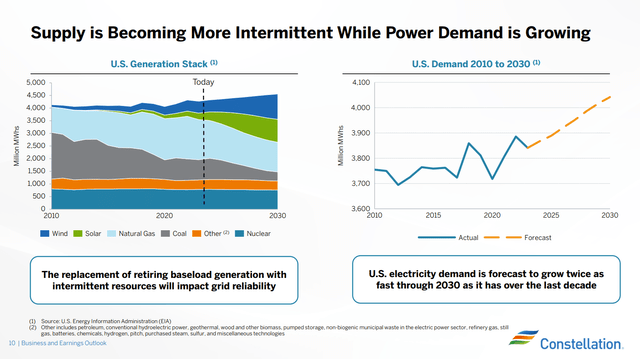
Public opinion and both political parties in the US have become more open to nuclear as a reliable, clean energy source. Nuclear generation has become increasingly supported by governments, starting with state subsidies in the 2010s, through the PTC’s in the Inflation Reduction Act.
The production tax credits add a maximum of $15/MWh to the price received by Constellation in the market. In 2024, these will phase out between $25 and $43.75/MWh. Each year, these floors are adjusted upward based on inflation, so not only do the PTC’s provide a market price hedge, but an inflation hedge as well.
Constellation Energy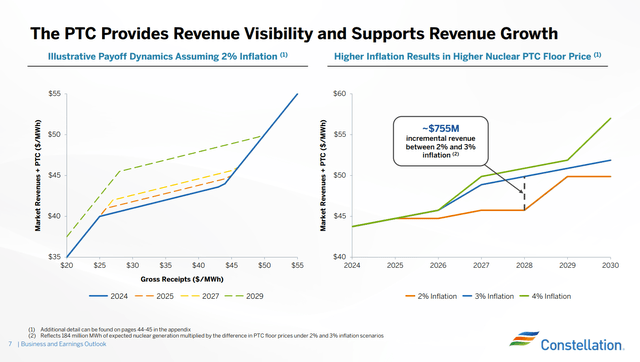
On top of these government subsidies, Constellation also has commercial customers who have made commitments to have a set percentage of their electricity usage generated by a carbon-free source. They are willing to pay extra for this, even if the actual power they are receiving comes from a non-green source, as long as it can be matched with an equal number of kWh generated by Constellation’s nuclear plants. Constellation refers to this revenue as “attribute payments”, and the amount of electricity available to be sold in this manner will grow in the years ahead as the state subsidies from last decade come to an end.
Constellation Energy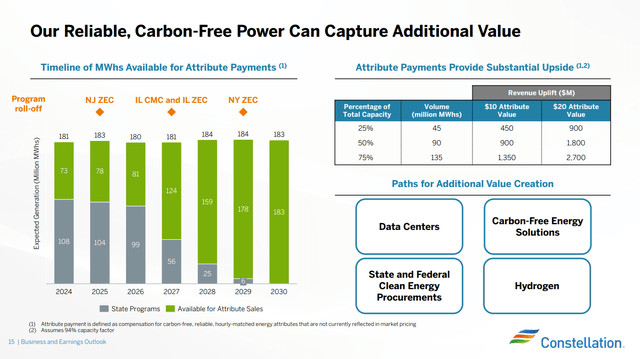
These pricing supports are the main source of growth for Constellation’s base earnings, now expected to be $5.45-$5.55 per share in 2024 and growing by an average of 10% per year going forward. Note that the company has switched to EPS from adjusted EBITDA as the key financial metric for easier comparison with other companies. As we will see below, the company can also support volume growth with cash available after dividends for projects such as capacity expansions at nuclear plants, natural gas, wind, and solar installations. Constellation may also grow by acquisition as they did in 2023 with the purchase of a stake in a South Texas nuclear plant.
Enhanced Earnings Growth
In addition to the base growth, Constellation expects 10-20% of its earnings to come from what it calls enhanced earnings. The stability of the nuclear PTC program relieves Constellation from the need to fully hedge its generation, which can cap its upside in strong markets. With this greater flexibility, the company can take more advantage of volatility and occasional price spikes as opportunities to trade or sell forward its generation. For 2024 and 2025, this enhanced revenue is expected to exceed 20% of the total, with high power prices above the PTC ceiling in PJM ISO (Great Lakes area) and higher than normal spark spreads for natural gas power generation in ERCOT (Texas).
Putting it all together, Constellation expects total EPS of $7.23 – $8.03 in 2024, including $2.13 of enhanced earnings at the midpoint ($7.63). For 2025, the company is showing better than average base earnings growth to $6.35 – $6.45, plus my estimate of $1.87 of enhanced earnings based on other data in the slides, for a total of $8.32 at the midpoint.
Constellation Energy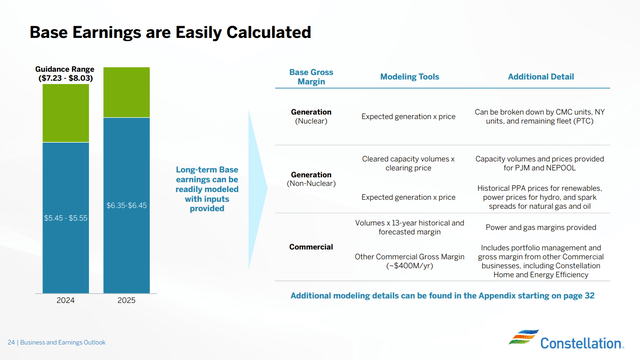
These estimates far exceed the analyst consensus estimates that existed ahead of the earnings release, which were just $6.36 in 2024, followed by 5.5% growth to $6.71 in 2025.
Seeking Alpha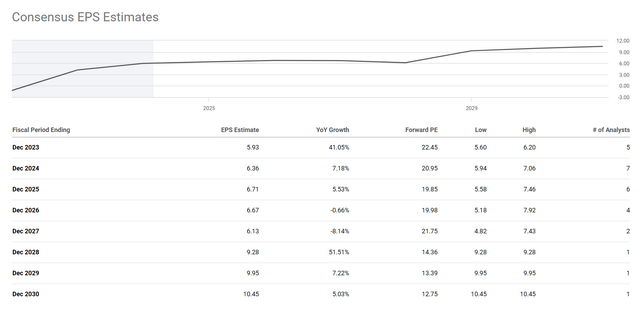
A Different Kind Of Utility
The advantages that Constellation clarified in the earnings call make it clear that the comparisons to other Independent Power Producers like Vistra (VST) and NRG Energy (NRG) that I made in earlier articles are not really useful. Constellation has a steady forward earnings growth rate of at least 10% supported by the nuclear PTC program, unlike the other IPP’s with volatile earnings dependent on market pricing. It also has a better balance sheet and an investment grade credit rating. Even compared to regulated utilities, Constellation has some advantages. Constellation has positive free cash flow, with more discretionary capex spending, unlike T&D utilities that have thousands of miles of lines and related infrastructure to maintain. Constellation also has built-in inflation protection from the PTC formula, unlike regulated utilities which have to justify every proposed rate increase to the regulators.
Constellation Energy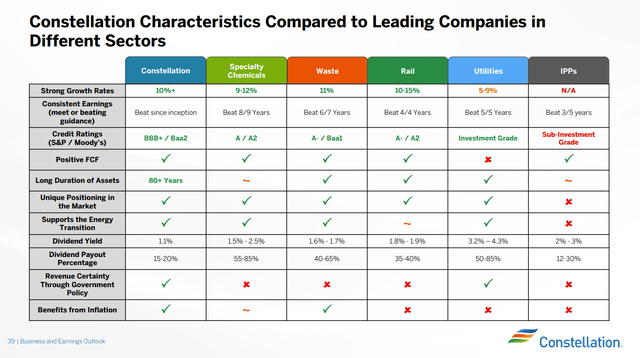
With these advantages, Constellation is not overly expensive even after the big pop after earnings.
Valuation
If we go back two quarters ago, I pointed out in this section that Constellation was on the cheap end compared to the fully regulated utilities, which I thought were a better comparison than the IPP peers. Since then, Constellation share price has risen while most utility stocks have declined in price. Last quarter, Constellation was in the middle of the pack. Now, we see that it is clearly more expensive than the others based on P/E, which is 20.3 times 2024 EPS, or 18.6 times 2025. Based on this earnings growth rate of 9%, it has a PEG ratio of 2.25.
| Price | $155.00 |
| EPS, 2024 | $7.63 |
| EPS, 2025 | $8.32 |
| P/E, non-GAAP (FY2) | 20.31 |
| P/E, non-GAAP (FY3) | 18.63 |
| Earnings Growth (2024-25) | 9.0% |
| PEG (2024-25) | 2.25 |
The peer set has 2024 P/E ratios ranging from 14.6 – 16.5 but EPS growth rates are lower, in the 5.1 – 6.4% range. That makes Constellation the most attractive based on PEG ratio. Still, 2.25 is above the high end of what I normally look for in a PEG ratio. For it to come back down to 2.0, we would need earnings around what is expected in 2025. Therefore, I think the stock can trade sideways for a year or more, subject to drops on any negative surprises. In the meantime, any pullback to $137.50 would be a buying opportunity (18 times 2024 EPS).
Capital Management
Constellation just raised its dividend 25% to $0.3525 quarterly from $0.282 previously. Going forward, it plans to grow the dividend 10% per year. For a utility, this is still an unusually low yield of 0.9% and a low payout ratio of 18.5%.
The company has a solid balance sheet with debt/EBITDA leverage below 2.0 and around $1 billion of debt maturing in 2025 and 2028 but little to none in any other year through 2032.
Constellation Energy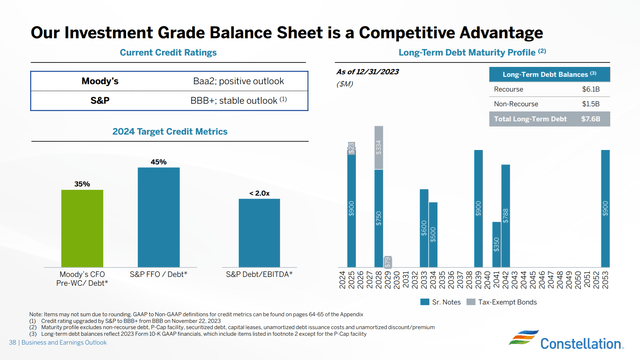
The company will have free cash flow around $5 billion total in the next two years, including $900 million already committed to growth capex. After paying out $900 million in dividends and $1 billion in buybacks over the 2-year period, there remains at least $3.1 billion available for additional growth projects. If no such projects are available that generate an attractive return, this cash can be used to pay off the 2025 debt maturity and increase buybacks.
Constellation Energy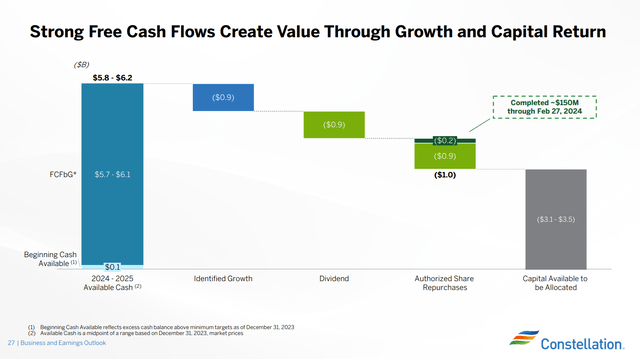
Conclusion
I clearly missed the big share price pop in Constellation because I was not as nearly as optimistic about forward earnings as the company was in its new guidance. The detailed discussion of power prices and sources of growth, as well as the shift to EPS-based guidance, increases confidence that the company can achieve this forecast. Still, the immediate share price spike on earnings day leaves the stock vulnerable to any negative surprises, such as lower volatility in power prices or any hint of a change in the supportive government policy. I do not want to chase the stock at these levels, so I maintain my Hold rating. My Buy target is $137.50, or 18 times 2024 earnings.
Credit: Source link