

Pixelimage
According to the earnings results of Blue Owl Capital Corporation (NYSE:OBDC), the dividend margin of safety slightly eroded in the fourth quarter and the business development company suffered an uptick in its non-accrual ratio as well.
Blue Owl Capital’s dividend pay-out ratio in the fourth quarter increased to 69% (84% with supplemental dividends) and with lower short-term interest rates potentially awaiting the BDC, I believe it is poised to see much lower net investment income growth this year.
I consider lower short-term interest rates a big risk for Blue Owl Capital’s dividend statistics, primarily because the BDC is heavily concentrated in floating-rate loans which are set to throw off lower income in a lower-rate world.
My Rating History
I gave Blue Owl Capital a Sell stock classification as the BDC invested heavily into floating-rate loans that as of 4Q-23 accounted for the overwhelming amount of all investments.
As predicted, the lack of a catalyst for net investment income growth resulted in a QoQ increase in the pay-out ratio. Credit quality also worsened.
I reiterate my Sell rating for OBDC and would consider buying the BDC at a price of $13.90 or lower.
Blue Owl Capital Continued To See Pressure On Its Portfolio Value
Blue Owl Capital is a 97% floating-rate BDC with a primary focus on First and Second Lien Debt. The BDC’s portfolio was valued at $12.7 billion at the end of 4Q-23 which reflected a $182.8 million QoQ decline.
The portfolio value also fell from a year-end 2022 value of $13.0 billion primarily because of a faster repayment speed as well as loan sales. First and Second Liens accounted for 82% of all investments at the end of 2023, a figure that declined by 1 percentage point QoQ.
Portfolio Overview (Blue Owl Capital Corp)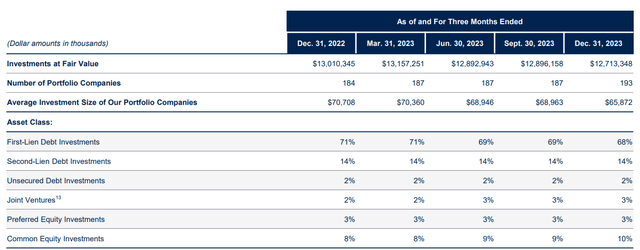
In the fourth quarter, investment repayments and sales of $1.14 billion exceeded the company’s net new investment fundings of $1.3 billion, resulting in a shrinking portfolio. In a higher-for-longer interest rates environment, I would expect Blue Owl Capital to continue to suffer elevated loan repayments as well as pressure on the BDC’s portfolio value.
Portfolio Highlights (Blue Owl Rock Corp)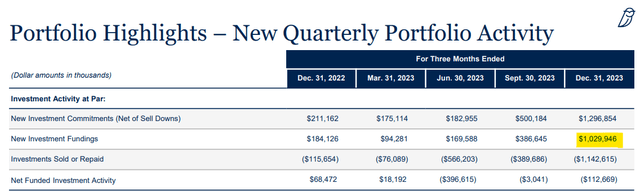
Unfortunately, the BDC also reported an increase in its non-accrual ratio which adds to my concerns about Blue Owl Capital. The non-accrual ratio increased to 1.1% based on fair value, up from 0.9% in 3Q-23, as one new portfolio company was added to the BDC’s non-accruals, up from three in the prior quarter. The non-accrual ratio measured portfolio performance problems and, in the worst case, could lead to loan defaults, lower NII and a hit to net asset value.
As far as Blue Owl Capital’s actual investment results are concerned, the BDC produced good results that were boosted by the company’s aggressive floating-rate exposure.
In 4Q-23, Blue Owl Capital earned $199.0 million in net investment, reflecting 23% YoY growth. This growth was mainly driven by a 15% boost in the company’s interest income from loan investments which produced higher income in a rising-rate environment. Blue Owl Capital profited greatly from interest rate tailwinds which resulted in the pay-out of generous supplemental dividends in 2023.
Taking into account that the central bank has said it may push interest rates lower this year, I do think, however, that Blue Owl Capital is unlikely to reap similar NII benefits this year. With interest rates even set to fall, passive income investors must be prepared to see negative net investment income growth as well as a narrower margin of dividend safety.
Net Investment Income (Blue Owl Capital Corp)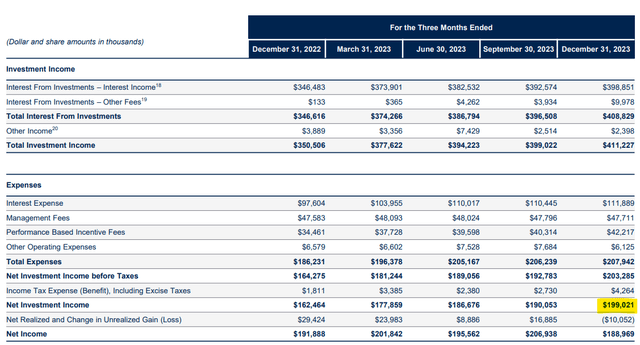
Small Deterioration In The Margin Of Safety
Blue Owl Capital more than out-earned its dividend with net investment income in 4Q-23, helped by a floating-rate debt investment portfolio that produced higher income, as I discussed in the prior section.
If we break down Blue Owl Capital’s net investment income results to the per share level, then the BDC earned $0.51 per share in net investment income in the fourth quarter which equates to a dividend pay-out ratio of 68.6%. The pay-out ratio deteriorated by a 1.3 percentage points QoQ, however.
Blue Owl Capital returned excess portfolio income to shareholders in 2023, in the form of supplemental dividends which amounted to $0.29 per share. Including those dividends, the dividend pay-out ratio rises from 69% (no inclusion of supplemental dividends to 85%, on a 2023 full year basis.
Dividend (Author Created Table Using BDC Information)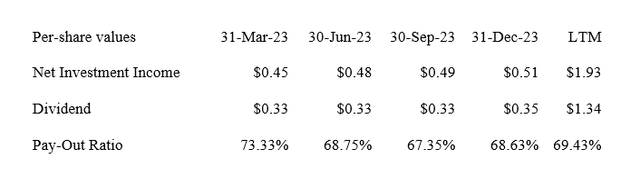
Valuation Multiple And At What Point I Would Consider Buying
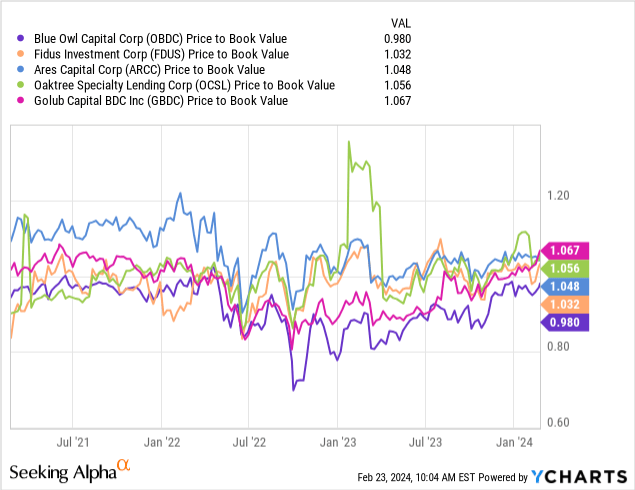
Blue Owl Capital is selling near net asset value which, in my view, is an unattractive buy point. With the lack of a clear net investment income growth catalyst and a rise in non-accruals in 4Q-23, I don’t see much upside in the BDC’s net asset value either, particularly not with a 97% floating-rate posture just when the central bank is poised to lower short-term interest rates. Blue Owl Capital’s net asset value per share was $15.45 in 4Q-23, reflecting a $0.05 per share increase compared to 3Q-23.
A BDC’s net asset value is an approximation of its intrinsic value and I rarely like to pay more than this, no matter how safe the dividend. Like I said in my last piece on Blue Owl Capital, I don’t consider the BDC to be attractively valued near NAV which is explained by my predilection to be an opportunistic buyer of BDCs, and this typically requires a 10% or higher discount to net asset value.
This is purely my personal preference because I like to supplement my passive income with potential for capital appreciation which is harder to come by when a BDC is selling for full price based on NAV.
With the stock of OBDC selling for 97 cents on the dollar, I continue to see limited re-rating potential. I would be a buyer at $13.90 which would reflect a 10% discount to NAV. The same holds true for other BDCs, for most of which I also have Hold stock classifications.
Why My Investment Thesis May Not Play Out As Anticipated
Higher-for-longer interest rates are the kryptonite to my investment thesis. If the central bank walks backs its commentary on interest rates and instead keeps them higher-for-longer in light of inflation concerns, then Blue Owl Capital could actually avoid a deterioration in its dividend metrics and produce net investment income growth. The non-accrual ratio is also a bit of concern as it trended up, however.
My Conclusion
Blue Owl Capital suffered a deterioration in its non-accrual ratio in 4Q-23 which together with an unfavorable macro outlook (lower short-term interest rates), ongoing pressure on book value due to higher prepayments and an uptick in the dividend pay-out ratio affirm my negative stock rating.
Hence, I am very cautious in 2024 as the central bank’s rate shift is set to upend the party in the high-yield debt market that has been raging ever since it started to hike rates in 2022.
With net investment income tailwinds poised to fall by the wayside in 2024, the profit and NII upside here also seems limited, considering that Blue Owl Capital continues to maintain a 97% floating-rate posture in the fourth quarter.
Credit: Source link