
Stephen McCarthy/Sportsfile via Getty Images
In this quarterly update to my investment thesis on Telefônica Brasil (NYSE:VIV), I’m upgrading my recommendation from buy to strong buy after the company reported solid results in the fourth quarter, culminating in a robust improvement in its financial position throughout 2023.
Although Telefônica Brasil’s shares have risen 45% in the last twelve months, I am reasserting my optimism in the investment thesis that combines defensiveness, dividends, and growing cash flow.
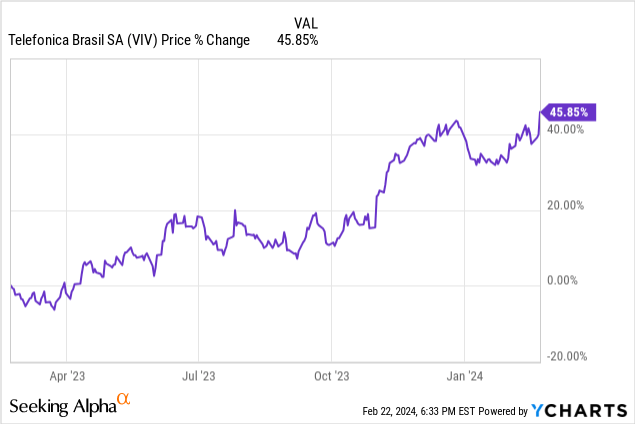
Telefônica Brasil has significantly accelerated its organic growth through solid execution in consolidating the mobile telephony sector. Additionally, the company has expedited its fiber growth, combining access expansion with ARPU growth.
As I previously reported in my article, Telefônica Brasil commits with its Spanish parent company, Telefónica (TEF), to generate significant returns for their shareholders. This commitment was reaffirmed in the Q4 earnings announcement, continuing the 100% profit-sharing payout until 2026 through dividends, buybacks, interest on equity (“JCP”), and capital stock reduction. This strategy should yield a very attractive double-digit shareholder yield for the next few years. In my view, this makes Telefônica Brasil an ideal income stock for a dividend-focused investment portfolio.
Telefônica Brasil’s Q4 Earnings Results
Telefônica Brasil reported a net profit of R$1.601 billion in the fourth quarter of 2023, a 42.1% increase compared to the same period in 2022. According to S&P Global Intelligence on the Koyfin platform, the consensus average expected a net profit of R$1.41 billion for the period.
Telefonica Brasil’s IR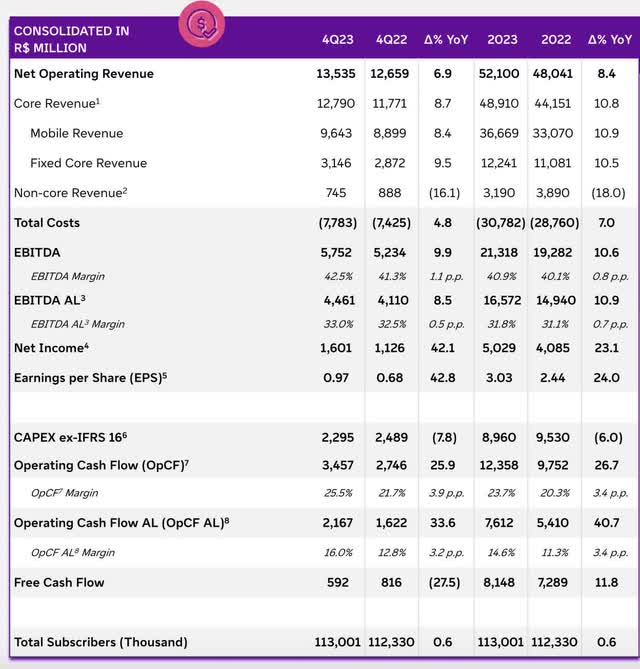
EBITDA totaled R$5.752 billion in 4Q23, marking a 9.9% increase from 4Q22, attributed to the solid performance of core revenues, which rose 8.7% year-on-year and a 4.8% increase in cost control during the quarter. The EBITDA margin reached 42.5% between October and December last year, up 1.1 percentage points (p.p.) from the margin recorded in 4Q22.
The robust bottom-line result was driven by net revenue, which reached R$13.5 billion in the fourth quarter of last year, a 6.9% increase compared to the same period in 2022, surpassing Brazil’s current inflation rate of 3.5%. This growth was primarily fueled by an 8.7% increase in mobile service revenue year-over-year.
The customer base totaled 113 million accesses, with 99 million mobile accesses, maintaining Vivo’s position as the market leader ahead of Claro and Tim Brasil. In the post-paid segment, Telefônica Brasil registered 1.4 million accesses in 4Q23, while churn reached an all-time low of 0.97%.
Total costs, excluding depreciation and amortization expenses, amounted to R$7.783 billion in the quarter, representing a 4.8% year-on-year increase. Meanwhile, the net financial result showed a negative R$631 million in the fourth quarter of 2023, a 4.5% increase in financial losses compared to the same period in 2022.
In 4Q23, CapEx reached R$2.295 billion, marking a 7.8% reduction year-on-year, representing 17.0% of net revenue for the quarter, a decrease of -2.7 p.p. year-on-year. These investments focused on strengthening the company’s mobile network, emphasizing 5G coverage in 173 municipalities, encompassing 47% of the Brazilian population, and expanding the fiber network. Consequently, Telefônica Brasil, through Vivo, continues to excel in signal quality in Brazil.
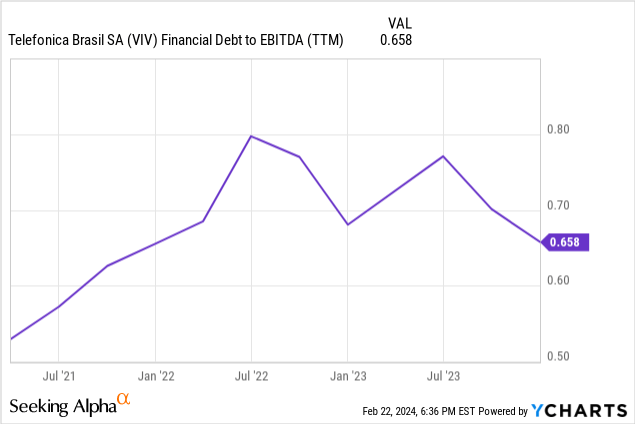
Finally, net debt saw a 13.3% decrease compared to the same period in 2022, with Telefônica Brasil recording R$14.17 billion, maintaining a net debt/EBITDA ratio of 0.6x.
Robust Shareholder Yield For The Years Ahead
One of the pillars of my investment thesis in Telefônica Brasil is its potential as a robust income stock, given its commitment to returning dividends to its parent company in Spain, Telefónica.
Telefônica Brasil ended 2023 in a very robust financial position, boasting around R$4.359 billion in cash and equivalents and R$18.78 billion in cash from operations. Net income was 23% higher than the previous year, reaching R$5 billion in 2023, and free cash flow generation grew by double digits, reaching R$8.1 billion. This improvement in the company’s cash position, combined with the payment of senior debt and 5G license obligations, substantially reduced financial net debt compared to the previous year, with R$4.45 billion in debts paid off.
As a result, the company ended 2023 with a net income of R$5.04 billion. Throughout 2023, Telefônica Brasil distributed R$2.5 billion in interest on capital and R$1.8 billion in dividends and executed almost R$500 million of its share buyback program, totaling R$4.8 billion in shareholder remuneration. Even after these distributions, the company ended the year with a modest dividend yield of 3.11%.
Koyfin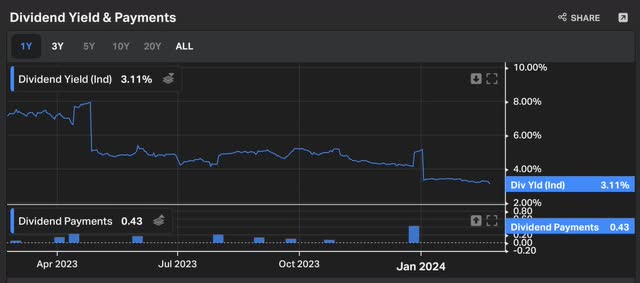
However, this yield could become robust again in 2024 and over the next few years.
More recently, in December last year, the company canceled 11 million shares, corresponding to 0.5% of the company’s total shares, in addition to the 13 million shares already canceled in February 2023. In November 2023, the company released formal guidance to the market, committing to pay shareholders equal to or greater than 100% of net income in 2024, 2025, and 2026.
By adding the dividend yield to a buyback yield of 0.5%, plus a debt paydown yield of 4.87%, we arrive at a shareholder yield of 9.63%, which is quite attractive.
Koyfin, data from S&P Global Intelligence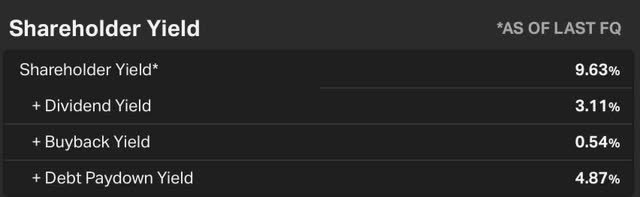
This distribution will continue similarly for the following years through dividends, interest on capital, capital stock reduction, and share buybacks. Upon releasing its results, the company also announced that the first tranche of capital reduction for R$1.5 billion was approved at the Extraordinary Shareholder Meeting held in January this year. It will be paid before the end of July 2024.
As the consensus points to a 14% increase in EPS for 2024, in the face of a more promising scenario with more moderate inflation in Brazil and falling interest rates, potentially 9% by the end of the year, the expectation may be for a net profit of R$5.819 billion. The consensus also suggests a growth of 19% in 2025, which would take the company to a net profit of R$6.945 billion, indicating a dividend yield of between 7% and 8%.
Seeking Alpha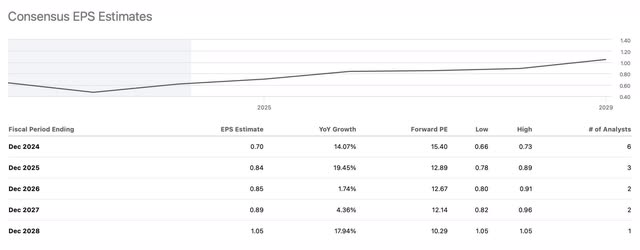
The expected improvement in profitability over the next few years, coupled with the generous initiatives to compensate shareholders guaranteed for the next three years at least, reinforce a shareholder yield above double digits for 2024 and 2025.
Valuations: Nothing to Worry
Telefônica Brasil trades at a forward P/E of 14.7x, which aligns well with the sector average of 15.1x and is slightly above its historical average of 13.2x. Compared to its primary U.S.-traded domestic peer, TIM S.A. (TIMB), it trades at 13.1x earnings, indicating a premium over its peer.
Seeking Alpha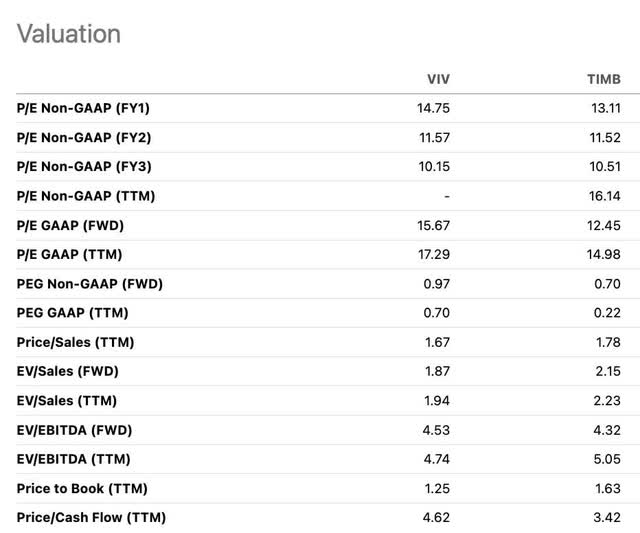
This valuation premium is justified because Telefônica Brasil is a more mature company than Tim SA and has a better-defined shareholder remuneration policy. However, investors should be aware that a slightly higher valuation may be a minor drawback to the investment thesis. This is due to the risk of the economic scenario in Brazil, where a potential increase in inflation could impact the company’s operating costs, reducing profits and earnings—although this is not the predominant perspective at the moment.
Nevertheless, suppose Telefônica Brasil maintains its profitability growth at levels similar to this year’s by 2026. In that case, the company tends to have a P/E ratio 10x, which is well below the industry average and practically in line with Tim SA.
The Bottom Line
Telefônica Brasil has once again posted a solid quarter, continuing the trend of recent quarters by achieving growth above inflation and expanding margins. The company has effectively executed its mobile and fixed services strategy while providing good dividends.
A positive trend is expected for increased profits throughout 2024 and 2025, attributed to a more favorable macroeconomic scenario in Brazil, including falling interest rates and more controlled inflation.
With the company continuing to distribute its profits in total, a shareholder yield above double digits is anticipated for the next two years at least. Despite its valuation aligning with the industry average, I am upgrading my stance to a strong buy, considering Telefônica Brasil an excellent income stock to include in the portfolio.
Credit: Source link