

istetiana/Moment via Getty Images
By Andrew Prochnow
Recent developments suggest that those banking on a March rate cut by the Federal Reserve may need to recalibrate their expectations. The likelihood of a March rate cut diminished significantly in early February following the U.S. Labor Department’s announcement affirming robust hiring in the economy and the unyielding stability of the U.S. unemployment rate at record lows.
On top of the robust labor market, another February report from the government indicated that problematic levels of inflation haven’t yet been completely tamed.
On Feb. 13, the Bureau of Labor Statistics revealed that inflation was higher than expected during the month of January, with the Consumer Price Index (CPI) rising to 3.1%. That was above the expected 2.9%, and more importantly, well above the Fed’s target of 2%.
In addition to these overarching trends, another significant development has emerged that is likely to grab the attention of Federal Reserve leaders—the surging price of eggs.
As many American consumers will recall, the dramatic rise in egg prices grabbed headlines back in 2022, contributing to multiyear highs in U.S. inflation.
Following a low point of around $1.35 per dozen during the initial stages of the COVID-19 pandemic, egg prices continued their upward trajectory throughout 2021 and 2022, eventually reaching a peak of about $5.30 per dozen.
However, in response to the Fed’s vigorous efforts to combat inflation, egg prices plummeted back down to around $2.00 per dozen by the fall of last year, as depicted below.
price of a dozen eggs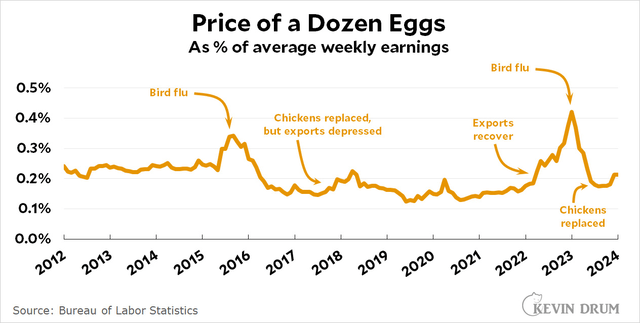
Unfortunately, egg prices rebounded at the end of 2023, and have been steadily climbing again in early 2024.
Year-to-date, egg futures are up about 46%, climbing to $3.20/dozen as of February 20. It should be noted, however, that recent action in the egg market hasn’t necessarily been driven by strengthening demand.
Instead, it’s the supply side of the egg market that’s been under pressure, as outlined in the next section.
Avian Flu Outbreak Threatens U.S. Egg Production
Throughout the past ten years, U.S. egg producers have grappled with a significant challenge posed by the Avian Flu (H5N1), a viral infection predominantly impacting birds, notably poultry like chickens, ducks, and turkeys.
The avian flu is characterized by its high contagiousness, particularly within the densely populated flocks maintained by numerous U.S. egg producers.
Moreover, the current strain of the virus often proves fatal to infected birds. Consequently, any outbreak demands prompt and resolute measures, typically involving the culling of infected and susceptible birds from the affected flock.
Last year, a decline in bird flu cases in the United States no doubt contributed to the weakening in egg prices. But cases started rising again in autumn of last year, ultimately leading to a nation-wide outbreak.
The U.S. Department of Agriculture estimates that some 80 million birds were culled in the last two years in response to the bird flu. That includes around 20 million during the last three months of 2023 alone.
Bloomberg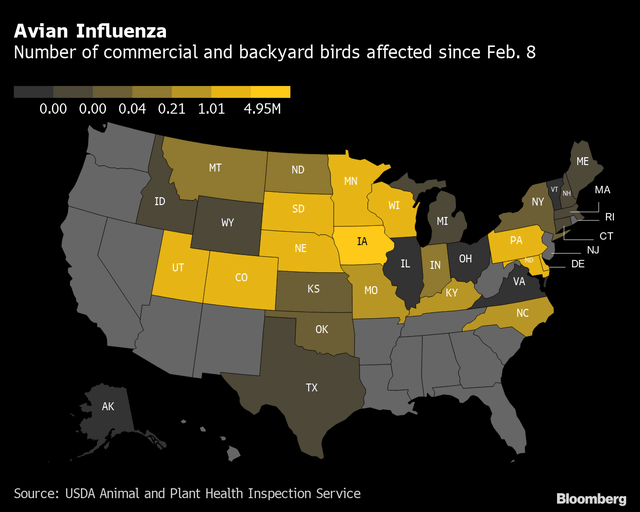
Due to the severe impact of these bird flu outbreaks—particularly over the last several years—annual egg production in the U.S. has been on the decline. Prior to the COVID-19 pandemic, the U.S. produced about 9.4 billion eggs in 2019. But last year, that figure was down to around 9.1 billion.
As is often the case in commodities markets, those supply constraints have been bullish for prices, which is a key reason that eggs got so expensive in 2022.
All told, that means the current surge in prices may not be linked to a second bout of inflation, but rather to the current outbreak of avian flu. But most consumers won’t care about the exact reason for the spike in prices, instead, they’ll focus on the fact that prices are rising.
And unfortunately, food inflation remains stubbornly high, despite the broader decline in overall inflation. For example, food inflation rose by 0.4% last month, while total CPI increased by 0.3%.
But those statistics only provide a partial picture. Restaurant prices continue to climb at a worrisome rate, rising at an annualized rate of 5.1%, which is well above the CPI rate of 3.1%.
For most American consumers, food prices are one of the most visible parts of the economy, so when prices start rising, most Americans take notice. As a result, it’s almost assured that the Fed will note that egg prices have spiked during early 2024, and that could factor significantly into the upcoming rate decision.
Not surprisingly, the aforementioned employment and inflation data has also affected ongoing market expectations for the first rate cut in 2024. Several months ago, most expected the Fed to cut rates by a quarter percentage point during its March meeting.
But as of now, those expectations have shifted —the interest rates futures market now indicates that benchmark rates will remain at current levels until mid-June.
That means the Fed will likely stand fast at its next two meetings, which are scheduled for March 19-20 and April 30-May 1. But if egg prices continue to climb, or other pockets of the economy start to experience faster-than-expected price growth, then expectations could shift again—pushing out the first rate cut even further.
Amidst a major election year, that means volatility could increase during the next several months, as investors and traders wrestle with the potential impact of “higher rates for longer” on the underlying economy.
Credit: Source link