
bymuratdeniz/iStock via Getty Images
Engie (OTCPK:ENGIY) has been on a mission to transform the company from a traditional utility to a provider of clean energy. Essentially, management is streamlining the business selling assets in geographies which are not considered key markets. During this process shareholders have not been forgotten, but in all likelihood future dividends will be reduced.
Engie intends to further invest in renewable generation capacity while this will need to be funded from cash flow or debt rather than disposals. With markets at or near all-time highs, a dividend that likely will be reduced and high capex requirements to fund the transition into renewables, Engie does not present an appealing prospect at this point in time.
Company overview
Over the last few years Engie embarked on a transition into renewables and simultaneously simplified the structure of the company. Whereas the company previously operated 25 business units, this number reduced to four, see figure 1. Moreover, the geographic presence was reduced from more than 70 countries to less than 30 currently.
Figure 1 – Engie Global Business Units, 2021 investor day (engie.com)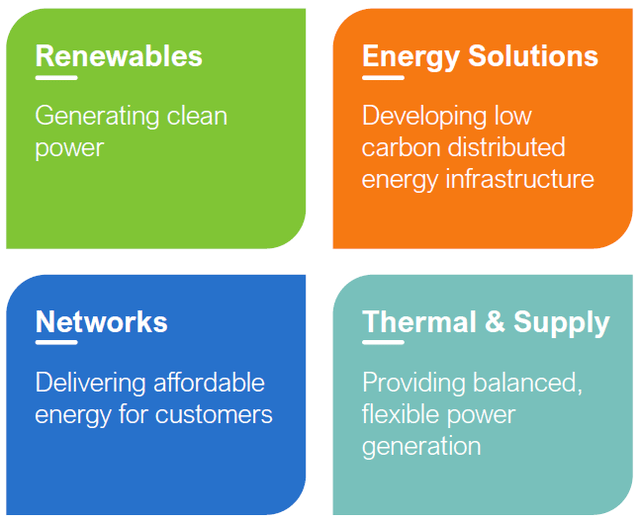
Besides these business units, two operating entities exist, namely Nuclear and Global Energy Management & Sales (‘GEMS’).
The Nuclear business relates to two reactors the company operates in Belgium. While the company intends to phase out nuclear, and officially the reactors should close by 2025, the Belgian government pushed for an extension of the two (out of 7) youngest reactors till 2035 to ensure demand for electricity can be met.
According to the annual report, through GEMS Engie “sources energy, sells its own production and hedges upstream and downstream positions to meet customers’ needs for risk management and decarbonisation, as well as secure supply in Europe”.
Performance
At the FY23 results presentation Engie presented a strong set of results, see figure 2. This was in line with expectations as management has already raised guidance over the course of 2023.
Figure 2 – Performance update, FY23 results presentation (engie.com)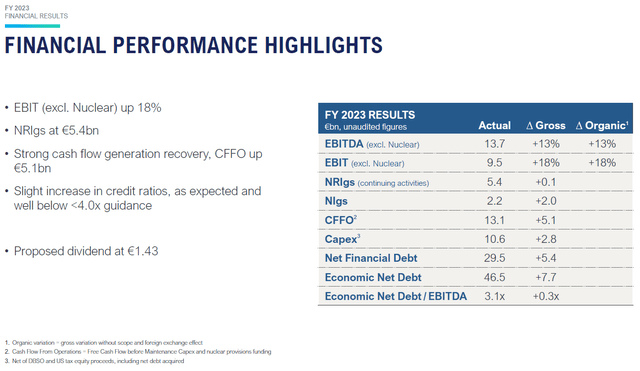
For example EBIT growth was impressive, but also cash flow generation was remarkable. Revisiting the goals as shared during the 2021 investor day, Engie management expected to deliver a 2023 EBIT in the range of €5.7 to 6.1Bn. This target was beat handsomely indicating the company is on the right track.
One of the reasons for this performance is that the GEMS operating entity contributed much more than expected and was actually the main driver of EBIT, see figure 3.
Figure 3 – EBIT structure, FY23 results presentation (engie.com)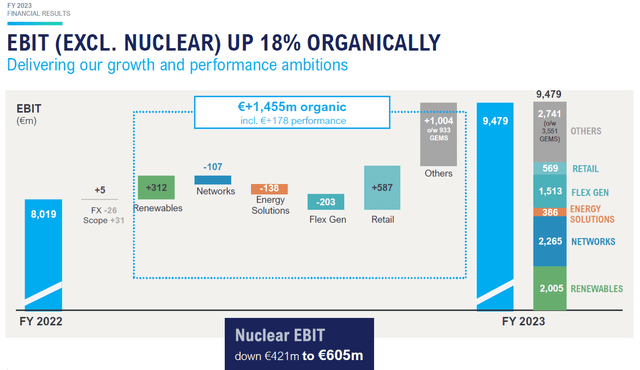
In the year 2022 “GEMS saw a record level of activity in all activities in an exceptionally volatile price environment and optimized long-term contracts by leveraging the optionality in ENGIE’s commercial contract-base.” This performance continued in 2023 as, especially in the first half of 2023, energy prices remained elevated. In the third quarter prices normalized further and tranquility remained in the fourth quarter of 2023. The reduced volatility in terms of year-over-year numbers is shown in figure 4.
Figure 4 – Volatility in power prices, FY23 results presentation (engie.com)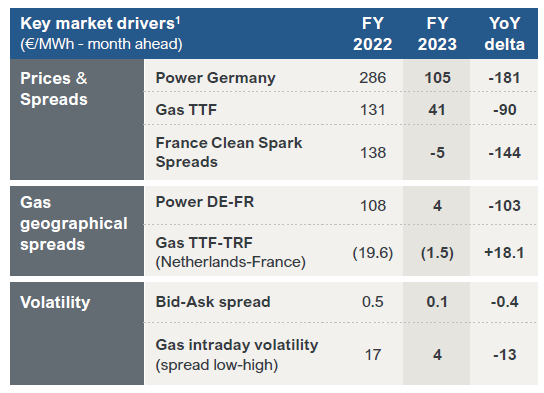
With volatility reducing, it may be expected the contribution of GEMS to EBIT will normalize. This expectation was already shared by the company in the 2022 annual report:
GEMS EBIT is likely to be lower over 2023-2025 compared to the exceptional level of 2022, but it should remain above the historical level of 2020-2021 due mainly to commercial growth and continuing challenging energy markets, bringing optionality and volatility as well as increased customers demand for risk management.
To get grips on the ‘historical level’ of GEMS contribution, reference is made to the EBIT dissection as shown in the FY22 annual report, see figure 5.
Figure 5 – EBIT contribution by activity, annual report 2022 (engie.com)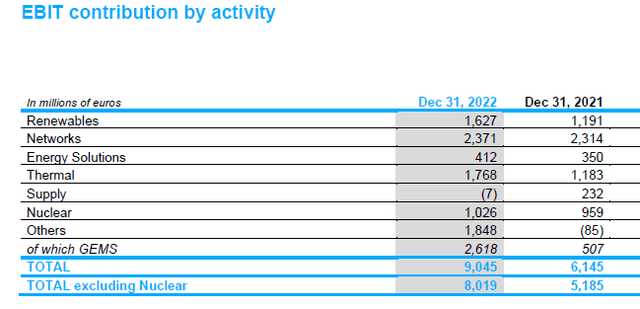
The 2021 contribution of GEMS to EBIT was €0.5Bn, a number which increased five-fold a year later in 2022. Based on the data made available for the latest results presentation, the contribution in 2023 topped €3.5Bn. Without a doubt the contribution of the GEMS entity has been a major driver to beat the EBIT estimates. As volatility appears to be reducing, the contribution of GEMS to EBIT will likely reduce as well.
Recurring income
A difficulty with a business in transition, and disposing assets at the rate Engie does, is to determine how investments and dividends are funded. To present more clarity management uses ‘net recurring income group share’ or NRIgs. This parameter entails ‘net income group share adjusted for unusual or non-recurring items’. In other words, which part of the income is expected to recur, in order to pay e.g. dividends.
For this reason, the dividend distribution has been tied to the NRIgs indicator. After all, the most interesting part of dividend is not the yield, but rather the ability of a company to sustain and grow the dividend.
Figure 6 – NRIgs development and debt ceiling, FY2023 results presentation (engie.com)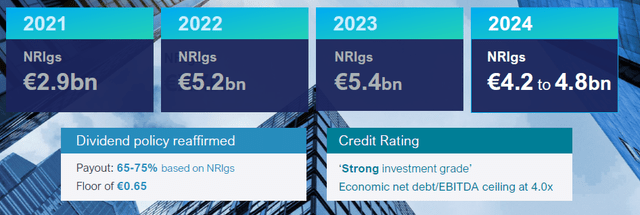
From the data in figure 6, it is evident the sustained performance of the GEMS unit, or volatility in energy markets if you will, continued to support NRIgs in over the last two years. Nevertheless, guidance by management reflects the reduction in volatility and as a result a reduction in recurring income for 2024. This is important as dividend payouts are tied to the recurring income.
Cash flow
In spite of NRIgs being used by management, as an investor I like to know how income relates to expenses based on familiar metrics such as free cash flow. Or more to the point, is the company overspending or can the dividend be sustained?
Instead of free cash flow, Engie merely present figures for Cash Flow From Operations (CFFO) which it defines as ‘Free Cash Flow before maintenance Capex and nuclear phase-out expenses’. This is a slight deviation to the regular definition as cash flow from operations usually is only corrected for capex to arrive at free cash flow.
Either way, and apart from exact definitions, one would want a company to generate sufficient cash to cover investments and returns to shareholders. Therefore, in figure 7, CFFO is plotted against dividend outflows, nuclear expenses and total capex.
Figure 7 – Cash from operations and disposals versus outflows (data engie.com, chart by author)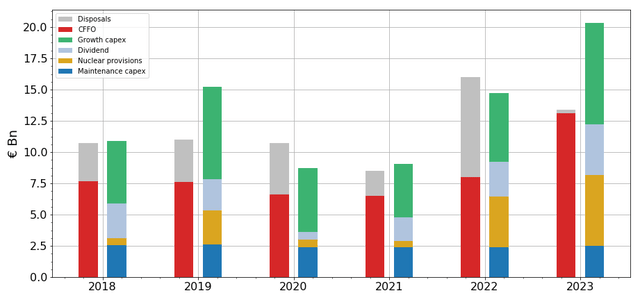
Before drawing conclusions from this figure it must be noted the numbers for ‘nuclear provisions’ contain only the provisions for the back-end of the nuclear fuel cycle, dismantling of plant and equipment and site rehabilitation as taken from the respective annual reports. Potential other items have not been included in the numbers presented.
Making the distinction between growth and maintenance capex, it is evident CFFO is consistently sufficient to cover the maintenance capex and dividend distributions. Adding the nuclear provisions it is clear the variability in these provisions mainly determine whether or not it is covered by cash flow.
As Engie last year announced an agreement with the Belgian government regarding a life-time extension of its nuclear plants, it will reduce the variability and amount of these provisions. Therefore it may be expected CFFO will be sufficient to cover maintenance capex, dividend and nuclear provisions.
Another clear observation is the increase in CFFO in 2023. The increase is remarkable, and mainly attributable to changes in working capital, continued exceptional performance in the GEMS entity and good performance in the Renewables segment. For reference, over 2023 the change in working capital attributed to CFFO increased by €2.8Bn. Correcting for this item, CFFO increased by €2.1Bn, rather than €5.1Bn, compared to last year. Nevertheless, CFFO is showing signs of growth, which in turn will support the transition and shareholder returns in my view.
This is necessary as well as management indicated disposals will reduce to about €1Bn per year, meaning the growth will need to be funded from cash flow unless additional debt will be taken on. While the company remains within the targeted net-debt-to-EBITDA ratio of 4, even after increasing debt by €5Bn last year, cash flow needs to remain elevated to avoid taking on excessive debt. How the company will fund the transition into renewables now disposals are reduced is something to keep an eye on.
Returns
Over the long term, Engie has underperformed the market as the stock price dropped significantly after the GFC, see figure 8.
Figure 8 – Engie stock price since 2010 (YCharts)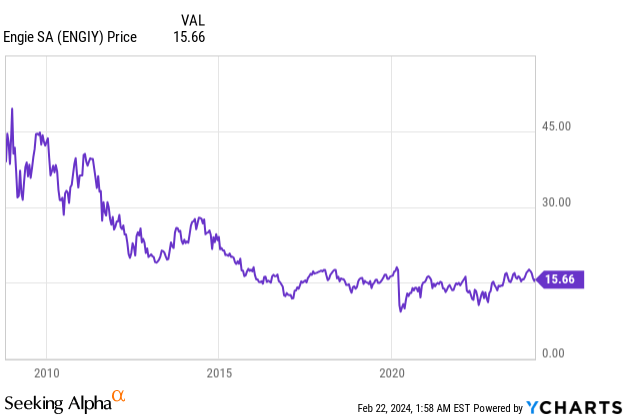
However, a company like Engie is arguably bought for the dividend rather than stock price appreciation. Concerning dividend the FY2023 amount was announced to be €1.43 implying a yield just shy of 10 percent, based on a EUR/USD 1.08 exchange rate. This number is up 3 cents compared to last year.
Going forward however it is questionable whether this dividend can be sustained. As shown in figure 7 the company does generate quite some cash, but management typically looks at recurring income.
While turmoil in the energy markets continued to support performance of Engie last year, the outlook shared in figure 6 clearly shows management does see the volatility as exceptional rather than a given. This implies net recurring income, and thus dividend distributions may reduce again.
Even so, if NRIgs would drop to a level of €4.2Bn, and a 65% pay-out ratio is used, the dividend per share would end up at approximately €1.12, well above the €0.65 floor. At the current price, such a dividend translates into a yield of approximately 7 percent which is still high.
Risks
One of the main risks related to an investment in Engie was formed by the uncertainty surrounding two nuclear plants in Belgium. With these plants based near densely populated areas, many concerns have been raised over safety of the operations. The uncertainty surrounding both plants was addressed when in July 2023 Engie and the Belgian government reached an agreement concerning both the Doel and Tihange reactors. By the end of the year the deal was sealed, meaning clarity was provided on one of the main risk factors.
As the transition into renewables is done prudently and earnings are supported by volatile energy markets, this does not necessarily mean it comes without risk. For example, targets shared by Engie at the Investor Day in February ’23 indicated the company intends to achieve 50 gigawatt renewable generation capacity by 2025, and up this to 80 gigawatt in 2030. As noted in an article on Enel (OTCPK:ENLAY), the decline in renewable development costs have stalled implying the business case may need to be revisited. As Engie has committed to a pipeline of investments, these will either need to be postponed or additional debt will be required if it can’t be covered by cash flow.
What’s more, to fund the transition into renewable generation capacity Engie has been divesting assets of which many were fossil fuel plants. This means that, in case income from the Renewables segment declines, there is less opportunity to make-up for this in other parts of the company.
Fortunately, TotalEnergies (TTE) CEO Patrick Pouyanne raised concerns stating “that governments are under-selling the effects of the energy transition if they fail to acknowledge publicly that the shift would lead to higher energy costs”. Furthermore he warned to “reduce oil and gas production before securing sufficient reliable renewable energy resources to take its place”.
While higher renewable prices initially may seem a boon for Engie, the political landscape in Europe is changing at this very moment. After a period of high inflation, politicians currently holding office can’t use elevated energy prices if they want to be re-elected.
This link to politics is made as the French government holds a direct stake of 23.64 percent in the company with a voting right of more than 34 percent, see figure 9.
Figure 9 – Engie shareholders (engie.com)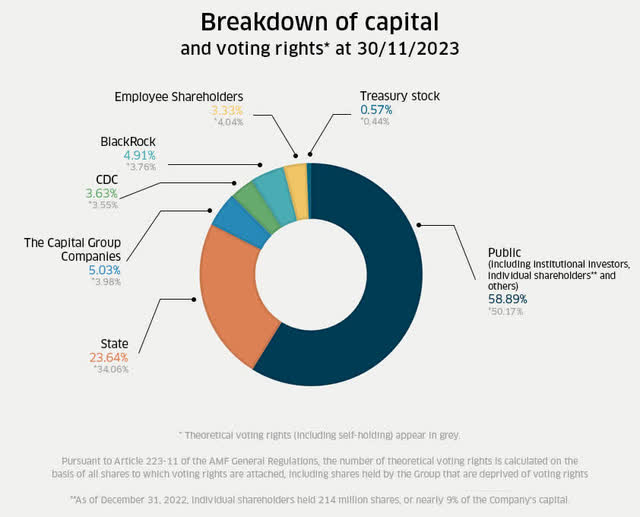
This number increases even further if the holding of CDC, Caisse des Dépôts et Consignations, is added. CDC is basically the investment fund of the French state, meaning it may be expected it will vote in the same line as the State. In case energy prices increase to the point it becomes problematic, the French government may request the company to think of manners how to alleviate the burden of energy prices on the French consumers. As it stands, this risk is not hypothetical in my opinion and was briefly touched upon in a piece on TotalEnergies.
Conclusion
Engie has been on a mission to transform the company from a traditional utility to a provider of clean energy. Essentially, management is streamlining the business selling assets in geographies which are not considered key markets. While disposals and volatility in energy markets have supported the transition, Engie is now entering a phase where the level of disposals will be reduced and volatility is returning to more normal levels. This implies expansion into renewables needs to be funded from cash flow unless debt levels are increased.
Regarding dividends, shareholders have been spoiled over the last two years, but it’s to be expected the dividend will be reduced if recurring income potentially drops. If the dividend reduces to €1.12, well above the €0.65 floor, a yield of approximately 7 percent can still be achieved. While this may seem worthwhile, investors need to be aware further investments in renewable generation capacity need to be funded from cash flow or debt. Cash flow was strong last year, but several risk factors exist which could potentially lead to a lower cash flow. If anything, one should ask the question whether cash flow has started a sustainable ascend, or may revert to historical levels.
All in all, with markets at or near all-time highs, a dividend that likely will be reduced and high capex requirements to fund the transition into renewables, I will not invest in Engie at this point in time.
Editor’s Note: This article discusses one or more securities that do not trade on a major U.S. exchange. Please be aware of the risks associated with these stocks.
Credit: Source link