

Andriy Onufriyenko/Moment via Getty Images
Market Commentary
High yield bonds and leveraged loans produced gains in the fourth quarter, with high yield bonds outperforming their floating rate peers. During the quarter, benign inflation and dovish Fed rhetoric helped drive interest rates meaningfully lower, which benefited high yield bonds in particular. In addition, credit spreads tightened in both asset classes as earnings were generally better than expected and economic growth remained resilient.
In Q4 2023, all of the sectors in the high yield bond market produced a gain. The top performing sectors were Banking, Retail, and Insurance. Conversely, the biggest laggards were Transportation, Energy, and Capital Goods. Similarly, all sectors in the leveraged loan market produced a gain. The top performing sectors were Forest Products & Containers, Financial, and Consumer Non-Durables. Meanwhile, Consumer Durables, Retail, and Chemicals were the biggest laggards.
Following Q3’s decrease, capital market activity for high yield bonds increased modestly in Q4, with over 75% of that total used to refinance existing debt. Close to 20% of the quarter’s new bonds were used to finance leveraged buyouts (“LBOs”) or acquisitions.
Conversely, leveraged loan new issue activity decreased when compared to the prior quarter. Like high yield bonds, refinancings represented the largest use of proceeds, accounting for close to 55% of the quarter’s total. For the full year 2023, primary market activity for high yield bonds and leveraged loans was ahead of the total issued during the previous calendar year.
Lastly, default activity increased in Q4 relative to the previous quarter. At the end of Q4, the trailing twelve-month default rates for high yield bonds and leveraged loans were 2.1% and 2.1%, respectively. These levels remain below their historical averages of approximately 3%.
Portfolio Performance & Attribution
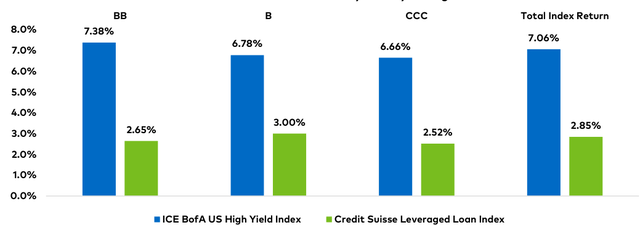
During the fourth quarter, the U.S. Opportunistic High Yield composite returned 3.94% gross and 2.88% net of fees, respectfully, compared to the 7.06% return of the ICE BofA U.S. High Yield Index (the “Index”).
In Q4, U.S. Treasury yields moved materially lower. The Portfolio maintained a shorter duration relative to the Index, which resulted in a negative duration effect. Further, the Portfolio’s income advantage compared to the Index contributed to the Portfolio’s relative performance. Lastly, the Portfolio’s restructured private equity holdings in the aggregate detracted modestly from relative returns.
Turning to quality attribution, the quality allocation effect was negative and driven primarily by the Portfolio’s overweight to CCC1-rated and CCC3-rated issues. These negative effects were partially offset from the Portfolio’s overweight to CCC2-rated issues, which contributed to relative performance. In addition, the Portfolio’s security selection effect by quality rating was negative. Specifically, the Portfolio’s CCC2-rated and CC-rated holdings lagged those of the Index and detracted from relative performance. These negative effects were partially offset by the positive security selection effects generated by the Portfolio’s CCC1-rated and CCC3-rated holdings, which outperformed those of the Index.
From a sector perspective, sector allocation was negative and detracted from relative performance. This negative effect was primarily driven by the Portfolio’s overweight in the Capital Goods sector. In addition, the sector security selection effect was negative. The Portfolio’s holdings in the Basic Industry and Healthcare sectors underperformed those of the Index and detracted from relative performance. These negative effects were partially offset by the positive security selection effects produced by the Portfolio’s holdings in the Automotive sector, which outperformed those of the Index.
Q4 2023 Total Returns by Quality Rating
From a sector perspective, sector allocation was negative and detracted from relative performance. This negative effect was primarily driven by the Portfolio’s overweight in the Capital Goods sector. In addition, the sector security selection effect was negative. The Portfolio’s holdings in the Basic Industry and Healthcare sectors underperformed those of the Index and detracted from relative performance. These negative effects were partially offset by the positive security selection effects produced by the Portfolio’s holdings in the Automotive sector, which outperformed those of the index.
A notable issuer that detracted from the Portfolio’s total return for the quarter is set forth below.
- Cano Health (CANOQ) – Cano Health operates primary care centers and supports affiliated medical practices. The Company specializes in primary care for seniors, and its business model is aligned with improving the health of its patients and lowering overall healthcare costs through preventative care. Cano underperformed Polen’s expectations due to a variety of factors since the position was initiated, and the Portfolio’s investment in the Company’s 6.25% Senior Notes due 2028 depreciated in value during the quarter. During November 2023, Polen opted to exit its entire position in Senior Notes at a substantial loss. Polen’s research indicated that the Company’s remaining liquidity was dwindling and that there would be a high likelihood of a comprehensive restructuring in the next six months. With approximately $1bn of First Lien debt ahead of the Senior Notes, in a restructuring, the holders of the Notes would be in a disadvantaged negotiating position. Polen believes would result in a de minimis recovery for the holders of the Senior Notes. As such, Polen believed that exiting the position, even at a substantial loss, was the best course of action.
Portfolio Activity
Polen Capital did not make any significant changes to the positioning of the Portfolio during the quarter. However, we increased positions in certain existing holdings, and initiated several new positions. Lastly, we executed the credit sale of Cano Health described above, while other sales that we executed, such as the one described below, were relative value transactions.
- Purchase – Forgital SPA (“Forgital”) is a leading manufacturer of open die rings used in aerospace engine construction as well as other broad industrial purposes worldwide. The Company’s products include rolled and forged rings, fan cases, valves and related products, which are used to create the external structure for products like airplane engines, transmissions and power generation fluid transfer equipment. Forgital benefits from long-term contracts with many major engine manufacturers. The Company is benefitting from a substantial backlog in aerospace work as the projected ramp in aircraft deliveries, particularly wide body planes, begins to come to fruition. Given the stringent specifications of the Company’s products, Forgital’s products are critical to their customer base, which greatly reduces product competition or substitution risk. During the quarter, funds and accounts managed by Polen Capital (including the Portfolio) initiated a position in the Company’s 7.375% First Lien Notes due 2026. Polen Capital believes the strong earnings trajectory of the business, combined with a modest loan-to-value, may lead to a refinancing of the First Lien Notes in the near term.
- Relative Value Sale – Ford Motor Company is an automotive manufacturer producing and selling over five million cars annually in the U.S. as well as certain other international markets. Funds and accounts managed by Polen Capital, including the Portfolio, originally purchased certain Senior Notes issued by Ford after its downgrade into the high yield market in March 2020. At that time, Polen Capital’s view was that the Company’s credit metrics would improve over the ensuing 2-3 year timeframe to levels in-line with other investment grade issuers. As a result of strong operations, a favorable auto pricing environment and Ford’s industry leading product portfolio, including the F-150 (which is the best-selling vehicle in the U.S)., the Company’s fundamental profile improved. This improvement ultimately resulted in the ratings agencies upgrading the Company, returning it to Investment Grade status in Q4 2023. Given the less attractive yield offered on the Senior Notes following the upgrade, Polen Capital eliminated its exposure to Ford and redeployed the proceeds to higher yielding opportunities.
Outlook
Leveraged credit markets ended 2023 on a high note. The recent rally among risky assets, including high yield bonds and leveraged loans, erased some of the memories of what was a tumultuous year. Both markets shrugged off concerns about the banking sector in U.S., which resulted in higher U.S. Treasury yields, as well as growing domestic and geopolitical angst. While banking woes appear subdued for now, the upcoming Presidential election in the U.S. will likely be the topic du jour for 2024.
Regardless, the end of year decline in yields that spurred the November-December rally may help leveraged credit issuers capitalize on lower interest costs to refinance existing debt in the new year. This dynamic, if it comes to pass, would be especially helpful for lower-rated credits that have been largely sidelined for most of the last two years. Assuming a lower-yield environment persists, we would anticipate an uptick in borrowers coming to market to price new issues.
Aside from lower financing costs, lower-rated borrowers would also benefit from a “soft landing” for the economy, the likelihood of which continues to grow. As we have noted repeatedly, fundamentals in the high yield market have proven resilient and would only be aided by a situation where rates drop while economic activity continues to remain positive.
Although loan fundamentals are more challenged than those of their high yield bond peers, this type of macroeconomic environment would also benefit issuers in this market.
Ultimately, in our view, this outcome would likely keep default rates at or around long-term averages.
As we head into 2024, while the recent rally has resulted in a tightening of spreads, we maintain a constructive view of the high yield bond and leveraged loan markets. Although we anticipate volatility during the upcoming year, we believe that current yield levels are attractive and more than compensate investors for the increased risk. Although leveraged credit market fundamentals in the aggregate remain healthy, careful credit selection remains paramount. We continue to identify attractive opportunities amongst issuers across each segment of the leveraged credit market. Accordingly, we view the current environment as favorable for an active manager like Polen Capital to potentially generate significant alpha for its clients.
Thank you for your interest in Polen Capital and the U.S. Opportunistic High Yield strategy. Please feel free to contact us with any questions and comments.
Sincerely,
Dave Breazzano, Ben Santonelli, and John Sherman
Credit: Source link