

sankai/iStock via Getty Images
I covered the Janus Henderson AAA CLO ETF (NYSEARCA:JAAA) several times last year. I was bullish, due to the fund’s strong, growing 6.2% yield, and safe, stable holdings. In this article, I’ll be covering JAAA once again, focusing on recent developments impacting the fund and its shareholders.
JAAA’s dividends have seen double-digit growth these past few months, a significant benefit for the fund and its investors.
The Federal Reserve intends to cut rates this year, which would almost certainly lead JAAA to cut its dividends. Although this is a significant negative, I believe that JAAA’s yield is likely to remain competitive after these cuts.
Credit spreads have narrowed, increasing the attractiveness of higher-quality, investment-grade funds like JAAA, over riskier, lower-quality funds and securities. Default rates have risen, with the same impact.
In my opinion, JAAA’s fundamentals remain reasonably strong, although the fund is likely to see lower dividends in the coming years. JAAA’s competitive 6.2% yield and safe, stable holdings make the fund a buy.
JAAA – Quick Overview
A quick overview of the fund, before analyzing some recent developments. I have a more in-depth look at the fund, and its underlying securities, here.
JAAA is an actively-managed ETF investing in senior CLO debt tranches, focusing on those rated AAA.
JAAA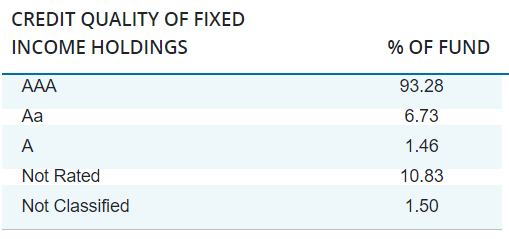
CLOs tend to generate a lot of income, with JAAA itself yielding 6.2%. It is a good yield on an absolute basis, and higher than that of most bonds and bond sub-asset classes. High-yield bonds do tend to yield more, however.
Fund Filings – Table by Author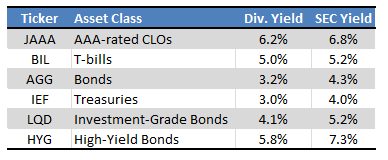
Credit risk is extremely low, as these investments are senior to other tranches / investors. As per S&P, not a single AAA-rated CLO has ever defaulted, and the product has existed for several.
S&P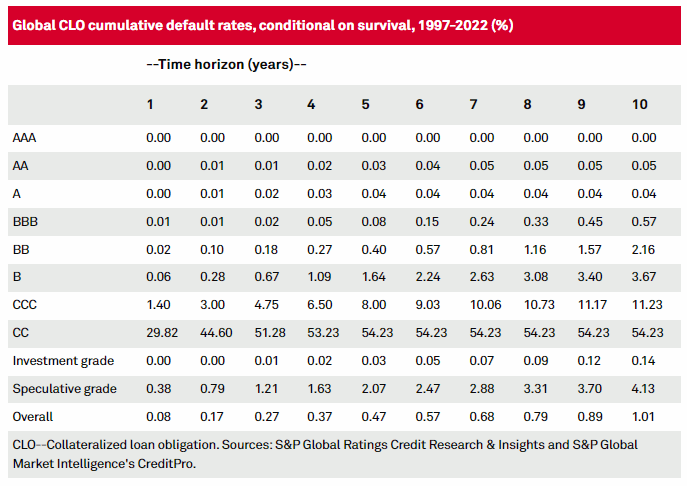
Low credit risk should lead to comparatively low losses during downturns and recessions, leading to outperformance versus riskier asset classes. JAAA has yet to experience a recession, so I am unable to gauge the fund’s performance during said scenario.
Interest rate risk is extremely low too, as JAAA’s underlying investments are variable rate. The fund sports a duration of 0.1 years, comparable to that of t-bills.
Fund Filings – Table by Author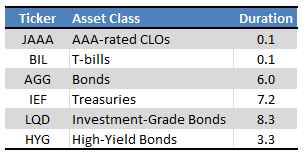
Low interest rate risk means outperformance when rates rise, as has been the case since early 2022.
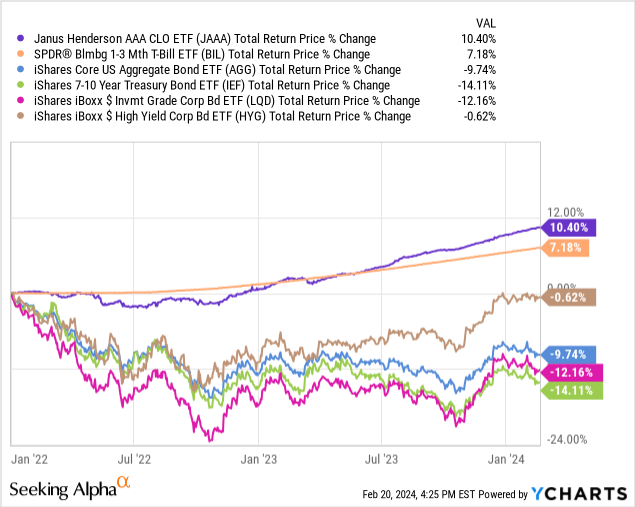
Low interest rate and credit risk leads to a comparatively safe fund with a stable share price, low volatility and drawdowns. JAAA is much less volatile than the average bond fund, although still riskier than t-bills.
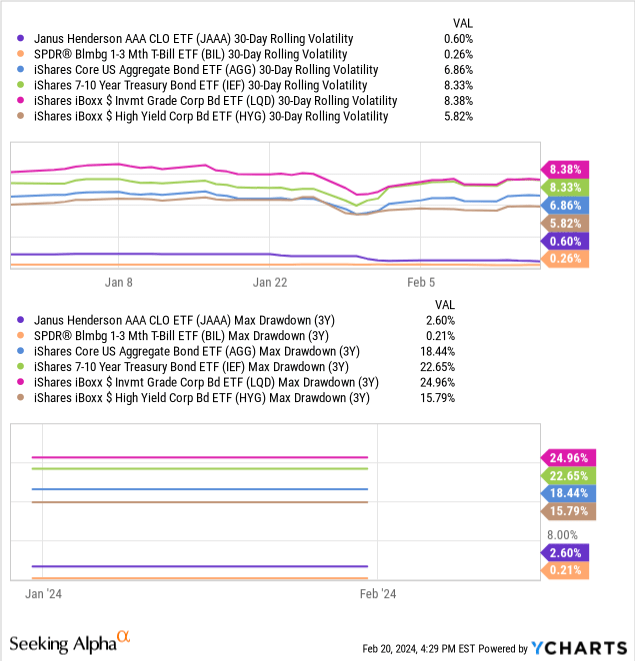
JAAA is an incredibly safe, stable fund and it sports an above-average 6.2% yield. In my opinion, this is an incredibly strong value proposition and risk-return profile, although obviously better suited for more conservative, short-term investors.
JAAA – Recent Developments
Strong Dividend Growth
JAAA’s dividends have seen very healthy growth these past few months. Dividends have more than doubled these past twelve months, growing by a whopping 102.1%. Most bond funds have seen lower growth, generally in the double-digits.
Seeking Alpha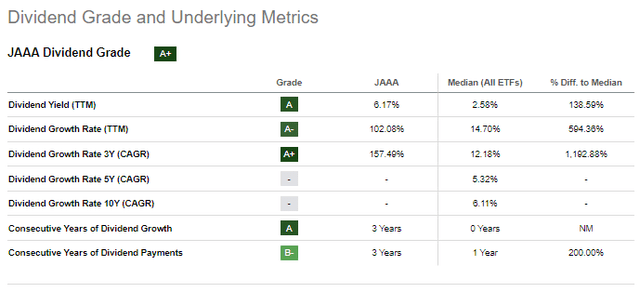
JAAA’s dividend growth was almost entirely due to Federal Reserve hikes. Rates went up by around 5.0% – 5.25%, and JAAA’s yield has increased by around 5.0%, so far.
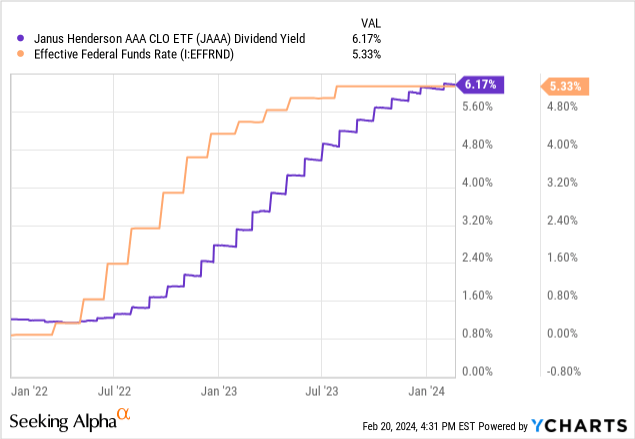
JAAA’s yield should continue to increase, as evidenced by the gap in the figures above. Annualizing the fund’s latest monthly dividend payment nets me a 6.4% yield. The fund sports a 6.8% SEC yield, a more forward-looking, standardized yield metric. Under these conditions, the fund should yield around 6.4% – 6.8% moving forward.
Recent dividend growth makes JAAA a stronger, more compelling investment opportunity right now than before. At least under current conditions, which brings me to my next point.
Expected Federal Reserve Cuts
The Federal Reserve is guiding for three rate cuts this year, another five next year. Rate cuts will necessarily lead to lower CLO yields, almost certainly resulting in lower JAAA dividends. The impact should be swift, and of similar magnitude to the rate cuts. As such, JAAA will very likely see significant dividend cuts in the coming months and years, a significant negative for the fund and its shareholders.
Notwithstanding the above, I believe that JAAA will continue to offer strong, competitive dividends to investors even after the Fed cuts rates.
One reason for this is the fact that most other ultra-short term securities and funds would also see lower dividends, and JAAA trades with a healthy spread to most of these already. As an example, the fund yields around 1.0% – 1.5% more than t-bills right now and should continue to yield more than t-bills after the Fed hikes. Federal Reserve hikes would impact the fund’s dividends on an absolute basis, but not relative to other short-term funds and securities.
Long-term bonds are another matter, but the fund’s 6.8% SEC yield is at a healthy spread to most of these. As an example, the fund yields around 2.5% more than 10Y treasuries.
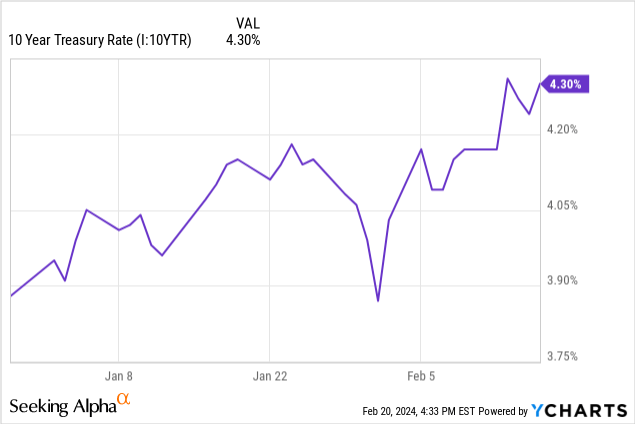
The Fed is guiding for three rate cuts next year, which would leave JAAA yielding around 1.75% more than 10Y treasuries. Double the rate of hikes, and JAAA would still yield 1.0% more. Go for the terminal rate, as projected by the Fed, and JAAA would yield 0.2% less.
Expected Fed rate cuts will almost certainly result in lower dividends for JAAA in the coming months and years, a significant negative for the fund and its shareholders. Nevertheless, I believe that fund dividends will remain competitive, and reasonably strong relative to peers.
Narrower Credit Spreads
Credit spreads have narrowed since at least mid-2022, as recession and inflation fears recede, and as markets turn bullish. Spreads currently stand at 3.3%, compared to a recent average of 4.0% – 5.0%.
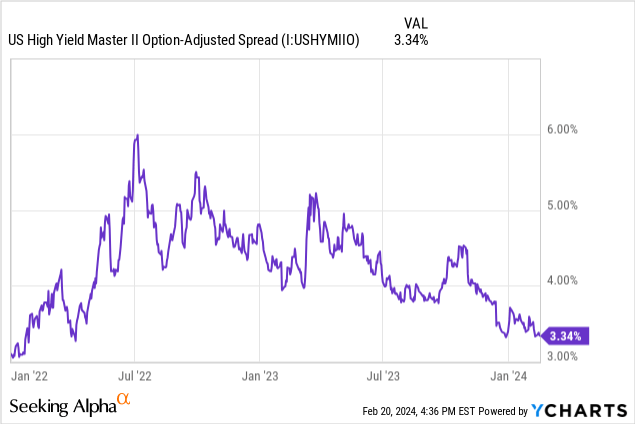
Spreads look even tighter relative to long-term averages.
JPMorgan Guide to the Markets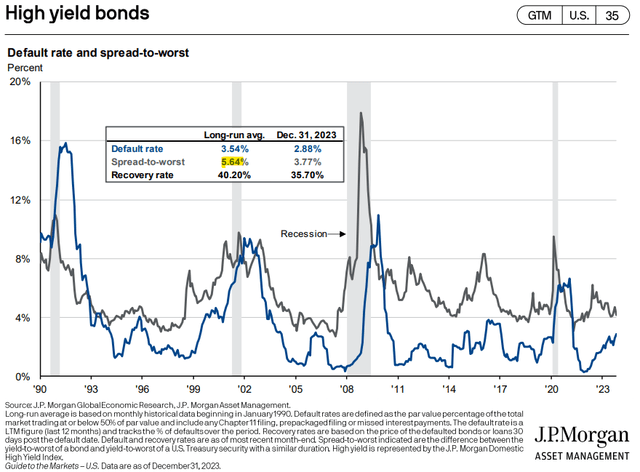
Tighter credit spreads increase the attractiveness of higher-quality, investment-grade securities and funds over riskier, lower-quality alternatives. JAAA focuses on AAA-rated CLO tranches, and is positively impacted by these trends. Still, riskier, higher-yielding bonds and funds should outperform long-term, but by less than in the past, and perhaps at unacceptable levels of risk.
Higher Default Rates
Tighter credit spreads have coincided with a worsening of economic conditions, with default rates reaching 4.2% this past September. Default rates are much higher than in the recent past, slightly higher than long-term averages.
S&P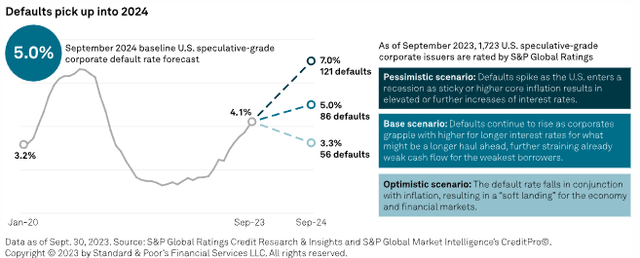
Higher default rates have the same impact as tighter credit spreads. Prospective returns for riskier, higher-yielding bonds are lower, with higher-quality, investment-grade securities offering somewhat more compelling value propositions. JAAA focuses on AAA-rated CLO tranches, and is positively impacted by these trends.
Conclusion
JAAA’s competitive 6.2% yield and safe, stable holdings make the fund a buy.
Credit: Source link