Eugene Mymrin/Moment via Getty Images
Thesis
Simplify Asset Management is an innovative ETF manager which came to market in 2020 as a direct result of a regulatory landscape change:
Alternative strategies can be a powerful way to improve portfolio risk-adjusted returns, but for decades these strategies have only been available to institutional investors, corporations, and the ultra-rich through hedge funds. This all changed in 2020 when the SEC announced rule 18f-4, allowing many of these strategies to be run inside ETFs, which are accessible to everyone.
We have covered a number of names from Simplify, some being more successful than others, but without a doubt, this asset manager has been very prescriptive about embedding complex strategies within the ETF wrapper. This strategy ultimately benefits a retail investor via the availability of exchange traded vehicles for said market views. The important part for an investor is to fully understand said strategies and decide if they fit within their portfolio and market views.
The Simplify Market Neutral Equity Long/Short ETF (EQLS) is another recently launched product from Simplify, in this case the ETF having come to market in mid-2023.
The fund represents a take on a classic long/short equity vehicle, with the added twist of embedded leverage via a TRS structure. In this article, we are going to take a closer look at what EQLS does, how it goes about to achieve that goal and try to present to an informed retail investor our take on this new vehicle from Simplify.
What is a long/short equity fund?
Let us see what BlackRock tells us regarding long/short strategies:
Long/short funds are designed to maximize the upside of markets, while limiting the downside risk. For example, they may hold undervalued stocks that the fund managers believe will rise in price, while simultaneously shorting overvalued stocks in an attempt to reduce losses. Long/short funds also use other strategies aimed at mitigating market volatility, including leverage and derivatives. Market neutral Long Short -strategy aimed at minimizing the fund’s sensitivity to outside market volatility.
Source: BlackRock
A long/short strategy is generally a hedge fund type of trade, where a manager can purchase a stock while shorting another, aiming to take advantage from the relative outperformance of one of them. Let us put this into context for 2024. A successful long/short strategy would have involved going long the S&P 500 versus short small caps:
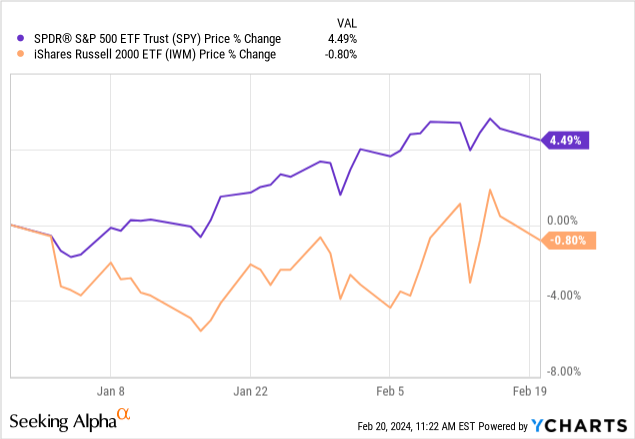
In this set-up, the fund manager would have bought the SPY while at the same time shorting the iShares Russell 2000 ETF (IWM). This strategy would have netted over 5% net return before any fees.
A similar strategy could have been pursued within the construct of the ‘Magnificent 7’ cohort itself. A long Amazon (AMZN) short Tesla (TSLA) trade would have outperformed in 2024:
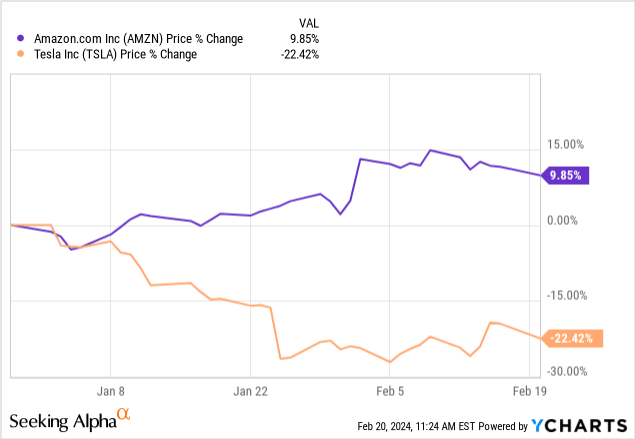
This trading pair done at a 1:1 initial deltas could have generated in excess of +30% this year.
What an investor needs to keep in mind is that the reversal can backfire significantly as well. Being long Tesla but short Amazon could look like a low volatility trade on paper (or in light of the 2023 performance), but would have generated significant losses in 2024.
At the end of the day, the strategy is very much dependent on the portfolio manager acumen, and in reality it contains two risk factors via the two chosen names.
Simplify is a bit vague when it comes down to their selection criteria, stating only the following:
The portfolio’s equity ranking system is driven by a proprietary multi-factor, machine-learning stock selection model developed by an industry-leading quantitative research firm.
What does the EQLS portfolio contain? Holding the cards close to the chest
The fund undertakes its long short strategy via total return swaps rather than outright holdings. Total Return Swaps (or ‘TRSs’) are derivatives which pass on the risk and rewards of pre-defined portfolios:
Holdings (Fund Website)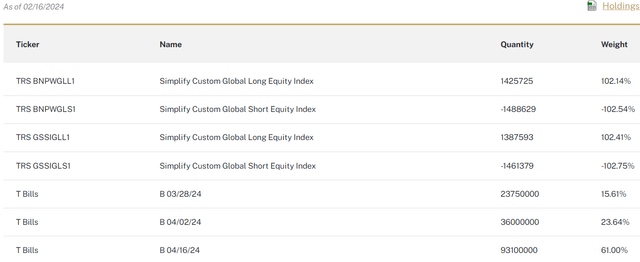
As of February 16, 2024, the fund seems to have 2 TRS facilities, one with BNP and one with Goldman, both being reported via their long and short legs. When it comes to actual individual names and their representation though, the ETF does not disclose anything. All we can gather is a macro allocation reporting:
Positions (Fund Fact Sheet)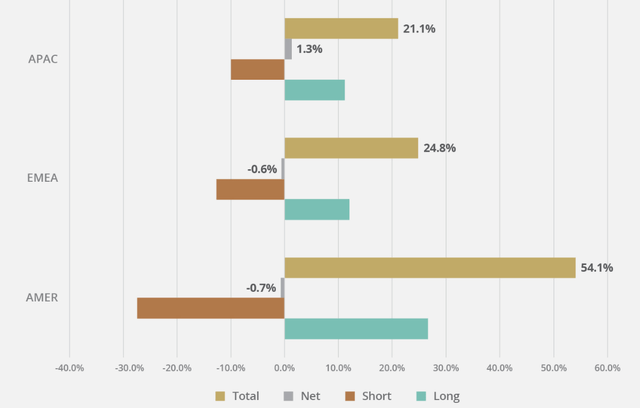
All we can tell from the above chart from Simplify is that the ETF is U.S. oriented with 54% of its gross exposure there, but we do not have an understanding of the individual names or sectors which are bought or sold.
From this angle EQLS is an opaque black-box hedge fund strategy, because an individual investor does not have any understanding of the individual long/short relationships pursued, and thus cannot determine any risk factors or appetite for said relationships. You just have to trust Simplify, or better said you have to look at the fund’s historic performance and determine whether its black box approach passes muster.
Performance is lagging so far
Given the black box approach undertaken by the fund, let us have a look at how it has performed since inception when compared to other long/short equity funds and the S&P 500:
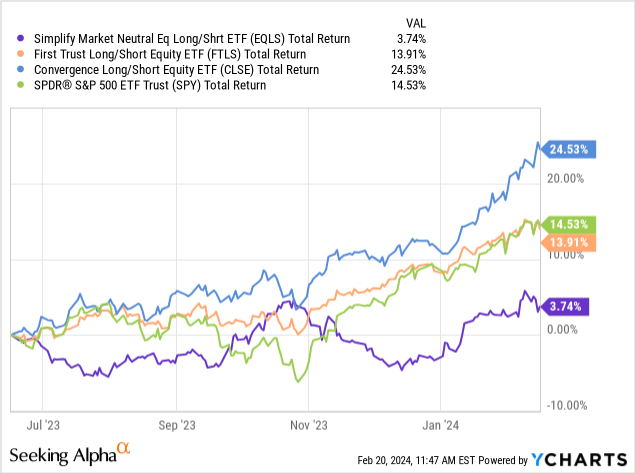
The fund has lagged when compared to the First Trust Long/Short Equity ETF (FTLS) and the Convergence Long/Short Equity ETF (CLSE), which are up over 13% since mid-2023.
However, EQLS does look to be market neutral from the current construct (i.e. neutral delta theoretically), while FTLS, which we have covered here, can be positioned directionally. The ultimate equalizer will be represented by analytics here, and once the 1-year anniversary for the fund comes around we will be able to analyze volatility figures, standard deviations as well as Sharpe ratios for the name. So far, it has failed to impress, and has barely beat a portfolio of T-Bills.
Is it worth buying or selling this ETF right now?
Given its black box approach to its portfolio, a retail investor cannot understand the fund sectoral or individual positioning, hence can only trust the manager. Trusting asset managers completely is never a good idea in our view, and the best approach is to monitor performance and risk factors. The ETF is new and lacks a track record, thus it is impossible at the moment to make an informed decision on whether to go long or short the name.
What we can gather from the above performance graph is that the fund was correctly positioned for the high beta names sell-off in October (the ETF gained value in October/November when other funds were selling-off), while in 2024 it has not been able to gain traction via the mega-tech outperformance versus the rest of the market.
Distributions and current yield
Given its TRS utilization, the fund has a high 30-day SEC yield of 4.02%:
Yield (Fund Website)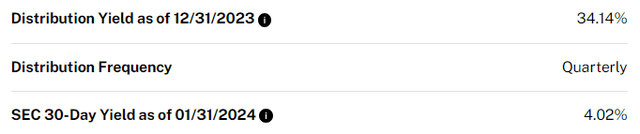
TRS facilities require margin posting but do not hit the balance sheet fully with the same funding requirements as an outright portfolio, thus the ETF is able to engage in some funding arbitrage and pay shareholders T-Bills returns minus fund fees (which are currently at an eye watering 100 bps).
Do not get too excited about the 34% distribution yield as of 12/31/2023. The ETF seems to want to pass on to investors annually the gains on the trading via one-time distributions, thus expect this ETF price to stay in a tight range in normalized markets, all while receiving large end of the year distributions in up-markets for the name.
Conclusion
EQLS is an equity long/short fund from Simplify. The vehicle is a new addition to the Simplify suite of products, having IPO-ed in mid-2023. The fund is described as a market neutral one, but takes a black box approach, disclosing very little in terms of actual individual names or sectors traded.
Since inception, it has lagged other peers in the long/short space, but we would need a full year of analytical data in order to derive true comparisons. The fund charges a high fee of 1% and currently lacks the transparency needed in terms of making an informed trading decision on taking a position in the name. What is fairly unique about EQLS is its innovative TRS usage, which allows it to pay investors a high 30-day SEC yield of 4.02%, driven by high T-Bill yields.
Credit: Source link