krisanapong detraphiphat/Moment via Getty Images
Investment Thesis
Sabra Health Care REIT, Inc. (NASDAQ:SBRA) Has been relatively plateauing over the last year, gaining just 2.80% compared to the S&P’s 500 gain of 21.38%. The price has been moving within a narrow range compared to the previous years, indicating a lack of momentum.
TradingView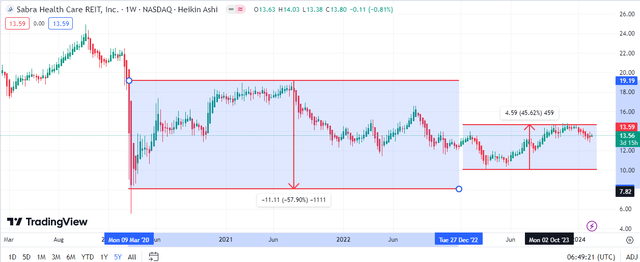
However, I am bullish on this stock given its strong upside potential, although investors should be wary of the risks involved.
The Appealing Face Of Sabra (The Reward)
Sabra has some attractive attributes that I believe could appeal to most investors, I inclusive. To begin with, the company has a diverse, stable, and balanced portfolio that blends private pay and government reimbursement sources.
SBRA Q3 2023 Presentation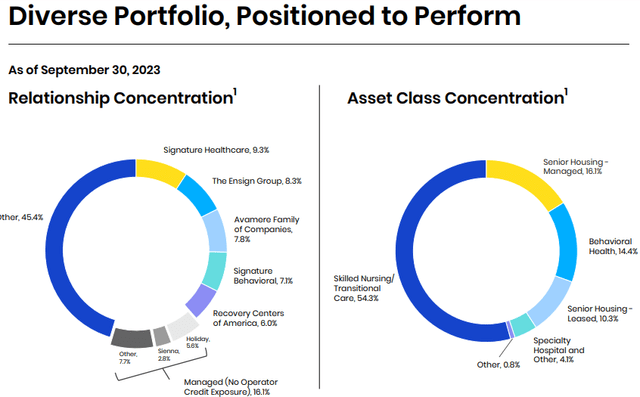
With such a diverse portfolio, it can only make sense to investors if it delivers. With this in mind, in the Q3 of 2023, the company reported an occupancy rate of 81.9%, slightly above the industry average of about 80% and a sequential increase of 170 bps, and the highest occupancy for the last 5 quarters. This not only signifies the strong performance of its assets but also signifies the company’s recovery post-Covid 19. Further, the company reported revenue of $161.63 million, marking a YoY growth of 14.82%. NOI for the quarter grew 5.3% excluding government stimulus funds.
From this information, the company’s portfolio is very stable and is delivering excellent results. The increasing occupancy rate, rent escalations and lease amends that the company is executing will keep driving this performance in the long run.
The other attractive aspect of SBRA is its dividend yield. The company has a 4-year average dividend yield of 9.28$ which is way above the sector median of 4.44%. Further, its trailing yield of 8.66% is also way above the sector median of 4.91%.
Seeking Alpha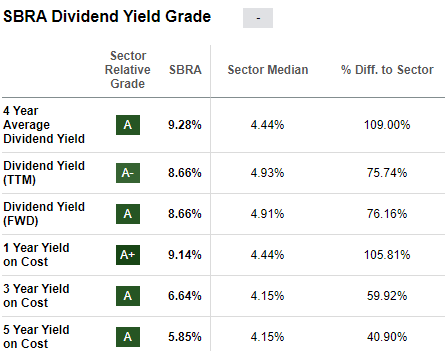
Interestingly, SBRA has paid dividends for 12 consecutive years compared to the sector median of 8 years, implying that it is a reliable and consistent dividend payer. Although the company’s consistent dividend growth was cut short by the pandemic, it is estimated that revenues will hit pre-pandemic levels this year, and thus I expect the company to resume its history of dividend growth by the end of this year or by next year.
Seeking Alpha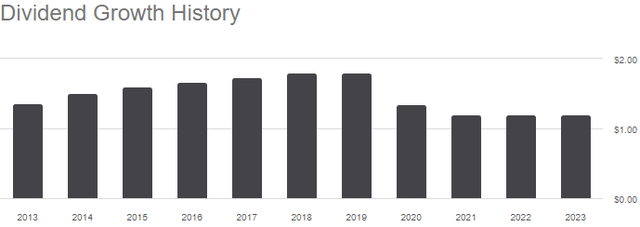
While dividend sustainability is a key thing to consider, most investors may be scared by the fact that SBRA reported negative net earnings, and therefore it could appear that the dividend is unsustainable, however, I think the dividend is safe considering FFO. It is important to use FFO to measure REITs dividend sustainability because it excludes non-cash expenses such as impairments. In Q3 2023, the company had an FFO per share of $0.33 which is higher than its forward dividend of $0.30. With this background, I think this company’s dividend is safe, and I expect the FFO to keep improving as the company benefits from its tailwinds as well as its improving efficiency through the capital recycling strategy.
Above all, the most pleasing aspect of this company is its growth opportunities. First off, Sabra is optimizing its portfolio through quality acquisitions and capital recycling. For example, in the MRQ, the company generated $80 million in gross from the sale of 13 assets, and the proceeds were used to reduce the outstanding debt. In my view, this efficiency strategy will improve the company’s productivity as well as give them financial flexibility if sustained in the long run.
Besides the portfolio optimization, the company’s growth is backed by major tailwinds. The first tailwind is the increasing rate of the aged population. Since 2000, the population aged 85 and above has grown by 60% translating to higher demand for Sabra’s facilities, especially the senior housing.
Q3 2023 Presentation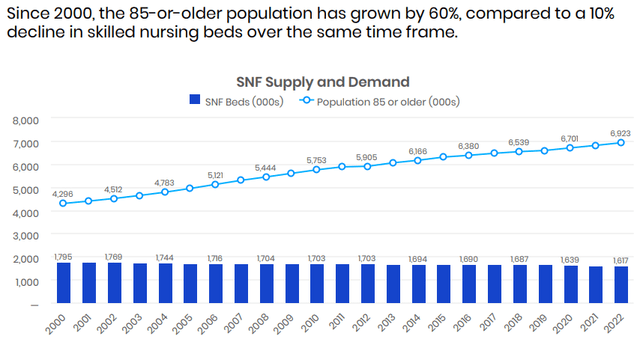
According to WHO, the population aged 80 years and above is expected to triple between 2020 and 2050. With this projected growth rate, I expect Sabra’s occupancy rate to increase significantly as they also increase their portfolio through quality acquisitions to tap into this projected growth.
The other tailwind is the rising healthcare spending. In 2022, the US NHE grew by 4.1%, and it is projected that it will grow by a CAGR of 5.4% between 2022-2031. To tap into these opportunities, the company’s strategy has been to diversify its portfolio and develop long-term relationships with operators who can deliver excellent services. With this in mind, the company has 65 operator relationships with a max relationship concentration of 9.3%. Further, its portfolio is among the top 5 relationship concentrations, which positions them competitively to capitalize on these tailwinds.
Q3 2023 Presentation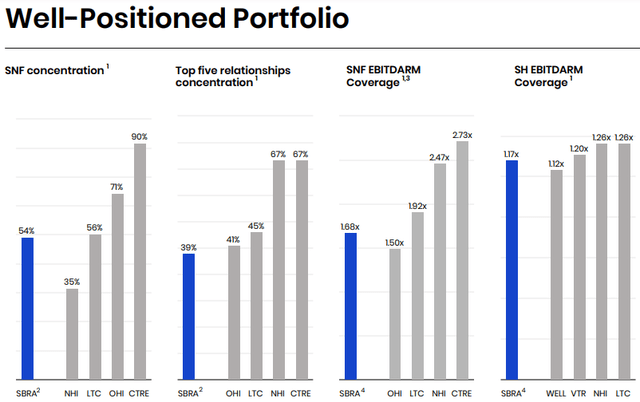
This growth bodes well for the company’s top and bottom lines, especially given its growing occupancy rates and rent increment. Another tailwind that compliments the aging population and growing NHE is the increasing rates for Medicaid and Medicare.
SBRA Q3 2023 Presentation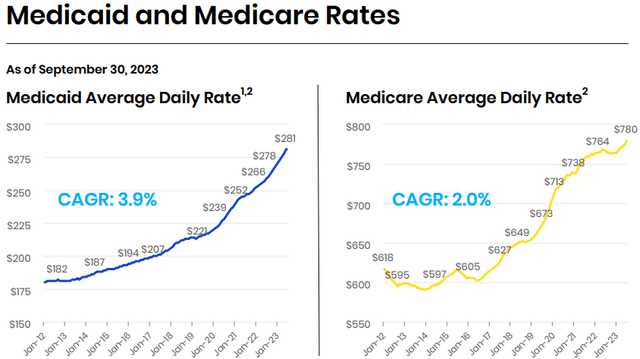
This growing rate translates to higher revenues and improved margins for Sabra. Most importantly, the rates are growing as the insured population grows, a double advantage for this company! In 2022, the US insured population grew to 92% which was a historic high. Further, private health insurance increased by 2.9 million and Medicaid enrollment grew by 6.1 million individuals. This strong growth bodes well for the company’s future financial performance, which should also be reflected in its share prices.
Headwinds
Although I am bullish on this stock, investors should be aware of some major headwinds that could dent their investments. To begin with, this company faces regulatory and reimbursement uncertainty. Sabra highly relies on regulatory reimbursement, especially those that rely on government programs such as Medicare and Medicaid. For this reason, any changes in rates, policy, eligibility, or criteria would adversely affect its financial health. For instance, the implementation of the Patient-Driven payment model in October 2019 caused volatility, with the stock declining significantly from its highs to its lows.
TradingView-Author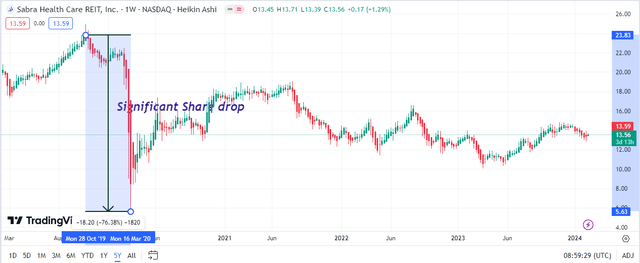
The other risk is the company’s leverage and interest rate risk. With a net debt to adjusted EBITDA ratio of 5.57x lower than its peers’ median of 5.07x, its leverage is relatively high. This could limit its financial flexibility and ability to pursue growth opportunities.
SBRA Q3 2023 Earning Report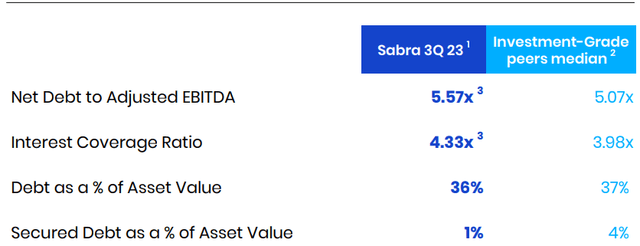
Additionally, its weighted average interest rate is 4.24% with a weighted maturity of about 5.1 years. With these long maturity dates, any increment in interest rates would increase the borrowing cost and therefore hurt its profitability and valuation.
Valuation
Based on my DCF model, I estimated a fair value of $15.92 translating to an upside of 17% from the current price of $13.59. In my estimations, I assumed a growth rate of 6% which is conservative considering the company’s 5-year free cash flow CAGR of 19% and the risks mentioned in this analysis. Further, I used a discount rate of 7.5% which is the company’s WACC according to my computations. Using the trailing FCF/share of 1.25 as the base, below is the model output given these assumptions.
Author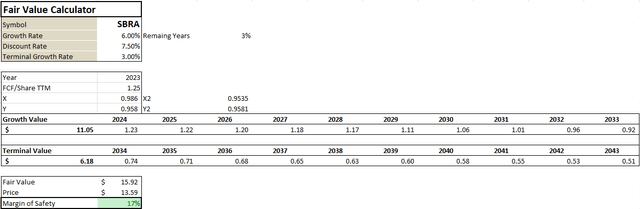
Based on this output, it is apparent that SBRA is undervalued with a double-digit upside potential and therefore it is a good entry point for potential investors.
One More Thing: Q4 2023 Earning, Near-Term Volatility Catalyst
With the company expected to announce its Q4 2023 earnings on the 27th of this month, this will be the stock’s near-term catalyst for volatility. Based on the company’s past performance and growth levers such as the increasing rent, occupancy rates, and increasing Medicaid and Medicare rates, I expect a strong Q4 2023. I expect revenue to be in the region of $161 million and EPS to be about 0.14. I also expect NOI to improve given the company’s resource optimization efforts. In a nutshell, I anticipate a strong quarterly performance which will trigger an upward movement of the company’s share prices.
Investment Takeaway
While this company has two major risks that could lead to a bearish momentum, I believe its growth opportunities, diversified business model and attractive dividend yield provide a strong downward protection and translate to a solid upward trajectory. Further, with no major debt maturities before 2026, I believe the downside is unlikely at the moment and therefore investors should leverage on the discounted entry point to enter this promising company. With its growth capabilities, I believe the company will generate adequate cash flows to pay its debt and lower its leverage. Further, its capital recycling strategy could also go a long way in mitigating the debt risk. In conclusion, I recommend with undervalued stock to potential investors, but they should be aware of the high risk-return trade-off.
Credit: Source link