
VALERY HACHE/AFP via Getty Images
Introduction
I previously covered Klepierre (OTCPK:KLPEF) all the way back in October 2021 where the focus of the article was on operations recovering post-COVID-19. You can tell how much things have changed since then, as the 10-year German government bonds were trading at a negative yield of -0.11%, well below the 2.37% as of the time of writing this article.
With the ECB hiking cycle widely expected to be over and ECB rate cuts forecasted to start this summer, in this article, I will highlight Klepierre’s debt structure and my target price for the company under several ECB cut scenarios.
Klepierre debt – low cost for years to come
Klepierre has neatly presented its outstanding bonds on its website. Looking through the upcoming maturities, we can observe that the company has 5.3 billion EUR in bonds outstanding, with 2.65 billion EUR locked in at rates below 2% until 2030 at the earliest:
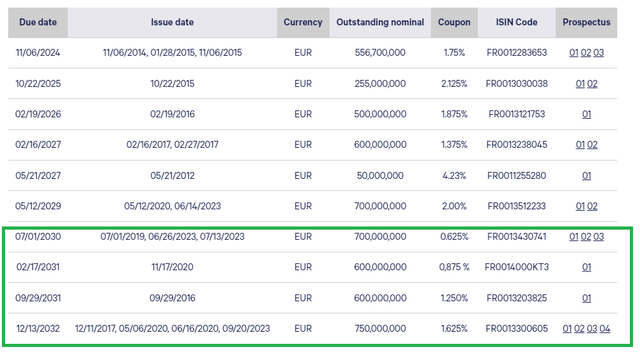
Structure of Klepierre bonds (Klepierre website)
The table above shows that half of Klepierre’s bonds don’t mature until 2030, with an interest rate fixed well below current levels. For comparison, Klepierre’s 0.875% February 2031 bonds with ISIN FR0014000KT3 currently yield around 3.92% and trade at an 18% discount to par:
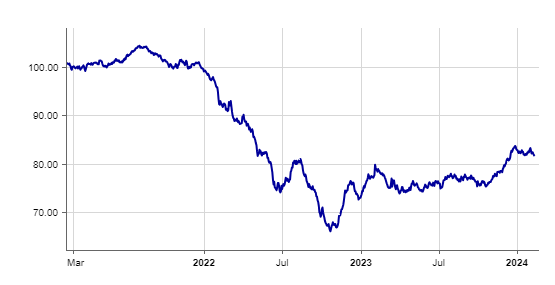
Klepierre 0.875% February 2031 bonds price developments (Boerse Frankfurt)
It should be noted that Klepierre uses other sources of financing in addition to bonds. Nevertheless, bonds account for about 70% of the company’s debt structure.
All in all, I expect the company to be able to fund itself long-term at a rate of 3.5%-4%, which is still above the 1.4% average cost of debt at the end of Q3 2023. As you can tell from the company’s bond maturity structure, the increase in interest expense will happen only gradually, with the company benefitting from rent indexation in the meantime.
Quantifying the impact of refinancing
As is evident from the previous paragraph, the company will only slowly refinance its debt at a higher level. In the table below, I will show the impact of refinancing all outstanding debt when it matures, assuming Klepierre issues the new debt at a rate of 3.75%:
| Due Date | Outstanding amount, a million EUR | Current Coupon | Change in interest when refinanced at 3.75% | Impact of net current cash flow, in EUR cents |
| November 2024 | 556.7 | 1.75% | 2.00% | 3.9 |
| October 2025 | 255 | 2.13% | 1.63% | 1.4 |
| February 2026 | 500 | 1.88% | 1.88% | 3.3 |
| February 2027 | 600 | 1.38% | 2.38% | 5 |
| May 2027 | 50 | 4.23% | -0.48% | 0 |
| May 2029 | 700 | 2.00% | 1.75% | 4.3 |
| July 2030 | 700 | 0.63% | 3.13% | 7.6 |
| February 2031 | 600 | 0.875% | 2.88% | 6 |
| September 2031 | 600 | 1.25% | 2.50% | 5.2 |
| 750 | 1.63% | 2.13% | 5.6 | |
| Total | 5,311 | 42.2, or 0.42 EUR/share |
Source: Author calculations
Using the current 286.5 million shares outstanding we see that the cumulative refinancing impact on net current cash flow (the key measure used by Klepierre to determine its dividend) should be about 0.42 EUR/share, with the majority of the impact, 0.24 EUR/share, only coming after 2030.
Calculating Klepierre’s market-implied cap rate
To calculate the market-implied net initial yield (or cap rate) I will use the EPRA Net Disposal Value (NDV) which I estimate stood at around 27.2 EUR at the end of 2023, after adjusting it downwards by 2 EUR/share for the fair value of interest rate debt as per the H1 2023 financial report (no NDV figure was released with the Q3 2023 results):
Market-implied net initial yield = Valuation net initial yield / Division factor where:
Division factor = Price/NDV Ratio * (1 – Loan-to-value ratio) + Loan-to-value ratio
Substituting with my estimates for Q4 2023, namely:
1. EPRA NDV = 27.8 EUR
2. EPRA Loan-to-value = 41%
3. Valuation net initial yield = 5.8%
4. Price at the time of writing = 23.5 EUR
You get a Price/NDV Ratio of 23.5/27.8 = 0.85, a division factor of 0.91 //0.85 * (1-0.41) + 0.41// and a market implied net initial yield of roughly 6.4%. We can also refer to this market-implied measure as Klepierre’s cap rate.
Cap rates between 2019 and 2023
In the table below, I will implement the above methodology to show the market-implied cap rate at the end of each year in the period 2019-2023:
| Period | Market-implied yield (cap rate) |
| 2019 | 4.72% |
| 2020 | 6.35% |
| 2021 | 6.06% |
| 2022 | 6.46% |
| 2023 | 6.18% |
| February 2024 | 6.40% |
Source: Author’s calculations
The data above can roughly be divided into two periods. In 2020 and 2021, Klepierre was mainly impacted by COVID-19, with the cap rate increasing by ~1.34% by the end of 2021, compared to 2019.
In the second period, 2022 and 2023, the main driver behind increasing cap rates was clearly the ECB, which took the rate on its deposit facility from negative 0.5% to 4.00%. This had the effect of an additional 0.12% increase in cap rates. However, due to the conservative structure of the company’s debt and its low fixed cost, the overall effect of the ECB rate hikes was manageable. Nevertheless, I would argue that the ECB rate hikes prevented the company from recovering some of the value lost due to COVID-19.
The ECB’s easing cycle
With ECB rate cuts only a few months away, the million-dollar question is what will be the long-term rate once the ECB finishes lowering its key interest rates. I reckon that due to the excessive impact COVID-19 had on Klepierre’s cap rate, the company should be able to recover some of that lost valuation as well. As a result, I think that should the ECB normalize policy at a level of 2% for the deposit facility, Klepierre will trade at a cap rate in line with its 5.8% valuation. In the table below, I will show three scenarios for rates on the ECB’s deposit facility and how these developments will impact Klepierre’s target price.
| ECB Deposit Facility Rate | Klepierre Target Price |
| 3% | 25 EUR |
| 2% | 27.5 EUR |
| 1% | 30 EUR |
Source: Author’s calculations
As you can see from the table above, we can roughly outline three ECB rate easing scenarios for Klepierre:
- Pessimistic – the ECB only lowers rates to 3%, implying a target price of 25 EUR for Klepierre.
- Base Case – the ECB lowers rates to 2%, implying a target price of 27.5 EUR for Klepierre
- Optimistic – the ECB cuts rates on its deposit facility all the way down to 1%, with Klepierre shooting up to 30 EUR/share.
Conclusion
Klepierre did an excellent job of hedging its interest rate costs during the 2022-2023 ECB rate hiking period. Half of its bonds outstanding mature in the early 2030s, with interest rates fixed at levels below 2%, well below current yields. The cumulative negative bond refinancing impact on net current cash flow over the next 10 years is set to be about 0.42 EUR/share and can be easily absorbed through rent indexation. That said, bonds only account for about 70% of the company’s debt, implying some additional costs associated with refinancing bank debt.
From a cap rate perspective, the superb hedging strategy and high valuation yields insulated the company from the ECB rate hike turmoil. Klepierre is now set to benefit as interest rates move down over the next two years, with my base case of a 2% ECB deposit facility rate calling for a target price of 27.5 EUR/share. Hence I believe the shares are worth buying at the moment. Since the company pays regular dividends and the ECB will only cut rates gradually, you may well supplement your Klepierre position with out-of-the-money short call options.
Thank you for reading.
Editor’s Note: This article discusses one or more securities that do not trade on a major U.S. exchange. Please be aware of the risks associated with these stocks.
Credit: Source link