• bitcoinBitcoin(BTC)$77,235.000.06%
  • ethereumEthereum(ETH)$2,524.260.49%
  • tetherTether(USDT)$1.000.00%
  • binancecoinBNB(BNB)$727.180.04%
  • rippleXRP(XRP)$1.370.77%
  • usd-coinUSDC(USDC)$1.000.00%
  • solanaSolana(SOL)$101.78-0.63%
  • tronTRON(TRX)$0.3398660.46%
  • Figure HelocFigure Heloc(FIGR_HELOC)$1.00-3.08%
  • zcashZcash(ZEC)$1,124.41-3.29%
  • HyperliquidHyperliquid(HYPE)$79.800.48%
  • dogecoinDogecoin(DOGE)$0.0847940.59%
  • RainRain(RAIN)$0.0157522.27%
  • moneroMonero(XMR)$539.243.69%
  • USDSUSDS(USDS)$1.00-0.01%
  • whitebitWhiteBIT Coin(WBT)$80.260.17%
  • chainlinkChainlink(LINK)$11.50-0.26%
  • leo-tokenLEO Token(LEO)$9.14-0.15%
  • cardanoCardano(ADA)$0.2072240.53%
  • stellarStellar(XLM)$0.1800321.06%
  • Ethena USDeEthena USDe(USDE)$1.000.00%
  • daiDai(DAI)$1.00-0.02%
  • bitcoin-cashBitcoin Cash(BCH)$226.29-0.64%
  • USD1USD1(USD1)$1.000.00%
  • litecoinLitecoin(LTC)$53.600.57%
  • uniswapUniswap(UNI)$6.356.24%
  • CantonCanton(CC)$0.0980550.82%
  • the-open-networkGram (prev. Toncoin)(GRAM)$1.381.61%
  • Global DollarGlobal Dollar(USDG)$1.000.01%
  • avalanche-2Avalanche(AVAX)$7.40-0.79%
  • hedera-hashgraphHedera(HBAR)$0.0746370.34%
  • shiba-inuShiba Inu(SHIB)$0.0000052.36%
  • nearNEAR Protocol(NEAR)$2.370.25%
  • suiSui(SUI)$0.72-0.02%
  • crypto-com-chainCronos(CRO)$0.0603357.01%
  • paypal-usdPayPal USD(PYUSD)$1.000.01%
  • BlackRock USD Institutional Digital Liquidity FundBlackRock USD Institutional Digital Liquidity Fund(BUIDL)$1.000.00%
  • MemeCoreMemeCore(M)$1.18-0.49%
  • tether-goldTether Gold(XAUT)$4,350.010.00%
  • Circle USYCCircle USYC(USYC)$1.140.00%
  • Ripple USDRipple USD(RLUSD)$1.000.00%
  • okbOKB(OKB)$114.451.13%
  • BittensorBittensor(TAO)$232.83-1.00%
  • Ondo US Dollar YieldOndo US Dollar Yield(USDY)$1.150.07%
  • aaveAave(AAVE)$125.450.65%
  • pax-goldPAX Gold(PAXG)$4,354.62-0.01%
  • AsterAster(ASTER)$0.690.70%
  • mantleMantle(MNT)$0.56-3.58%
  • World Liberty FinancialWorld Liberty Financial(WLFI)$0.0572113.34%
  • polkadotPolkadot(DOT)$1.02-1.99%
TradePoint.io
  • Main
  • AI & Technology
  • Stock Charts
  • Market & News
  • Business
  • Finance Tips
  • Trade Tube
  • Blog
  • Shop
No Result
View All Result
TradePoint.io
No Result
View All Result

This AI Paper Introduces StepCoder: A Novel Reinforcement Learning Framework for Code Generation

February 11, 2024
in AI & Technology
Reading Time: 5 mins read
A A
This AI Paper Introduces StepCoder: A Novel Reinforcement Learning Framework for Code Generation
ShareShareShareShareShare

Large language models (LLMs) are advancing the automation of computer code generation in artificial intelligence. These sophisticated models, trained on extensive datasets of programming languages, have shown remarkable proficiency in crafting code snippets from natural language instructions. Despite their prowess, aligning these models with the nuanced requirements of human programmers remains a significant hurdle. While effective to a degree, traditional methods often fall short when faced with complex, multi-faceted coding tasks, leading to outputs that, although syntactically correct, may only partially capture the intended functionality.

Enter StepCoder, an innovative reinforcement learning (RL) framework designed by research teams from Fudan NLPLab, Huazhong University of Science and Technology, and KTH Royal Institute of Technology to tackle the nuanced challenges of code generation. At its core, StepCoder aims to refine the code creation process, making it more aligned with human intent and significantly more efficient. The framework distinguishes itself through two main components: the Curriculum of Code Completion Subtasks (CCCS) and Fine-Grained Optimization (FGO). Together, these mechanisms address the twin challenges of exploration in the vast space of potential code solutions and the precise optimization of the code generation process.

CCCS revolutionizes exploration by segmenting the daunting task of generating long code snippets into manageable subtasks. This systematic breakdown simplifies the model’s learning curve, enabling it to tackle increasingly complex coding requirements gradually with greater accuracy. As the model progresses, it navigates from completing simpler chunks of code to synthesizing entire programs based solely on human-provided prompts. This step-by-step escalation makes the exploration process more tractable and significantly enhances the model’s capability to generate functional code from abstract requirements.

The FGO component complements CCCS by honing in on the optimization process. It leverages a dynamic masking technique to focus the model’s learning on executed code segments, disregarding irrelevant portions. This targeted optimization ensures that the learning process is directly tied to the functional correctness of the code, as determined by the outcomes of unit tests. The result is a model that generates syntactically correct code and is functionally sound and more closely aligned with the programmer’s intentions.

The efficacy of StepCoder was rigorously tested against existing benchmarks, showcasing superior performance in generating code that met complex requirements. The framework’s ability to navigate the output space more efficiently and produce functionally accurate code sets a new standard in automated code generation. Its success lies in the technological innovation it represents and its approach to learning, which closely mirrors the incremental nature of human skill acquisition.

This research marks a significant milestone in bridging the gap between human programming intent and machine-generated code. StepCoder’s novel approach to tackling the challenges of code generation highlights the potential for reinforcement learning to transform how we interact with and leverage artificial intelligence in programming. As we move forward, the insights gleaned from this study offer a promising path toward more intuitive, efficient, and effective tools for code generation, paving the way for advancements that could redefine the landscape of software development and artificial intelligence.


Check out the Paper. All credit for this research goes to the researchers of this project. Also, don’t forget to follow us on Twitter and Google News. Join our 36k+ ML SubReddit, 41k+ Facebook Community, Discord Channel, and LinkedIn Group.

If you like our work, you will love our newsletter..

Don’t Forget to join our Telegram Channel


YOU MAY ALSO LIKE

Blizzard Is Reviving StarCraft As An Open-World Shooter, But It’ll Be A Long Wait

Diablo V Is Coming Out In Spring 2029

Muhammad Athar Ganaie, a consulting intern at MarktechPost, is a proponet of Efficient Deep Learning, with a focus on Sparse Training. Pursuing an M.Sc. in Electrical Engineering, specializing in Software Engineering, he blends advanced technical knowledge with practical applications. His current endeavor is his thesis on “Improving Efficiency in Deep Reinforcement Learning,” showcasing his commitment to enhancing AI’s capabilities. Athar’s work stands at the intersection “Sparse Training in DNN’s” and “Deep Reinforcemnt Learning”.


🎯 [FREE AI WEBINAR] ‘Actions in GPTs: Developer Tips, Tricks & Techniques’ (Feb 12, 2024)


Credit: Source link

ShareTweetSendSharePin

Related Posts

Blizzard Is Reviving StarCraft As An Open-World Shooter, But It’ll Be A Long Wait
AI & Technology

Blizzard Is Reviving StarCraft As An Open-World Shooter, But It’ll Be A Long Wait

September 12, 2026
Diablo V Is Coming Out In Spring 2029
AI & Technology

Diablo V Is Coming Out In Spring 2029

September 12, 2026
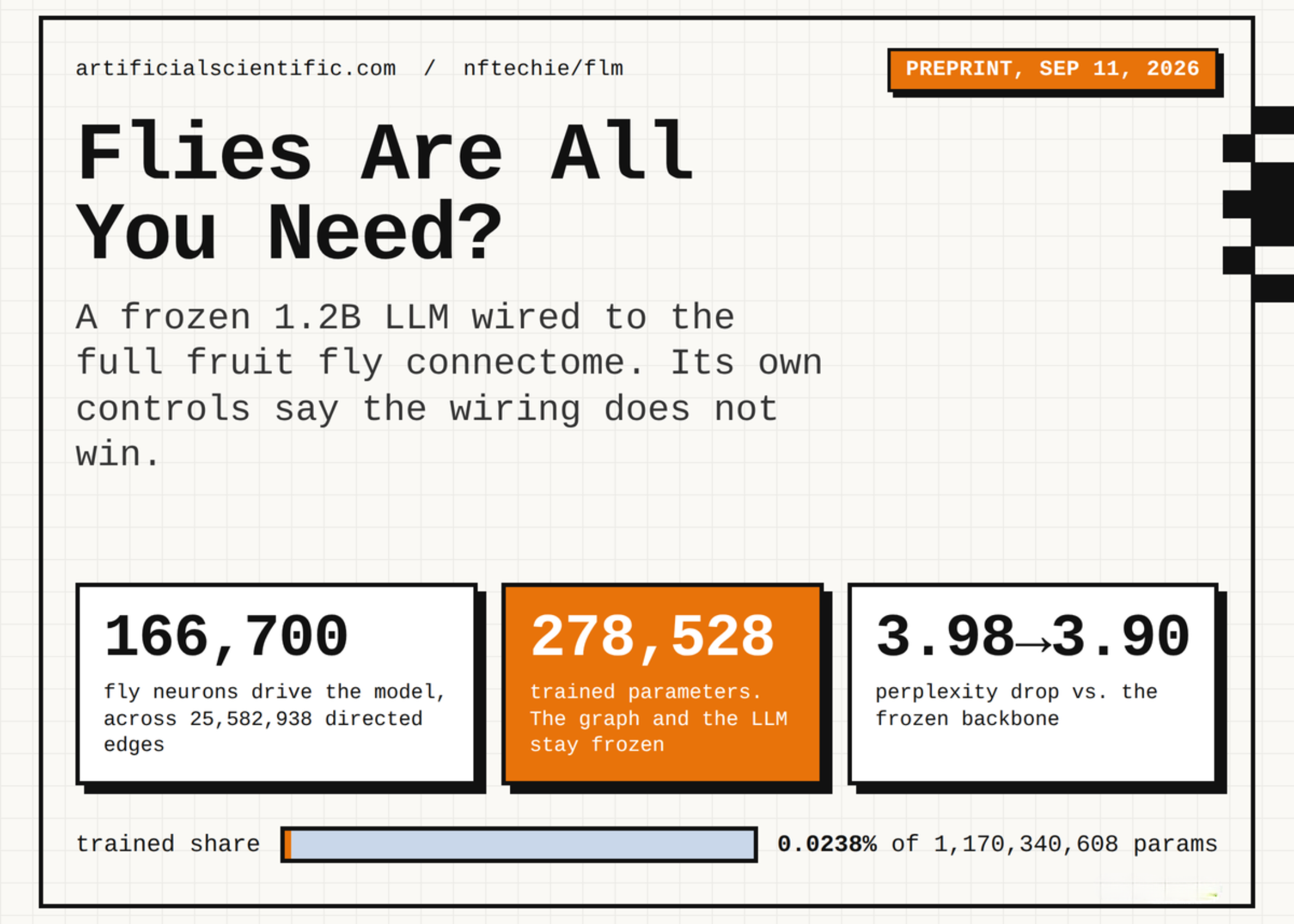
Fly Language Model (FLM) Wires the Full Fruit Fly Connectome Into a Frozen 1.2B LLM, and Its Own Controls Show the Wiring Does Not Help
AI & Technology

Fly Language Model (FLM) Wires the Full Fruit Fly Connectome Into a Frozen 1.2B LLM, and Its Own Controls Show the Wiring Does Not Help

September 12, 2026
Altman Says OpenAI Will Match Anthropic’s Embedded Evaluator Pledge – Unite.AI
AI & Technology

Altman Says OpenAI Will Match Anthropic’s Embedded Evaluator Pledge – Unite.AI

September 12, 2026
Next Post
S&P 500: Getting Crazy – Week Starting 12th February (Technical Analysis) (SP500)

S&P 500: Getting Crazy - Week Starting 12th February (Technical Analysis) (SP500)

Leave a Reply Cancel reply

Your email address will not be published. Required fields are marked *

Search

No Result
View All Result
Orca is seen torpedoing a sunfish, causing it to explode

Orca is seen torpedoing a sunfish, causing it to explode

September 6, 2026
OpenAI’s GPT-Live-1 Arrives in the API at alt=

OpenAI’s GPT-Live-1 Arrives in the API at $0.05 Per Minute – Unite.AI

September 10, 2026
More Weakness Ahead? Kevin Mahn Says Buy These 7 Stocks

More Weakness Ahead? Kevin Mahn Says Buy These 7 Stocks

September 10, 2026

About

Learn more

Our Services

Legal

Privacy Policy

Terms of Use

Bloggers

Learn more

Article Links

Contact

Advertise

Ask us anything

©2020- TradePoint.io - All rights reserved!

Tradepoint.io, being just a publishing and technology platform, is not a registered broker-dealer or investment adviser. So we do not provide investment advice. Rather, brokerage services are provided to clients of Tradepoint.io by independent SEC-registered broker-dealers and members of FINRA/SIPC. Every form of investing carries some risk and past performance is not a guarantee of future results. “Tradepoint.io“, “Instant Investing” and “My Trading Tools” are registered trademarks of Apperbuild, LLC.

This website is operated by Apperbuild, LLC. We have no link to any brokerage firm and we do not provide investment advice. Every information and resource we provide is solely for the education of our readers. © 2020 Apperbuild, LLC. All rights reserved.

No Result
View All Result
  • Main
  • AI & Technology
  • Stock Charts
  • Market & News
  • Business
  • Finance Tips
  • Trade Tube
  • Blog
  • Shop

© 2023 - TradePoint.io - All Rights Reserved!