

Ian Hitchcock/Getty Images News
Quantum-Si (NASDAQ:QSI) will launch the first low-cost desktop device capable of sequencing proteins from small samples without expensive equipment or specialist operators in the first quarter 2024. They have a first-mover advantage, an unmet need, and a developing scientific reputation.
If the launch goes well and the product is well received, QSI looks significantly undervalued and represents an excellent risk/reward investment.
This is the second article I have written on QSI; the first one explained the company’s technology and presented a mathematical model, the beginnings of a forecasting tool I will use to track the performance of QSI. In the six months since the first article was published, QSI has made huge strides forward. They are about to launch full-scale commercial activities, with a streamlined product lineup and a commercially focussed management team. The proteomics market they are entering is huge, held back only by the high cost of machinery to analyze and sequence the proteome.
The Product
The key to the success of QSI is its unique device. The world’s first desktop platform capable of sequencing proteins in the lab, one-tenth of the price of competing mass spectrometry equipment, it does not require specialist operators. It can work on tiny samples, delivering results at previously unthought-of speeds. QSI believes that their product should be in every medical lab worldwide.
I covered the technology and the potential size of the market in detail in my first article, but here is a short recap.
Samples are loaded into the device, where proteins are cleaved into smaller peptides that fall into millions of wells on top of the proprietary M2 silicon chip. Various reagents, which bind with specific amino acids, are added to the wells, and the silicon chip controls a series of lasers directed at each well. The different reagents emit different illuminances, which are recorded by the device. Measurement of the light is used to identify the elements within the protein, and the QSI software can deliver the required information to the researcher.
It is a unique and first-to-market solution capable of sequencing most proteins. With constant research into the reagents, it will eventually be able to sequence all proteins.
The potential market for the QSI platform is enormous; I previously linked a study by Markets and Markets that gave a TAM of $72.9 billion by 2028.
Changes Since My Last Report
Carbon Shelved
Carbon was the second device of QSI, and it was intended to be a partner device to automate sample preparation for use in the Platinum machine. In my last article, I reported that the device was under review, and in the Q3 earnings call, we heard it had been shelved indefinitely.
It seems a sensible move; the industry already has methods and practices for sample preparation, and integrating Platinum with those methods makes the device much easier to sell. It allows R&D to focus on improving the flagship product and ensure that the feedback from early adopters translates into changes quickly.
Re-design of the R&D operations
Having decided to drop Carbon, QSI has re-focussed its operations on more immediate issues, (CEO Q3 earnings)
To that end, during the strategic review process, we identified several product improvements across our library prep kit, sequencing reagents, and chips that could improve the sequencing output per sample, coverage and overall robustness of the full workflow from library prep to sequencing results.
I am pleased to share that these improvements will be included in Version 2 of our kits, which we expect to launch in the first quarter of 2024. We expect that these improvements will also provide greater compatibility between our next-generation protein sequencing technology, and the range of sample prep methods, sample types and even specific proteins our customers are interested in studying.
This new focus makes the company more customer-orientated, looking at the sample prep methods customers use and the proteins they are most interested in studying rather than what QSI could make. This is an excellent way to develop good long-term relationships, probably the only source of competitive advantage in today’s fast-changing world. At the moment, QSI has the only desktop protein sequencing tool. That situation will be short-lived, but by building these strong relationships, they will be in a solid competitive situation when new products arrive.
Consumables and reagents
QSI calls their consumables kits. Most of their work is now focussed on the kits, and version 2 of the kit will be released early in 2024, before the full-scale launch of Platinum. The kit is the set of reagents the machine needs to identify and sequence the amino acids in the protein sample.
The ability of the device to accurately recognize the amino acids it is looking at is crucial to the research being performed by the end user and, consequently, to the future sales of the device.
The reagents and recognizer chemicals are a crucial part of this ability. In the earnings call, we heard that the manufacturing of reagents had been brought in-house, which should lead to greater flexibility and improved margins as the company achieves large-scale production. Once the platform is in the field, consumables sales should be a long-term guaranteed repeating business.
In the Q and A session (Q3 223), a new recognizer was announced for glutamic acid, the proteome’s third most abundant amino acid. This delivery of new reagents and recognizers ensures the device is constantly improving, able to recognize more from smaller samples and increasing its value to research labs.
Quantitative data about precisely what the new V2 kit can identify will be released at the commercial launch (CEO Q3 earnings). The V2 is designed (unlike V1) to be compatible with the wide range of sample prep kits currently being used by potential customers, and it will be a crucial element needed for seamless integration of the platform.
Early Adopter Success
The controlled launch was an excellent commercial decision; it allowed problems to be ironed out before the full commercial launch. It ensured the product delivered what the customers wanted, not what QSI thought they wanted.
I described the customers who are part of the controlled launch as early adopters, and QSI has worked with them to improve many aspects of the product. Primarily the software and how it presents data. Feedback from the early adopters was crucial in ending the Carbon product, integrating Platinum with existing sample prep techniques and re-focusing the R and D on near-term improvements.
In October, QSI hosted a webinar in which Dr Danielle Tullman-Ercek, a professor at Northwestern University, lead scientist at the Tullman Ercek group, and founder of Opera Bioscience, discussed how she used the Platinum machine to accelerate her work. The webinar was aimed at Academic researchers and covered the benefits of next-generation protein sequencing, the technology behind it, and the results Dr Tullman Ercek had achieved using the device.
In the latest earnings call, the CEO of QSI said he expects the first published papers based on findings developed using the platform to arrive in 2024. This positive feedback from academia and new findings (when published) will build the market for QSI.
The Controlled Launch
As a forerunner to the full commercial launch, QSI has been running a controlled launch during the second half of 2023, first announced in the Q2 earnings call (Q and A). In the first half of 2023, QSI began building its commercial sales operation, hiring a sales and marketing team, and the first outbound marketing campaign was launched in Q2. The marketing team is developing the all-important customer relationships, identifying what features the device and software need to make it viable. Before the controlled launch, QSI had been selling products to small numbers of academic customers throughout 2023, the early adopters. The rollout will happen throughout 2023, and full-scale operations will begin in Q1 2024.
New Distributors
QSI has added several distributors since my first article in November Elta 90 signed up to distribute the product in South East Europe. Elta (based in Bulgaria) offers a range of medical and research equipment to the target market for Platinum. In December, 3Genes Distribution joined the team to cover Eastern Europe; 3Genes provides technology to life science and diagnostic companies and will be another good fit for Platinum. Thirdly, in January, QSI announced a Japanese distributor, Tomy Digital Biology, which is over 70 years old and imports and distributes life science technology throughout Japan.
These distributors are notable additions as they each serve the target market of QSI and will be able to get the product information in front of the right people at the right labs. It will likely lead to a significant ramp-up in sales after the commercial launch begins.
The Commercial Launch
The full commercial launch of Platinum will follow the launch of the V2 kit in Q1 2024, so it will incorporate all of the learnings made from the early adopters who have been using the device since early 2023 and the customers who made up the controlled launch over the last six or so months.
QSI has been building the infrastructure for this throughout the last two quarters, it will be an ongoing process and could affect the cost base; however, the new management team has so far managed costs well and has managed to reduce costs on a year over year basis by focussing on the products that count and eliminating those that will not deliver profits for the company or the shareholders.
The management
In my first article, I discussed the two recently appointed senior managers. The CEO and President were a key parts of my bullish thesis. They have proven skills for developing this type of company with a solid and successful track record.
They are now a year in post and have had a significant impact on QSI. Product development has become focused on customers and near-term alpha generation. A new team has been hired to manage the transition from a science experiment to a commercial, profitable entity. In Q3, we heard of a new CFO, COO, VP of operations, and VP of product development.
Three new independent directors were appointed, all with significant experience in the life science industry, and a chair of the nominating and governance committee was added to the team.
The new team chosen by the CEO and President is customer-focused and profit-orientated. They are developing commercial activities to ensure the launch’s success and that R&D focuses on the projects customers want.
As long as this team is in place, I will remain very optimistic about the chance of success.
The model
In my first article on QSI, I discussed a mathematical model I developed to track the progress of QSI. The article has information about version 1 and version 2 of the model, showing how I update when news arrives. V2 predicted FY 2023 and is proving to be accurate, the model forecast for Q3 2023 and its revenue was out by only 3%, and total operating costs missed by 2%.
With the commercial launch of the Platinum product imminent, I have extended the model to provide some longer-term guidance and targets. I will continue to use the model as a starting benchmark to track the company’s performance and develop an approximation for fair value using a DCF.
We are all aware of the inherent problems with this type of work; the output depends entirely on the input, and that input needs some explanation. The model is just a starting point; as QSI releases more data in 2024, the model will deliver insights I can use to make trading decisions later.
Model Revenue Growth
When Markets and Markets gave a TAM of $72.9 billion by 2028, they said the only restraint on the industry is the high cost of instruments and technologies. That will all change when the Platinum product becomes available in the coming weeks. The market is large, and demand is high. Protein research has potential in many areas, including toxicology, activity markers, drug action mechanisms, and new drug discoveries. If the product works as well as expected, it could be a huge revenue generator.
V2 of the model (the previous article had V1 and V2) forecasted Q3 revenue of $230K at a gross margin of 40%; Q3 came in with revenue of $223K and a gross margin of 48%. The model had total operating costs for Q3 at $26.7 million; actual figures were $27.3 million. I will use 48% as the GM in V3 of the model presented below, accepting that it will be lumpy in the early days of commercial production.
I have forecasted $5 million of revenue in 2024, following the $1 million I forecasted for FY 2023. The $5 million comprises $2.5 million from the US, $1.5 million from Europe, and $1.5 million from Asia. The 2024 forecast is higher than the current average forecast from Wall Street (they have $3 million); it takes in the recent distributor announcements for Japan and Eastern Europe. I have built in a steep ramp-up in sales from the initial launch to 2026, with the percentage increase dropping slowly toward the end of the forecast period. These revenue figures will be updated each quarter as management begins to provide color on the success of the commercial launch.
The steep ramp would reflect a successful launch of the product worldwide. This is not guaranteed, but it is a new disruptive technology with a pent-up demand in research institutes worldwide.
Revenue Growth (Author)
To generate Free Cash Flow, I need cost data not yet available from QSI as they have not yet begun commercial production. As a proxy, I have used the three-year averages from a mature and profitable company I follow in the medical manufacturing space, Intuitive Surgical (ISRG). The data taken from ISRG was as follows.
As a % of revenue
SG&A 14.4%, R&D 13.2%, Tax of EBIT 16.2%, Other Current Assets 4.5%, Tax Payable 1.2%, Deferred Revenue 7.7%, Other Current Liabilities 20.3%.
The model assumes QSI costs rise with inflation until they reach the values given by these ISRG percentages and, from then on, default to the percentage figure. Management has guided to full-year operating expenses of $100 million, slightly below the $104 million I had previously predicted so a slow cost growth seems reasonable.
As a % of Opening PP&E
Depreciation & Amortisation 20.3%, CapEx 43.4%
Other Data used in the model (from ISRG)
Days sales outstanding 53, Days Inventory 143, Inventory turns 2.6, Days Payable Outstanding 23.9.
The three-statement model delivers the following free cash flow forecast.
Fee Cash Flow Forecast (Author Model)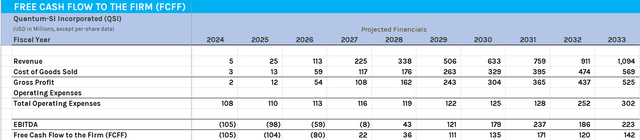
The model assumes a 10-year annual inflation rate of 2.15% and a calculated WACC for discounting of 3.54%.
For a terminal value, I decided to go with a multiple of final year forecast EBITDA. There are a couple of options for the terminal value, but the multiple of EBITDA is often used in industry as it makes for easier comparison between companies. The perpetual growth terminal value method is standard in academia and has a mathematically proven conceptual basis.
Intuitive has an EBITDA multiple greater than 50, which seems very big, so I decided against using it. A reasonable industry average appears to be between 9.7 and 17. I have used 10.
Under all of the above assumptions, the model gives a fair value calculation of $12.79 per share. At the time of writing, the shares are priced at $1.65.
The fair value is neither a price target nor a forecast; it represents what the business could be worth if it hits these revenue forecasts and manages its costs and manufacturing operations in line with a more established medical manufacturer.
The model also provides a potential break-even revenue of around $250 million.
I will use the model to track the performance of QSI and update it each quarter; eventually, it will become a valuable tool for predicting the future and lead to a better understanding of how individual financial figures affect the company’s cash flow.
The Balance Sheet
With no debt and shareholder equity at close to $300 million, QSI is in a strong financial situation.
QSI balance sheet summary (Author Database)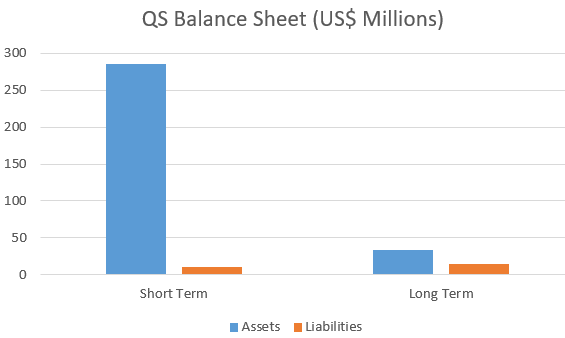
QSI has $275 million of cash on the balance sheet, giving it 11-quarters of cash runway. That will be enough to get to mid-2026, so some kind of capital raise will be necessary to reach profitability.
Conclusion
QSI is about to enter a new phase; it will start full commercial operation in the coming weeks. The Carbon platform has been shelved, and the V2 kit redesigned to integrate the Platinum machine with existing specimen prep workflows.
After running an extensive controlled release, the company has used feedback from its early adopters to improve the product to ensure it delivers what research scientists want in the way they want it.
The two senior managers I discussed in my previous article have made key hires as they transition the company to a commercial footing, building a sales and marketing team and focussing R&D on key improvements necessary to make Platinum a problem-solving device.
The device is significantly cheaper and easier to use than the current Mass Spectrometry method used by the industry, adding to its appeal.
If QSI can deliver its Platinum hardware device, the new V2 kit consumables, and continue to improve its software, the mathematical model suggests it may return hundreds of percent to early investors.
The mathematical model suggests a break-even revenue of $250 million and that free cash flow could arrive in 2027 with positive EBITDA in 2028. However, they currently only have the cash to get to mid-2026.
The risk to this bullish thesis is clear: QSI is about to launch. If sales go slowly, they will need to raise significant amounts of capital, and the break-even date will be pushed out beyond the forecast period.
If the product is poorly received, then the company will fail.
I am long QSI @$1.72 and will update in the comments as the trade progresses.
Credit: Source link