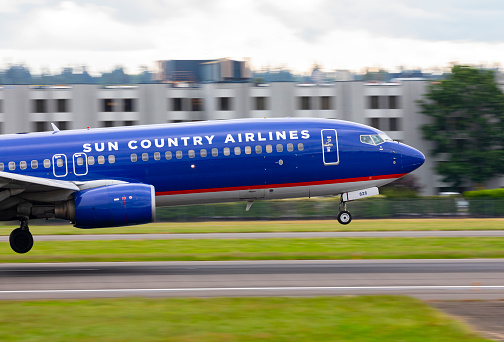

DaveAlan/iStock Unreleased via Getty Images
Investors should buy shares of Sun Country Airlines (NASDAQ:SNCY).
Down ~20% over the past year, Sun Country has garnered some short interest from investors looking to benefit from further declines in the firm’s stock price. However, Sun Country has subsequently outperformed companies such as Frontier (ULCC), Spirit (SAVE), and JetBlue (JBLU), which are its direct competitors in the discount carrier segment of the passenger airline industry.
Recent guidance provided in the firm’s December 2023 earnings report offers insight into Sun Country’s operational situation and the extent that the firm can reward current and future shareholders.
Going Concern
The following areas are of key importance to Sun Country’s performance:
- Segment results.
- Unit economics.
- Major liabilities.
1. Segment performance
Sun Country operates through two segments: passenger and cargo. The passenger segment accounts for ~90% of the firm’s revenues while cargo accounts for ~10%. Of the firm’s 54 aircraft, 42 are dedicated to passenger flights and 12 are purposed for cargo flights. Sun Country also offers charter contracts to complement its passenger segment. Key customers in this space include Major League Soccer and Caesars Entertainment (CZR). The firm’s major cargo customer is Amazon (AMZN). Sun Country operates converted aircraft on behalf of Amazon as “Prime Air.” This relationship has been beneficial for Sun Country, but encountered headwinds in 2023 as many of these cargo aircraft were grounded for extensive maintenance.
Past performance suggests that the firm’s management team will continue showing caution when growing new business lines. The legacy passenger segment has matured to account for all of the firm’s operating income. Sun Country’s cargo business generates revenue, but unfortunately does not add any operating income.
Sun Country November 2023 Investor Presentation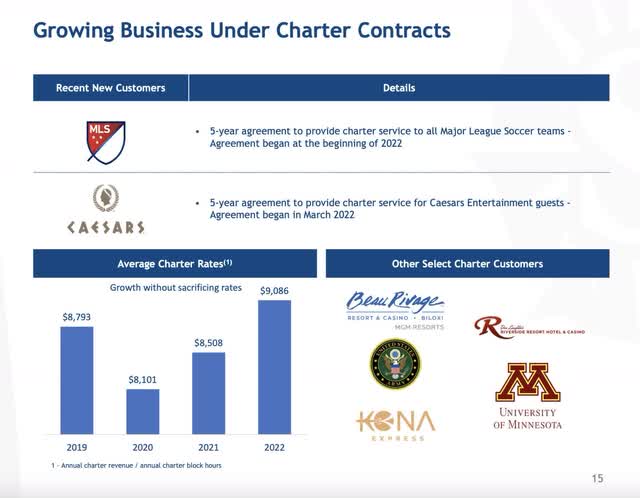
2. Unit Economics
Sun Country’s management team has focused on maximizing efficiency through the firm’s seasonal demand schedule. This is quantified by metrics including total revenue per available seat mile (TRASM) and EBITDA per aircraft. Sun Country boasts a higher TRASM than Frontier and Spirit. Moreover, Sun Country’s EBITDA per aircraft of $3.24 million exceeds that of its high-utilization competitors.
The firm’s per-unit efficiency is an area of competitive advantage that Sun Country’s management team should continue to exploit. This will require continued emphasis on not overestimating future demand.
Sun Country November 2023 Investor Presentation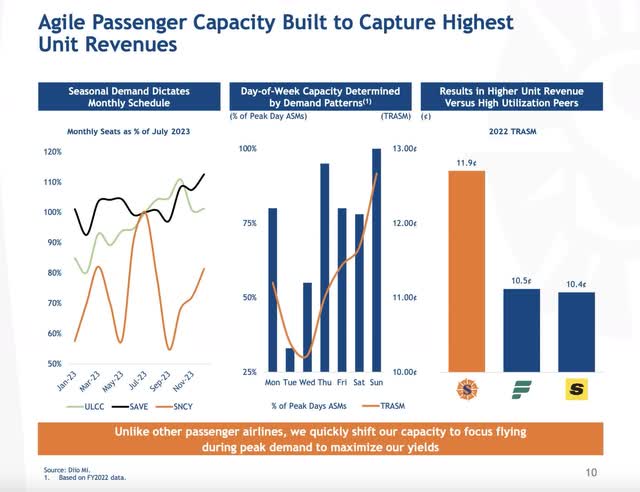
4. Major Liabilities
The airline industry is capital-intensive, which requires firms to take on high levels of debt. This debt can take on many forms, including pensions for employees, lease agreements for aircraft, and loyalty programs for customers. Pension debt, for example, made headlines in 2005 after Delta Air Lines (DAL) filed for bankruptcy and terminated the firm’s pilot’s pension plan. Moreover, in the same year, United Airlines (UAL) defaulted on its $9 billion pension obligation. Unfunded liabilities have subsequently been of utmost importance to equity analysts looking to understand the financial health of various airlines.
Sun Country does not have a pension plan for employees but does have a loyalty program for customers. This plan is intended to reward customers who frequently fly Sun Country’s domestic and international routes. From the firm:
The balance of the Loyalty Program Liabilities fluctuates based on seasonal patterns, which impacts the volume of loyalty points awarded through travel or issued to co-branded credit card and other partners (deferral of revenue) and loyalty points redeemed (recognition of revenue). Due to these reasons, the timing of loyalty point redemptions can vary significantly.
Sun Country’s financial managers must be cognizant to set aside enough funds to cover point redemptions. These redemptions seem to occur with reasonable regularity and timing, but a failure to anticipate future trends could harm the firm’s liquidity and solvency.
Another area of importance for Sun Country is its operating and finance leases. The key difference between these two is whether charges can be amortized (and thus written off for tax purposes) or paid out as a simple expense. Accounting rules dictate that finance leases are amortized, and operating leases are expensed. Fortunately for Sun Country, most of its planes are owned and not leased. In addition, of the planes that are leased, most are finance leased.
Modeling
To find a price target for Sun Country, I used multiples valuation. This is an admittedly subjective way of looking at the firm, but is appropriate given the capital intensity of the airline industry. My aim while constructing the model was to analyze all major airlines based in the United States to understand whether Sun Country is relatively overpriced or underpriced. Moreover, I utilized data from SEC EDGAR and Planespotters.
The model is structured into three major buckets: ultra-low-cost carriers, mid-sized carriers, and big four carriers.
- The ultra-low-cost carriers encompass Allegiant (ALGT), Frontier, and Spirit. These three companies are comparable to Sun Country because of their market capitalizations and business models. However, these companies feature more debt in their capital structures and have experienced declining EBITDA margins due to staunch competition.
- The mid-sized carriers include Alaska (ALK) and JetBlue which have larger market caps and enterprise values than Sun Country. Moreover, these companies are more financially stable than the ultra-low-cost carriers.
- The big four carriers are American (AAL), Delta, United, and Southwest (LUV). These companies don’t have much in common with Sun Country from a market cap or enterprise value standpoint. However, Southwest’s business model is fairly similar to that of Sun Country.
Following an analysis of these three buckets, two companies emerged as the best comps for Sun Country: Alaska and Allegiant. The median of these firm’s EV/EBITDA, 10.8x, was calculated to apply to Sun Country’s valuation.
EV/EBITDA is nothing more than a ratio comparing a firm’s enterprise value (its debt and equity) with its EBITDA (earnings before interest, taxes, depreciation, and amortization). Combining these metrics into a ratio allows for standardized comparisons across companies. A firm is theoretically undervalued if its current EV/EBITDA multiple is below that of its peer group.
Author’s model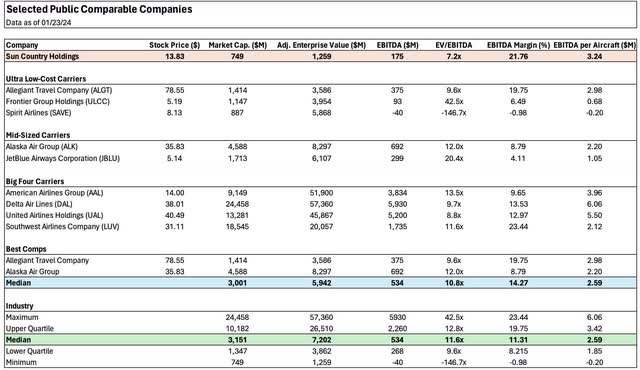
The peer EV/EBITDA multiple of 10.8x was applied to Sun Country’s existing EBITDA to find the firm’s enterprise value. This yielded an EV of $1.89 billion, which was then compared against the firm’s total debt and cash to find an equity value of $1.48 billion. Sun Country has ~60 million shares outstanding according to the treasury stock method (adding in-the-money stock options to common shares outstanding). This figure was divided out of the firm’s equity value to yield a share price of $24.91.
| EBITDA ($M) | 175 |
| Peer Multiple | 10.8x |
| Enterprise Value ($M) | 1,890 |
| Less: Total Debt ($M) | 435 |
| Plus: Cash ($M) | 27 |
| Equity Value ($M) | 1,482 |
| Shares Outstanding (m) | 60 |
| Share Price ($) | 24.91 |
Conclusion
After a challenging 2023, Sun Country Airlines presents a unique opportunity for value investors looking for small-cap industrial exposure. The firm is well-managed, and has avoided the quagmire of direct competition in the ultra-low-cost carrier segment of the airline industry. Even so, a thorough comparable companies analysis reveals that Sun Country appears undervalued relative to every other major airline in the United States.
Credit: Source link