

FrankRamspott/E+ via Getty Images
Investment Thesis
Global Insured Catastrophe losses exceeded $100bn for the 4th year running according to a recent report by Aon.
Climate change and demographic change make this likely to be a long term trend.
Insurance and reinsurance companies are one way to invest in this trend – but these have to be able to stay ahead of the trend in their pricing. Service providers to the insurance industry are set to profit even if insurance companies do not.
Loss adjusters play a critical role in helping insurance companies settle claims with their customers. When disaster strikes, demand for their services increases.
Crawford & Company (NYSE:CRD.A) (NYSE:CRD.B) is a leading global loss adjusting company, with a sound balance sheet, improving margins, good growth and a p/e ratio of under 12 x. As a data and tech company that flourishes in the eye of the storm, they are well positioned to capture growth and improve margins.
Crawford and Company Introduction
Atlanta GA based Crawford & Company is a leading global provider of claims management and outsourcing solutions to insurance companies and self‐insured entities with an expansive network serving clients in more than 70 countries.
They are in the business of putting a value on the costs of insured losses, and helping insurers estimate the true financial costs incurred by their clients in order that payouts can be agreed. They also help keep these financial costs down, by advising insurers and their clients of loss reduction steps, and speeding up the claims settlement and restoration process.
Crawford has four business segments, which are more or less equal in revenue contribution. These are North American Loss Adjusting, International Operations Loss Adjusting, Broadspire, a third party administrator, and Platform Solutions, a tech enabled outsourcing provider. I will provide more details of each segment below.
Improving Results
2023 has been a strong business turnaround year, as explained in their Q3 results presentation.
2022 had been a difficult year for Crawford, as with many businesses that had been blindsided by inflation, and mismatch between their income, often on pre-negotiated agreements, and their operating costs to execute on those agreements. In dealing with losses from both Hurricane Ian and the European storms in 2022, Crawford margins were significantly squeezed between a shortage of skilled loss adjusters, and service agreements that we in place with their clients. 2023 was a turnaround year, as Crawford were able to manage margins better on both ends of the chain, by adjusting pricing, and improving their operational productivity.
Q3 was a great set of numbers, with all businesses showing growth in top line, and a significant improvement in operating margins overall. This was the 12th consecutive quarter of revenue growth for the company.
Company Investor Relations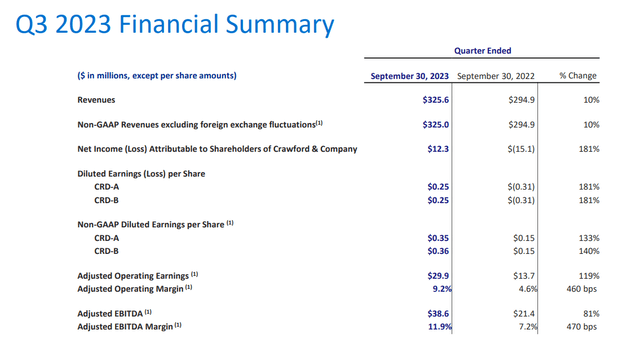
These results enabled CRD to increase the quarterly dividend from 6c to 7c in Q2, and maintain this in Q3 – a 16.6% increase in the dividend, which now produces a 2% yield.
Segment Results & Segment Deep Dive
I will explain in more detail the results of each segment, and delve a little deeper into what these segments do.
North American Loss Adjusting
Accounting for 24% of total sales, this unit provides loss adjusting services in U.S.A. and Canada to Property and Casualty Insurers. This is an expert adjusting model, which is focused on the settlement of complex claims by highly skilled adjusters. Forward growth is expected to be in the low to mid-single digits, with more margin upside.
The quarter showed a great increase of 19% in year on year revenues, and an improvement in operating margins.
Company Investor Relations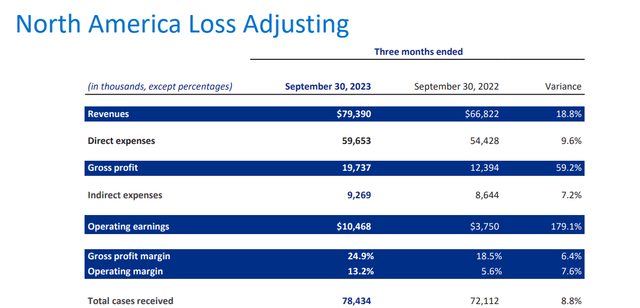
International Loss Adjusting
This segment is a direct equivalent to the North American segment, providing loss adjusting services in U.K., Europe, Australia, Asia and Latam. It is the largest segment, representing 29% of sales. It is also the segment with the poorest 2022 results, and produced a major turnaround. Revenues were up 14% and a $4bn operating loss in Q3 2022 recovered to a $2bn profit for Q3 2023. Management focus is on continuing to improve margins via pricing and productivity improvements.
Company Investor Relations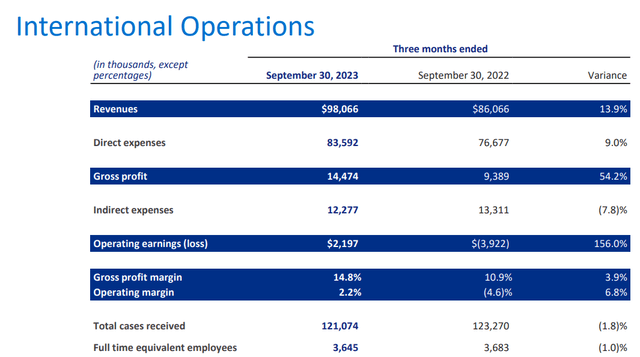
Broadspire
Broadspire is one segment where management expects to see increased revenue growth, and I concur. This segment, representing roughly 1/4 of revenues, deals with outsourcing of the claims processes, and serves what CRD refers to a ‘Alternative markets.’
This is a big growth segment in the Insurance industry, and worth understanding. The main areas here are MGA’s and Captives.
MGA’s – An MGA, or ‘Managing General Agent’ is an alternative to a full insurance model, in which an Insurer outsources most of the business operations to an agent, while bearing most if not all of the underwriting risk. In turn, MGA’s tend to run on a lean operating model, focused on underwriting and fully outsource most of the business operations, including claim management.
According the this report by McKinsey, the MGA space is growing rapidly, with some 7% of US and 10% of U.K. insurance premiums managed by MGA’s. 47% of US insurers have MGA relationships, including 70% of the top 10.
Captive Insurers.
There is an increasing trend for captive insurance companies as an alternative to traditional insurers. According to this report by Carlton Fields, the captive industry is expected to grow from $71bn of premiums in 2021 to $250bn of premium by 2028. A captive insurer is an insurance company which is set up by a company to help it retain and manage more of its own insurance risk, improving their risk management control, and reducing costs. As with MGA’s captive insurers operate on a lean basis, with most of their operations outsourced.
Broadspire offers data and analytics solutions to help captives manage high volume claims, particularly in medical insurance and workers compensation, two major areas of captive insurer growth.
Between Captives and MGA’s Broadspire is well positioned to capture above system growth in sales, and with data and analytics, improved margins. Q3 demonstrated this with a 12.7% increase in sales YOY and a doubling of operating margins.
Company Investor Relations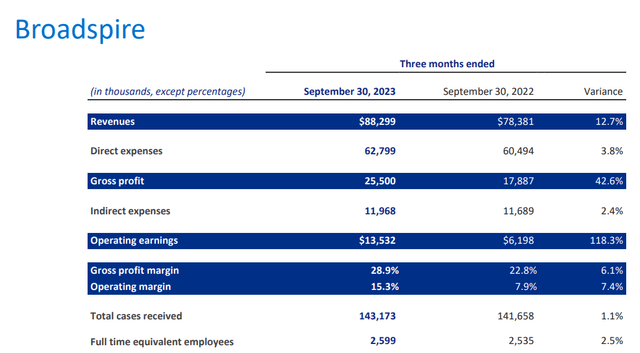
Platform Solutions
The smallest segment with 18% of revenues is in Platform Solutions. I see this as a pretty exciting area for growth, as this segment is where technology and AI are put to work. Platform solutions are streamlined Insurtech based businesses, which reduce the costs of mass claims management. Some of the main business areas here are CAT, and We Go Look.
We Go Look is a service where simple property damage claims can be assessed by Insurance companies without ever leaving the office. Basically Crawford has a large network of trained staff, who can visit a property and with imaging technology, upload details of the damages directly into the insurers systems.
Company Investor Relations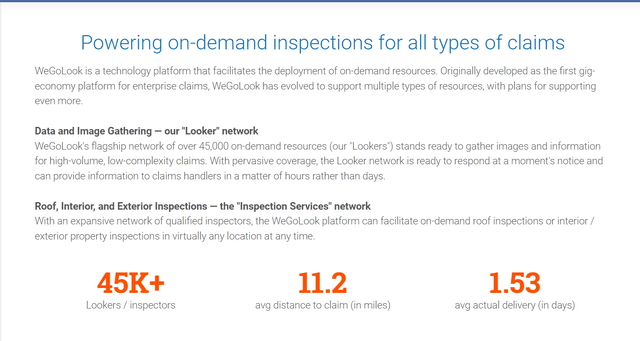
CAT
When large disasters strike, it becomes a mission critical time for Insurers the manage a much higher volume of claims than normal. Loss adjusters like Crawford become a key resource for insurers to be able to secure good financial outcomes, but also importantly good reputational outcomes.
More frequent and widespread Catastrophe events such as Hurricane Ian in 2022 have underlined the importance of having access to a high quality CAT response. Leveraging technology, such as predictive analytics, drones, and satellite imaging, CRD is able to supplement their large team of human loss adjusters with cutting edge loss assessment and adjustment solutions.
These are just two examples of how the Platforms segment works.
Q3 results showed the impact of a slower quarter for losses vs Q3 2022, with a 9% reduction in cases received, a 6% reduction in top line, and a 15% reduction in earnings. This is the highest margin of the four segments, with 23.5% operating margin.
Company Investor Relations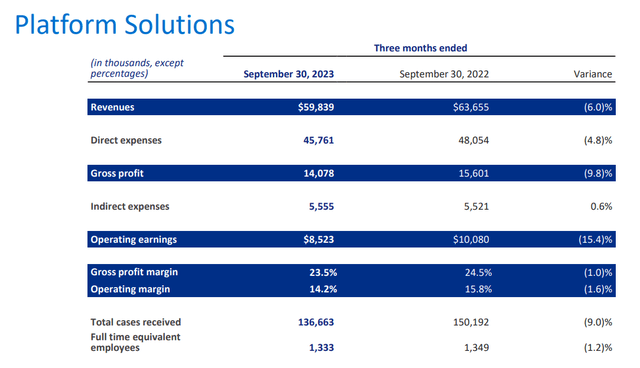
Growth Drivers
CRD identify several compelling growth drivers:
Company Investor Relations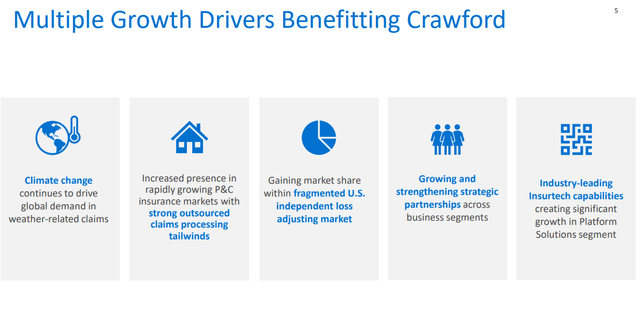
Climate Change – as highlighted by the Aon report, catastrophe losses have been increasing over the last decade, with an overall 25% increase over the decade, however all of the last four years loss burdens, have exceeded $100bn which indicated that the change is accelerating.
This exhibit from Swiss Re shows the trend clearly:
Swiss Re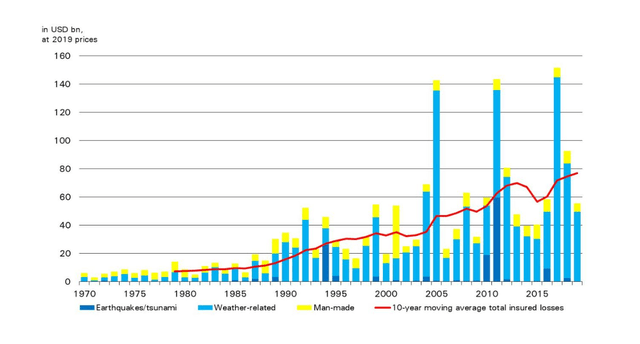
More claims outsourcing from a market which in itself is growing. CRD legacy client base, the Insurers, are under pressure to reduce costs. Typically, an insurance company spends up to 40c of every dollar of premium on their own operating and sales costs. With government pressure on insurance affordability, and disruptive business models enhancing competition, outsourcing is a strong focus for many companies. As discussed above, MGA’s and Captives are also expanding, both with mainly outsourced models.
Consolidating Market – the loss adjusting industry is highly fragmented, and with the need for investments in technology and scale in adjusting resources, the segment is consolidating. CRD is positioned to be one of the winners in this consolidation, both by organic market share, and M&A.
Technology – as discussed above, CRD is positioned as a technology and data driven company, who see data and tech as a huge supplement to their existing expert human model, and seek to offer this directly to clients through their Platform business. I am surprised that their Investor pitch doesn’t utter the ‘AI’ catchphrase, because I see AI, machine learning and data and analytics as a core part of their business.
Balance Sheet
The balance sheet is in decent shape, with a debt to EBITDA ratio of 1.4, which meets management’s target. While total debt to equity is on the high side at 132%, the current ratio is a solid 1.31. (figures according to Interactive Brokers).
The dividend raise and a share buyback show management confidence here.
Company Investor Relations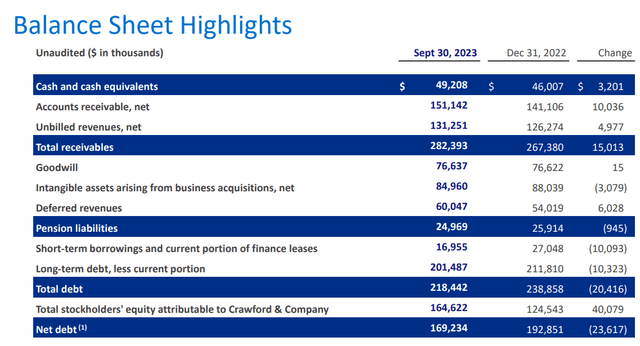
Valuation
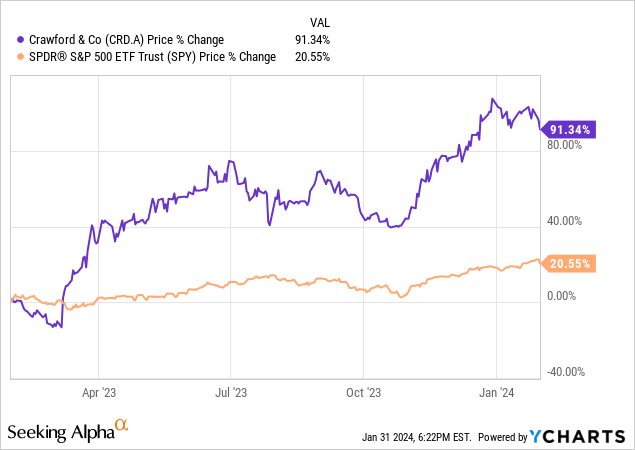
CRD has had a significant run up following the strong Q3 results, with the price recovery significantly better than the market (SPY) on a 12 month basis.
This has caused SA quant to drop their rating from a buy to a hold with a C for Valuation. Given the big volatility in 2022/2023 earnings, it’s not surprising to see SA Quant showing D under revisions.
Seeking Alpha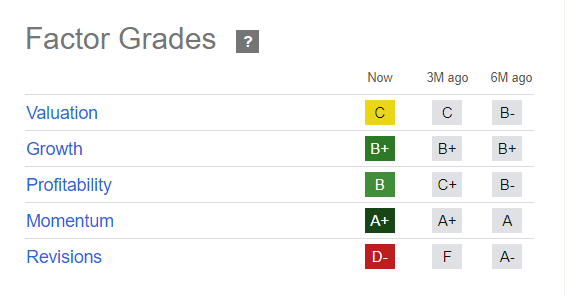
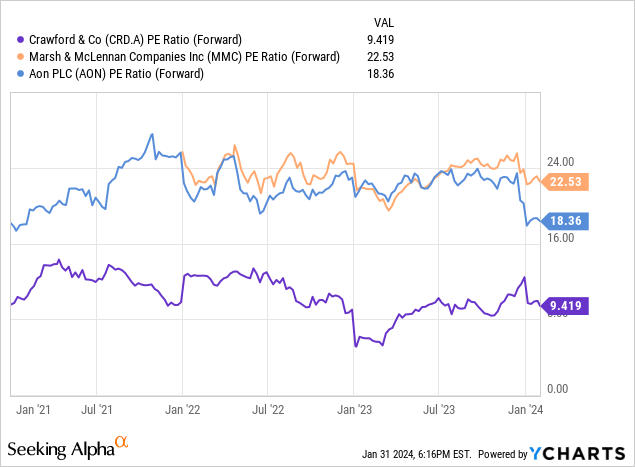
However, given the strong forward earnings outlook, the valuation looks much more enticing at 9.4x forward earnings.
It’s not easy to find a listed competitor with global scale in the loss adjusting business, as major competitors like Cunningham, and Thomas Howell have been either taken out by PE, or acquired by insurance broking groups. For comparison I have taken MMC and AON, who both operate in the Insurance services industry, while in the broking segment. At 9.4x forward earnings, CRD looks less expensive despite the big run up.
Risks
You have to look no further than the recent earnings volatility to see that CRD is exposed to significant risks.
I see the key ones as:
– Access to sufficient skilled adjusting resources.
– Competition
– Ability to adjust pricing short term.
– Margin pressure from key clients under cost pressure themselves.
– Cyber risk due to the high tech model pivot.
I do not see their business as exposed to economic cycles, as the underlying demand grows independent of cycles, other than the input/output inflation shock such as they experienced in 2022.
Management had a hard lesson in 2022, and have put in place mechanisms to ensure more pricing and productivity flexibility in the future.
Summary and investment strategy
- Insurance losses are increasing.
- The industry is moving towards an outsourced business model.
- CRD is positioned to take a bigger share of a bigger pie.
- Margin outlook is improving.
- Data and tech are at the core of CRD strategy.
- Long term CRD looks like a winner.
- Despite the big run up, I rate CRD a buy.
- Momentum is rolling over, so while I might initiate a small position at this level, I will look for a better entry point, and a Put Selling entry strategy.
Credit: Source link