

cemagraphics
Investors,
For the fourth quarter of 2023, Deep Sail Capital Partners (the “Fund”) returned 14.3% net of fees while averaging 92% net long exposure. For the full year 2023, the fund returned 6.8% net of fees while averaging 82% net long exposure. Please consult your individual capital account statements for your individual net returns.

In the fourth quarter, the fund outperformed our benchmarks, the Russell 2000 index, and the Russell Mid Cap Growth Index. The long portfolio performance was driven by a general reverse in the weakness in micro and small-cap equities that occurred in Q2 and Q3. Outside of the strength of microcaps, a few companies in our quality portfolio performed extremely well, including Elastic (ESTC) and Adyen (OTCPK:ADYEY), which we will discuss in the long portfolio summary below.
The short portfolio was negative for the quarter, driven by another liquidity-driven minibubble in long-duration high short-interest equities. Most painful was the move in our largest short position, Affirm, which was up 140% in Q4 based on renewed excitement that more consumers would utilize their Buy Now, Pay Later (BNPL) services during holiday shopping than in previous years.
Market Commentary
The story of the second half of 2023 in global markets was that of investor sentiment extremes.
At the very end of Q3, the Fear & Greed Index bottomed out and spent most of October in the
“Extreme Fear” quartile of the index. The index then rallied with the overall market from late October to mid-December, where it hit the “Extreme Greed” quartile of the index. That seems like quite a shift in just a few months, but 2023 saw this dynamic play out in 1Q during the banking scare. At all these points, the market has felt either very exuberant or very pessimistic, which is exactly the kind of behavior the Fear & Greed index is trying to convey. But sentiment shifts occurring so fast and with such voracity seem a big contrast to years prior to COVID.
Overall, from a fundamental perspective, most economic metrics have been lukewarm all year.
Very few economic metrics were either flashing red or going gangbusters at all this year.
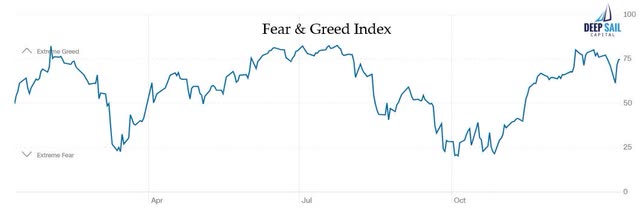
These quick shifts in investor sentiment seem to me to be occurring faster than historically. While this is driven by many factors, there are three main types of factors at play. The first is societal, which is driven by the rise of social media, the increased speed of news, and a higher polarization of viewpoints. The second factor is market structure, driven by the shift from active to passive investing, the rise of momentum and high-frequency trading, and the increased retail involvement in markets (i.e., WallStreetBets). The third factor, and likely the most important factor, is the uncertainty around the near-term interest rate path. Fed rate decisions and inflation CPI announcements were the most important market events in 2023. Sentiment can shift from bad to good based on a few percentage points less on the CPI or a slight change in the Fed dot plot.
So with this background in place, where do markets go in 2024? As history always shows, the future is path-dependent. I can envision multiple scenarios for 2024. At one extreme, it might be possible that we get an all-out “AI bubble” that builds for a few years, like the Dotcom bubble. In this scenario, we could see technology stocks, and more specifically, AI stocks, at insane valuations (Nvidia (NVDA) as the highest market cap company in the world, anyone?). On the other hand, inflation might take off again, forcing the Fed to act again, likely causing a recession. This scenario would be very similar to the 1970s, in which inflation took years to tame, which would suggest we are still in the early stages of dealing with inflation. I am not going to try to handicap the odds of either path-dependent future. Rather, I would say I am trying to be prepared for anything, not surprised at anything, and own quality companies that can deal with anything.
Long Portfolio Summary
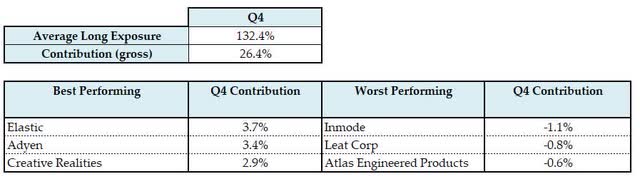
In the fourth quarter, the long portfolio outperformed both of our benchmarks, the Russell 2000 Index and the Russell 2000 Midcap Growth Index by a significant margin. The long portfolio reversed its weakness from the third quarter driven by a rally in the healthcare segment and a broad rally in microcap equities. The best-performing positions in the quarter were Elastic, Adyen, and Creative Realities (CREX). Elastic was up 38% in Q4 driven by an excellent Q3 earnings report that highlighted their business will benefit from the rising generative AI trend. Adyen rebounded off of the lows in Q4 after an investment day on November 8th that alleviated many of the investor worries about the trajectory of their global growth rates and competitive position. Creative Realities rallied in Q4 after they delivered a strong quarter of growth and reiterated their 2024 guidance.
In Q4, we closed five positions and opened five new positions driven largely by finding better opportunities in both the Microcap and the Quality focus. On the quality side we opened positions in two European Vertical Market Software serial acquires Topicus and Vitec Software Group. Below is my thesis on Vitec Software.
Current Position: Vitec Software Group (VIT.B-ST)
Vitec Software Group [Vitec] is a vertical market software (VMS) serial acquirer. Vitec is headquartered in Umea, Sweden, and operates in Nordic countries, including Sweden, Norway, Denmark, and Finland. The company was founded in 1985 by a pair of research scientists, Lars Stenlund and Olve Sandberg. Initially, the company was an energy efficiency consultancy that offered services that included software applications for their clients. At first, the software was used as a lead generator for their consultancy services, but in 1995, Olav came up with the bright idea, “We shouldn’t sell this as a license. We’re going to sell it like a newspaper” Source; Lars Stenlund Interview). This created potentially one of the first Software as a Service (SaaS) models (note that Salesforce is generally considered to be the first commercially successful SaaS model, which launched in 1999; Olav beat them to it by 4 years!).
After that, the company went through a few major shifts; the most important was developing a strategy of growth by acquisition (serial acquisition). They did this in part because they realized that growing a single vertical in software is extremely difficult. Sales ramped slowly, but once you lock in a consumer, the churn is extremely low. The cash flow that a vertical software business produces exceeds the amount that can reasonably be reinvested into the business. So, to grow fast and efficiently, you need to take those excess cashflows and acquire other similar VWS businesses.
In 2003, they shifted from a singular focus on growing their energy efficiency VMS company to acquiring other VMS companies. This was around the same time that Mark Leonard of Constellation Software (OTCPK:CNSWF) was implementing a similar VMS serial acquisition model in Canada. For anyone who follows this type of VMS software business, it will be clear to them that Vitec operates similarly to Constellation in a few ways, but there are some differences. The main difference between the two companies’ operating models is that Vitec will invest more in existing companies than Constellation. Vitec was born by scientists; they are natural tinkerers, and they employ a Kaizen strategy to achieve incremental gains, which aligns with their willingness to reinvest in the business.
This higher reinvestment in the business results in a higher organic revenue growth rate (the Vitec organic growth rate was 14% vs. 8% for Constellation last quarter). The effect of this difference is that Vitec will have higher depreciation and a lower ROIC (Vitec is 7% vs. Constellation at 16%) due to the incremental capital that is invested in the acquired businesses. The upside from this incremental investment is that Vitec has been able to keep high margins by directly providing their consumers with incrementally valuable products at a faster rate (Vitec Gross Margin: 52% and Net Margin: 12% vs. Constellation Gross Margin: 35% and 8%). Outside of this major operating model difference, there are a few other smaller differences between the two companies. Vitec has a higher acquisition bar when it comes to culture fit and regional location than Constellation. Overall, many investors think of Vitec as Constellation’s smaller Norwegian cousin, and I tend to agree. Lar’s even commented on the similarities between the two companies recently, saying “But we’ve understood that we’re not really Constellation. Our approach comes from the industrial side; we are geeks“.
In 2021, the company’s founder, Lars Stenlund, who had been chairman and CEO since Vitec’s founding, stepped down as CEO, and Olle Backman took over. Olle was the Vitec CFO prior to the appointment and has shown a strong aptitude for capital allocation since his appointment. Olle’s key impact has been optimizing the cash flow better than his predecessors, putting more capital to use quickly. I have listened to a number of interviews with Olle, and I am equally impressed with him as with the Vitec original founders. From 2018 until 2021, Vitec completed 4 or 5 acquisitions per year, with an average size of $35 million SEK (~$3 million USD) in revenue. Starting in 2021, the company began to increase the size of its targets while continuing to focus on completing roughly the same number of acquisitions per year. In 2023, the company completed a total of six acquisitions with an average revenue size of $100 million SEK (~$10 million). This includes a mix of business categories and sizes ranging from Enova (ENVA) ($280 million SEK) to DL Systems AB ($14 million SEK). Olle has been able to scale these acquisitions effectively and, so far, has been able to improve both EBITDA margins and operating margins since 2021.
Below is how I view the company in terms of the 4 Pillars of Exceptional Investment.
Vitec Software Group – 4 Pillars of an Exceptional Investment:
|
Pillar |
Rating |
Comments |
|
Pillar 1 – High Quality Business Model |
A+ |
• Vertical Market Software (VMS) may be close to the best technology end market in existence. |
|
• VMS businesses have extremely low churn, long-term pricing power, high switching costs, and low capital reinvestment requirements. |
||
|
• Vitec focuses on the Norwegian or near Norwegian market which offers both enough size for expansion while offering reasonable valuations as compared to the US. |
||
|
Pillar 2 – Exceptional Management |
A |
• The founders have created a culture of strong ownership while providing room to experiment which is a key part of their ability to grow organically. Founder Lars Stenlund is still heavily involved as the chairman of the board. |
|
• CEO Olle Backman has shown strong capital allocation skills in his first few years as CEO. |
||
|
• The company does a small consistent dividend which is a forced taxable event in the US, which I view as less than ideal. The payout ratio is only ~10% of FCF. |
||
|
Pillar 3 – Substantial Long Term Growth Prospects |
A+ |
• Focusing on both organic growth and growth through acquisitions gives the company enough levers to grow for many years. |
|
• Valuations in European VMS and software, in general, have been depressed relative to US valuations for some time, which I believe will persist offering Vitec ample reasonably valued targets. |
||
|
• VMS software is mission-critical to its clients, we do not see AI or horizontal software as a threat. |
||
|
Pillar 4 – Reasonable Valuation |
B- |
• Currently trades at 19x EV/EBITDA and 47x PE for NTM |
|
• We believe the company can compound at an IRR of ~30% over the next 3 to 5 years |
||
|
• Recent step up in acquisition size is not fully appreciated by the market |
Conclusion
Vitec’s business model, end market, and management create an extremely attractive business. Vitec has all the characteristics that we look for in an investment, including substantial reinvestment options, a strong capital allocation strategy, and a founder’s mindset. We currently believe Vitec will consistently grow at a high rate while maintaining strong, stable margins for many years to come. At the current price, we view the shares as reasonably valued to slightly overvalued, but we think over time the value of the shares will compound at a high rate. We plan to own Vitec for many years to allow our capital to compound with its high growth.
Short Portfolio Summary
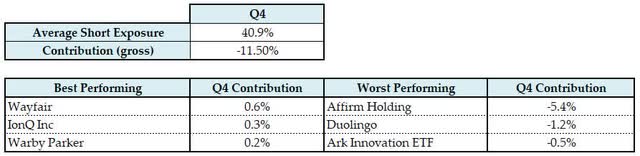
As described previously in our Q3 investor letter, we anticipated that the opportunities in the short portfolio were beginning to run thin in early Q4. This prediction ended up being spot on, and I underappreciated how strongly some long-duration stocks would rally in Q4. This rally in long-duration equities with unproven business models was in part a short squeeze coupled with tax loss harvesting by short sellers.
Our worst-performing short position in Q4 was Affirm Holdings (AFRM), the Buy Now Pay Later (BNPL) consumer lender. We continue to believe that Affirm’s model is nothing innovative or new but rather a normal consumer product lender wrapped up with a “technology” wrapper. The underlying business model has continued to show weakness in both the lending and securitization side of the business. I currently view the company as worth 0.9-1x their tangible book value, or roughly $6.80 a share, an 83% downside from the current price.
Due to the wide market rally that occurred in Q4 and the breadth of short opportunities that I am seeing, we are looking to increase our short exposure to higher-than-normal levels, but I remain patient as we wait for the correct timing of doing so.
Top Holdings & Current Exposure

At the end of the third quarter, the fund held 23 long positions and 25 short positions. The fund ended the quarter with an exposure of 133% long and 44% short or an 89% net long exposure.
Sincerely,
Sean
Disclaimer: Deep Sail Capital LLC (“Deep Sail Capital”) is an investment adviser to funds that are in the business of buying and selling securities and other financial instruments. This information is provided for informational purposes only and does not constitute investment advice or an offer or solicitation to buy or sell an interest in a private fund or any other security. An offer or solicitation of an investment in a private fund will only be made to accredited investors pursuant to a private placement memorandum and associate subscription documents. Past performance is no guarantee of future results.
“Deep Sail Capital Partners” returns in this document are shown as net returns or gross returns where stated. Historical net returns assume a 1.5% and 15% management and performance fee, respectively. For Net Returns of fees and expenditures figures please reach out to the fund manager at the email [email protected].
“Deep Sail Capital LLC” name was changed on April 7th, 2022 from the previous name “Organon Capital LLC”.
“Deep Sail Capital Partners LP” name was changed on April 6th, 2022 from the previous name “Westropp Funds LP”.
* – “Strategy Since Inception” refers to the Strategy inception date of July 2016. Deep Sail Capital Partners LP’s predecessor incubator fund, “Westropp Funds LP” pivoted from a Value Investment style to a Growth at a Reasonable Price (GARP) style fund on that date. For more details on this transition or the calculation behind the “Strategy Since Inception” returns please reach out to the fund manager at [email protected].
Original Post
Editor’s Note: The summary bullets for this article were chosen by Seeking Alpha editors.
Editor’s Note: This article discusses one or more securities that do not trade on a major U.S. exchange. Please be aware of the risks associated with these stocks.
Credit: Source link