
J. Michael Jones
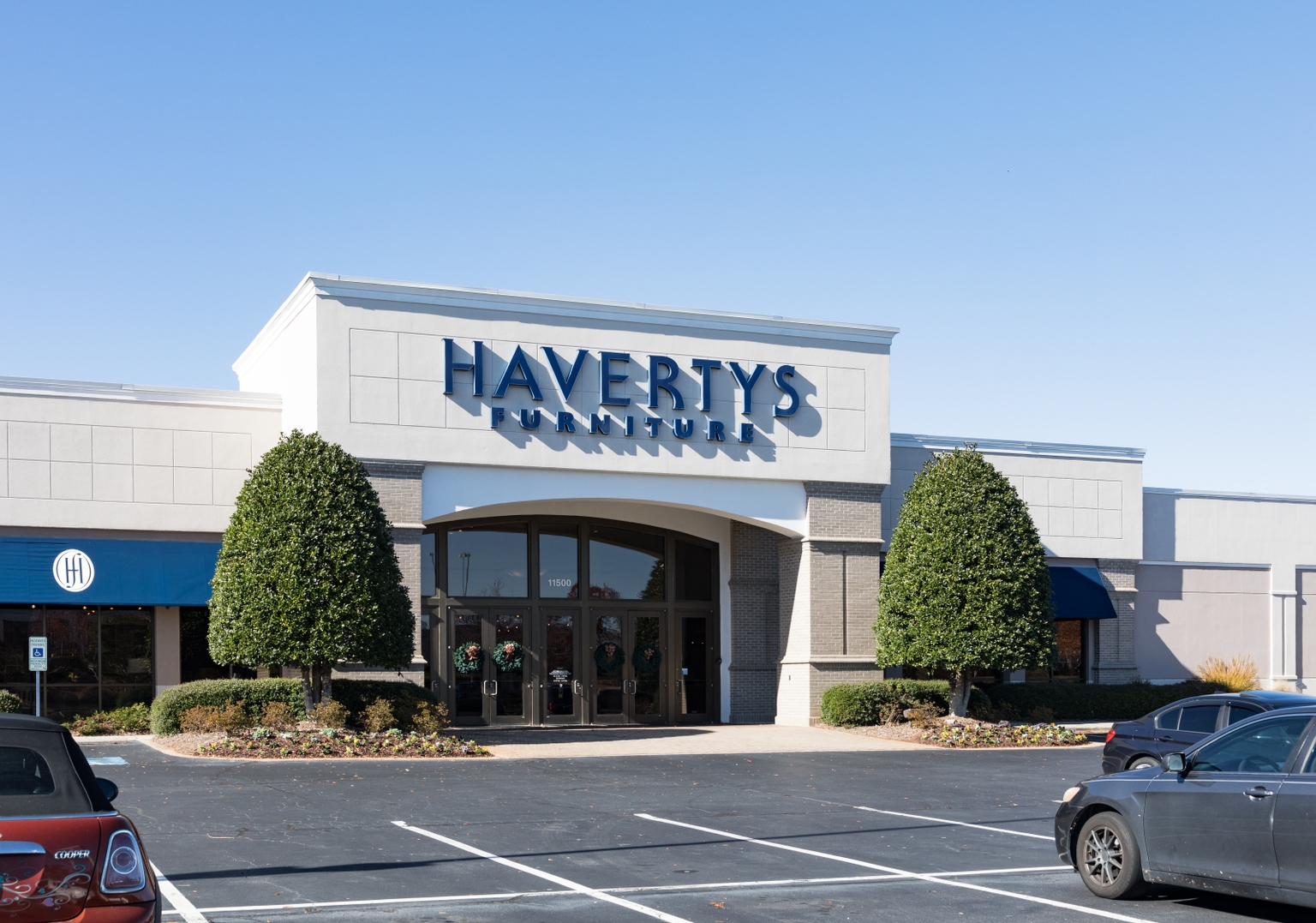
Founded back in 1885, Haverty Furniture Companies (NYSE:HVT) retails residential furniture in the United States under the Haverty brand through retail stores and the company’s website. The company targets the middle to upper-middle price range in its furniture offering.
The stock has had a mixed performance, as the stock was on a steady decline prior to the Covid pandemic. Since, as financials have improved, the stock has cheered up, over doubling from the pre-pandemic level. Haverty currently pays out a dividend yield of 3.46%.
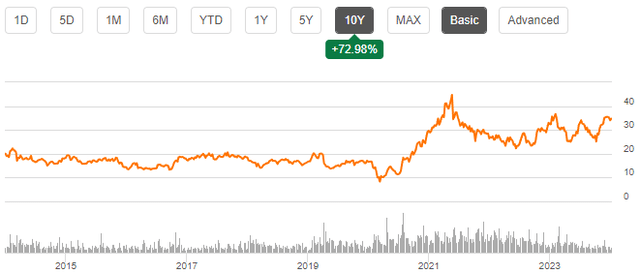
Ten Year Stock Chart (Seeking Alpha)
Financials
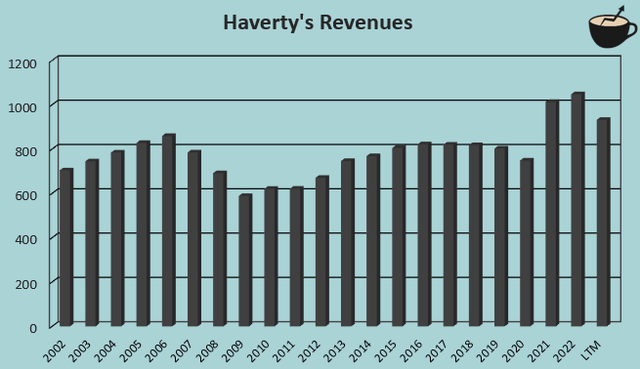
Haverty has had quite a mediocre sales history. The company has had periods of modest growth and sales declines in the past two decades, and prior to the pandemic, Haverty had three consecutive years of low single-digit revenue decreases.
Author’s Calculation Using TIKR Data
The pandemic initially pressured sales but has since resulted in a higher revenue level; Haverty’s revenues currently stand at $931.9 million compared to $802.3 million in 2019. I believe that the highly inflationary economy is a large factor in Haverty’s elevated revenues compared to pre-pandemic revenues with poor growth.
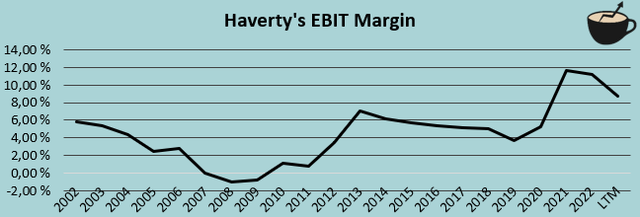
As a retailer, Haverty’s margins are fundamentally a byproduct of the same store sales volume due to a great share of fixed costs. With Haverty’s stable store count in the long term, margins follow overall revenues quite well. The company’s margins are still elevated from pre-pandemic levels – in 2019, Haverty’s EBIT margin was 3.7%, whereas the EBIT margin currently stands at 8.8%. The higher margin isn’t caused by a discrepancy in SG&A as a share of sales with the higher revenues, though, as historically has largely been the driver of margin changes. Haverty’s SG&A currently covers around 50.4% of revenues with trailing figures, compared to a very similar ratio of 50.5% in 2019. The company seems to have been able to push higher pricing in the name of inflation to customers; Haverty’s gross margin has been leveraged by 5.0 percentage points into a current 59.2% from 2019.
Author’s Calculation Using TIKR Data
Going forward, I still believe that margins will largely be a function of sales. The current revenue level has seen significant pressure from the macroeconomic situation, as well as the normalization from pandemic demand, as revenues have decreased significantly in 2023 so far. In Q3, revenues declined by -19.7% year-over-year into a level 5.3% above Q3/2019. Revenues still seem to have some room downwards in upcoming quarters, likely influencing margins negatively.
The higher gross margin seems to stick around as the margin has been constantly increasing throughout the past couple of years despite pressured consumer spending – I believe that Haverty’s EBIT margin will be sustainably higher in the long term than the company’s five-year average EBIT margin of 5.0% from 2015 to 2019 prior to the pandemic, although the margin could still face pressure from slower sales.
Investments in Growing Store Count
Haverty has spent a good amount of capital on investments in recent quarters. The company’s capital expenditures have increased from an average of $24.4 million from 2013 to 2022 into a 2023 guidance of $57 million.
With the bankruptcy of Bed Bath & Beyond, Haverty saw an opportunity to turn some of the stores into Haverty’s stores and acquired four leases from the struggling company. Haverty is looking to open the stores in H1/2024, as told in the Q3 earnings call. The company is planning to open five new stores both in 2024 and 2025 after opening four stores and closing down two in 2023. Compared to the current store count of 124, the growth is still very moderate, but does show potential for growth after very stagnant long-term revenues. I believe that it’s good that Haverty is taking a more active and opportunistic approach to growth.
Haverty’s strong balance sheet provides an opportunity to both invest and return capital to shareholders. The company has no long-term debt and has a strong cash reserve of $134.3 million. The management is looking to both invest in moderate store count, but to also return a growing dividend with potential opportunistic share repurchases.
No Upside at the Moment
Haverty trades at a forward P/E multiple of 10.0. In my opinion, the multiple seems quite fair for a company with very minimal growth in the mature furnishing industry.
To estimate a rough fair value for the stock, I constructed a discounted cash flow model as usual. In the DCF model, I estimate Haverty’s revenues to have pressure downwards from heightened pandemic sales and a worsening macroeconomic situation, making the growth -15% in 2023 and making revenues stagnant for 2024 despite some growth in the store count. Afterwards, I estimate a couple of years of moderate growth due to new store openings and an improving economy. With Haverty’s poor long-term growth, I anticipate the growth to eventually slow down into a perpetual growth of just 1%.
I estimate Haverty’s EBIT margin to come down slightly from an estimate of 7.9% in 2023, as gross margins could have some room downwards and as same-store sales seem to still be facing pressure. I estimate the EBIT margin to fall into a sustainable level of 7.0%, still quite well above the 2015-2019 average of 5.0%. As Haverty plans to open up new retail stores, I estimate the cash flow conversion to be poorer in the next couple of years, but to improve afterwards into a fairly good level.
With the mentioned estimates along with a cost of capital of 11.42%, the DCF model estimates Haverty’s fair value at $36.50, around 5% above the stock price at the time of writing. The stock seems to be valued for fair expectations in my opinion, not really leaving short-term upside for investors.
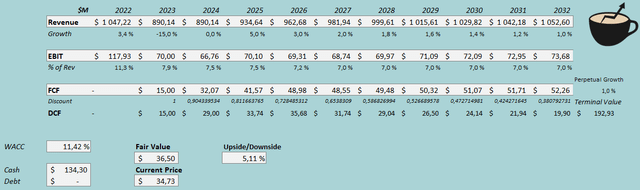
DCF Model (Author’s Calculation)
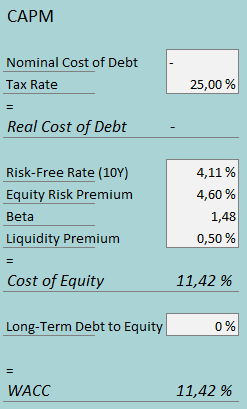
The used weighed average cost of capital is derived from a capital asset pricing model:
CAPM (Author’s Calculation)
Haverty hasn’t leveraged any debt in financing for a long period of time. I estimate the capital structure to stay the same, with a long-term debt-to-equity ratio of 0%. For the risk-free rate on the cost of equity side, I use the United States’ 10-year bond yield of 4.11%. The equity risk premium of 4.60% is Professor Aswath Damodaran’s latest estimate for the United States, made on the 5th of January. Yahoo Finance estimates Haverty’s beta at a figure of 1.48. Finally, I add a small liquidity premium of 0.5%, crafting a cost of equity and WACC of 11.42%.
Takeaway
Haverty is a conservatively led furniture retailer. The company has faced turbulent financials with the Covid pandemic, that seems to have temporarily elevated revenues but more sustainably raised the company’s gross margin from a historically low level. Margins could still face pressure as they are closely in tandem with the revenue level, though.
The company has geared up investments after a long period of stagnation and plans to open a total of ten stores before the end of 2025. While the store count growth is quite insignificant, the expansion could signal a more active approach from the management in the future. While investments are likely to cause some growth, I don’t see the stock as a very high risk-to-reward investment at the moment – Haverty’s future prospects seem to be fairly valued into the stock. For the time being, I have a hold rating for the stock.
Credit: Source link