

Maxxa_Satori
Rising interest rates have posed challenges for REIT stock prices over the last two years, leading to historically large discounts relative to broader equity markets.
However, yields peaking has historically been a catalyst for strong REIT market outperformance, and when combined with attractive valuations, the stage looks set for a bounce-back year for REITs.
Relative valuation: REITs versus equities
EV/EBITDA spreads, U.S. REITs minus equities, 2003–2023
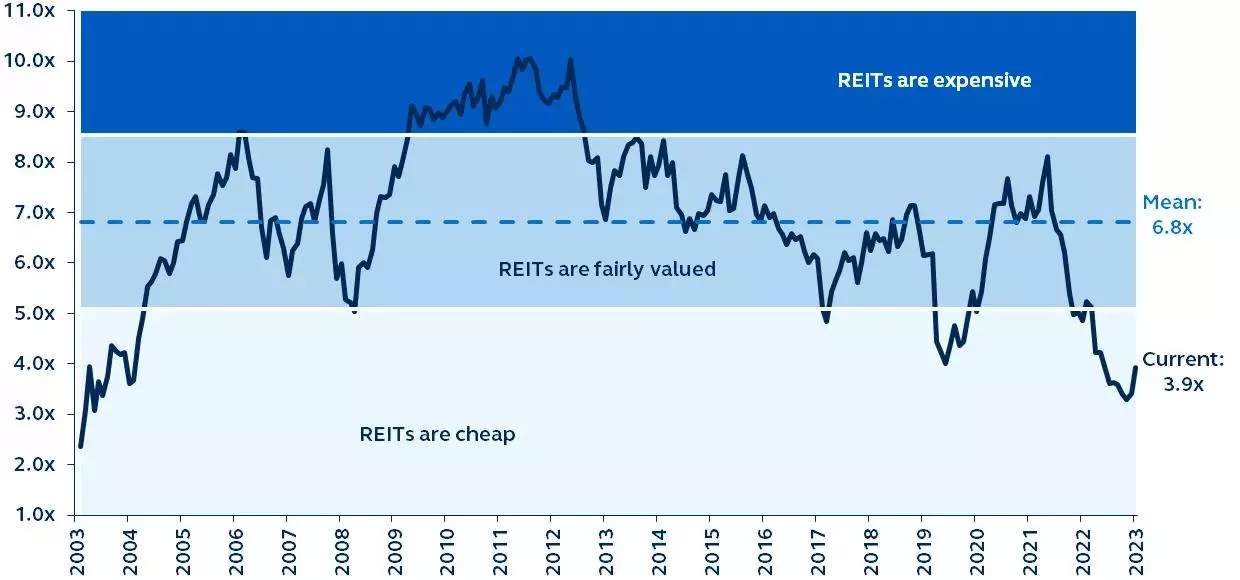
Note: Enterprise Value (EV) to EBITDA price multiples are used to measure valuations. The spread plotted is the EV/EBITDA of the MSCI US REIT index minus the EV/EBITDA of the S&P 500 index. Expensive and cheap valuations are represented by spreads higher or lower than one standard deviation from the mean, respectively. Fair value is represented by valuations between one standard deviation from the mean.
Source: Factset, Principal Real Estate. Data as of December 31, 2023.
The past two years have been tough for public REIT stock prices, both on an absolute basis and relative to other equities, as rising interest rates created headwinds for real estate.
However, with interest rates having peaked, prospects for future outperformance in the REIT market appear more favorable.
REITs are trading at historically significant discounts relative to broader equity markets, thanks mainly to the interest rate sensitivity of the REIT market.
While rising yields are a headwind for real estate values, the peaking of long-term real yields has historically been a significant catalyst for REIT market total returns and their relative performance to broader equity indices.
As yields declined in late 2023, REITs did indeed rally but are still presenting investors with pronounced valuation discounts.
REIT relative valuations also reflect investor concerns about real estate’s challenges – rising financing costs, lower capital availability, outsized debt maturities, and office market struggles.
However, these concerns are largely misplaced as balance sheet leverage is, on average, below 30%, REIT debt maturities are quite manageable, multiple capital sources, such as equity or unsecured debt, are open, and exposure to U.S. traditional office is below 4%.
The combination of peaking yields and attractive relative valuations could deliver a bounce-back year for REITs in 2024, and the durable, long-duration nature of REIT cash flows should provide defensiveness as economic growth slows.
Original Post
Editor’s Note: The summary bullets for this article were chosen by Seeking Alpha editors.
Credit: Source link