

skynesher/E+ via Getty Images
Diversified Healthcare Trust (NASDAQ:DHC) is off to a bad start in 2024, down (-22.2)% YTD (year-to-date), while the average REIT as represented by the Vanguard Real Estate ETF (VNQ) is off just (-3.44)% during that same period.
DHC stock price YTD (Seeking Alpha Premium)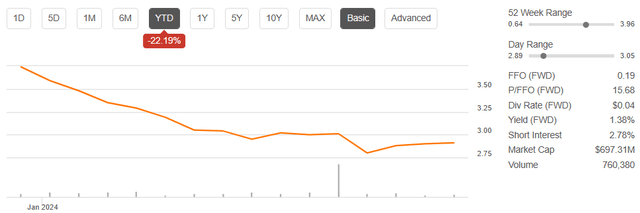
However, if you look at the trailing 12 months, DHC shares are up a phenomenal 295.5%, while VNQ shares are down (-2.5)%.
DHC stock price over trailing 12 months (Seeking Alpha Premium)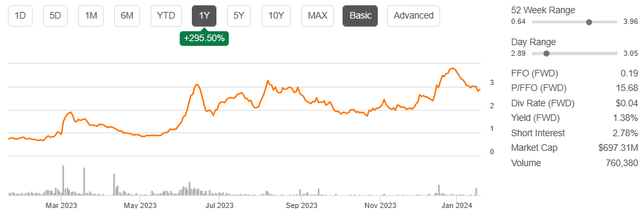
Taking a still bigger picture, DHC shares are down (-78.2)% since the company’s founding, opening at $14.57 in October of 1999, while VNQ shares are up 67% since their debut in September of 2004.
DHC stock price since inception (Seeking Alpha Premium)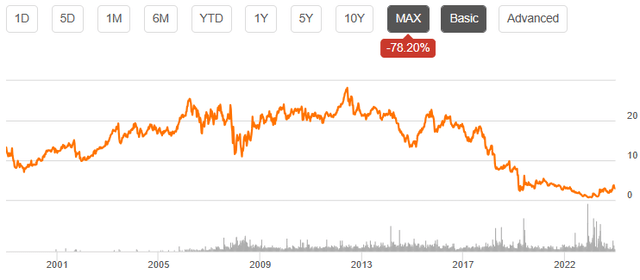
In other words, over the life of the company, DHC has been a significant long-term loser (while REITs in general have been modestly successful over the past 20 years). DHC shares have not made a new all-time high since 2013.
What is going on with this company? Is it in the midst of a miraculous turnaround, or was last year just a temporary blip in a continuing long-term decline?
Meet the Company
Diversified Healthcare Trust, headquartered in Newton, Massachusetts, is externally managed by RMR Group. A small-cap at $0.70 billion, the company holds a portfolio of 376 senior housing and office properties as of September 30, spread across 36 states and Washington DC, with a net book value of $4.86 billion. The largest concentrations of DHC assets are found in Florida (10% of gross book value), California (9%), Texas (9%), and Georgia (6%).
DHC investor presentation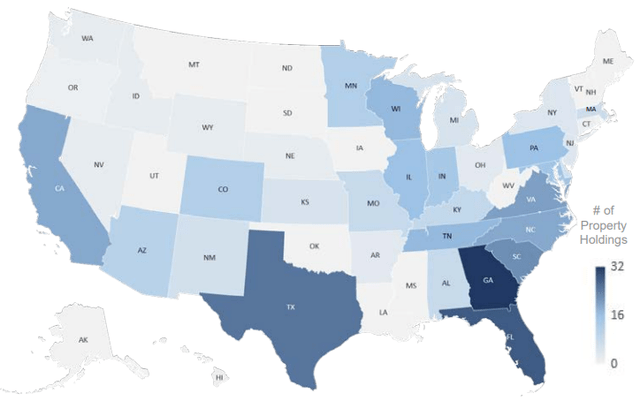
A little over 60% of the company’s holdings are senior housing facilities, while the next 28% of properties (33% by book value) are Office facilities. The remaining 37 properties are classified as “Other”.
| Segment | N Properties | % of Total | Book Value | % of Total |
| Senior Housing (“SHOP”) | 234 | 62.2 | $2.98 B | 61.3 |
| Office | 105 | 27.9 | $1.62 B | 33.3 |
| Other | 37 | 9.8 | $0.26 B | 5.3 |
| Total | 376 | $4.86 B |
Source: DHC 10-K
DHC also owns an interest in two relatively small unconsolidated joint ventures in medical office and life science facilities.
Predictably, the Senior Housing portfolio accounts for an even bigger share of the company’s revenue (80%) than the Office segment (17%).
Growth metrics
Here are the 3-year growth figures for FFO (funds from operations), and TCFO (total cash from operations).
| Metric | 2019 | 2020 | 2021 | 2022 | 3-year CAGR |
| FFO (millions) | 310 | 160 | (-8) | (-38) | — |
| FFO Growth % | — | (-48.4) | NA | NA | NA |
| FFO per share | 1.31 | 0.67 | (-.03) | (-0.16) | — |
| FFO per share growth % | — | (-48.9) | NA | NA | NA |
| TCFO (millions) | 266 | 159 | (-63) | (-40) | — |
| TCFO Growth % | — | (-40.2) | NA | NA | NA |
Source: Schwab.com, Hoya Capital Income Builder, and author calculations
DHC’s FFO was already shrinking before the pandemic hit in 2020, having contracted by (-17.8)% in 2019. Like all REITs, DHC was hit hard by COVID, but unlike most others, DHC has not recovered, continuing to lose more and more each year, on both a total and per-share basis. For 2021 and 2022, the company had revenue and cash flow below zero. However, it has shown positive FFO for 4 consecutive quarters now.
Meanwhile, here is how the stock price has done over the past 3 twelve-month periods, compared to the REIT average as represented by the Vanguard Real Estate ETF (VNQ).
| Metric | 2019 | 2020 | 2021 | 2022 | 2023 | 2024 | CAGR |
| DHC share price Jan. 23 | $12.71 | $8.34 | $4.42 | $3.01 | $0.78 | $2.91 | — |
| DHC share price Gain % | — | (-34.4) | (-47.0) | (-38.0) | (-74.1) | 273.1 | (-25.5)% |
| VNQ share price Jan.23 | $79.20 | $95.78 | $85.77 | $105.23 | $88.09 | $85.32 | — |
| VNQ share price Gain % | — | 20.9 | (-10.5) | 22.7 | (-16.3) | (-3.2) | 1.88% |
Source: MarketWatch.com and author calculations
While the average REIT as represented by the VNQ has delivered a sister-kissing annual return of 1.50% over the past 5 years, DHC has returned a life-wrecking (-25.5)%.
So, is last year’s phenomenal 273% gain a portent of things to come, or just a quick breath for a drowning man? The balance sheet tells the tale.
Balance sheet metrics
Here are the key balance sheet metrics.
| Company | Liquidity Ratio | Debt Ratio | Debt/EBITDA | Bond Rating |
| DHC | 1.79 | 120% | 14.3 | CCC+ |
| Healthcare REITs | 2.03 | 35% | 6.6 | — |
| Overall REIT avg | 1.91 | 30% | 6.3 | — |
Source: Hoya Capital Income Builder, TD Ameritrade, and author calculations
DHC is drowning in debt. A staggering 27.5% of that red ink is held at variable rates. Nearly half ($1.2 million) comes due in 2024 and 2025.
According to the company’s own 10-Q for Q3 2023:
As of September 30, 2023, our ratio of consolidated income available for debt service to debt service was below the 1.5x incurrence requirement under our credit agreement and our public debt covenants, and we cannot be certain how long this ratio will remain below 1.5x. We are unable to refinance existing or maturing debt or issue new debt until this ratio is at or above 1.5x on a pro forma basis. As of September 30, 2023, we had $278,122 of cash and cash equivalents and $700,000 of outstanding debt due within one year from the date of issuance of these financial statements, including $450,000 in outstanding borrowings under our credit facility, which matures on January 15, 2024, and $250,000 of senior notes that mature.
In addition, as of September 30, DHC had $500K of 9.75% senior notes due in 2025, as the figure below indicates.
DHC investor presentation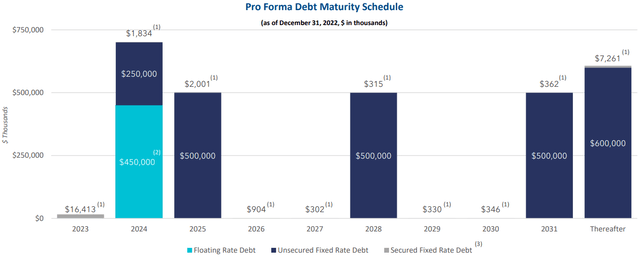
President and CEO Jennifer Francis provided this further glimpse into the company’s dire straits on the Q3 earnings call:
we’ve initiated a disposition strategy for a number of assets in order to increase liquidity at the company. Our goal is to pay off maturing debt and restart the capital projects we’ve deferred. The assets that we’ve selected for disposition come from each of our operating segments and are geographically diverse.
Dividend metrics
DHC cut its quarterly dividend drastically, from 15 cents per share to 1 cent, during the pandemic, and has yet to restore any part of that cut.
| Company | Div. Yield | 5-yr Div. Growth | Div. Score | Payout | Div. Safety |
| DHC | 1.39% | (-51.9)% | 0.15 | 120% | C |
| Healthcare REITs | 4.71% | ( -3.3)% | 4.26 | 70% | C |
| REITs overall | 3.80% | 5.5% | 4.46 | 65% | C |
Source: Hoya Capital Income Builder, TD Ameritrade, Seeking Alpha Premium
Dividend Score projects the Yield three years from now, on shares bought today, assuming the Dividend Growth rate remains unchanged.
DHC has been a poor payer over the past 5 years, is a poor payer now, and will remain a poor payer for the foreseeable future.
Valuation metrics
Given the company’s evident problems, you might expect shares to be dirt cheap, but they are not. Price/FFO ’24 of 20.4 is significantly higher than both the Healthcare REIT average and the overall REIT average.
| Company | Div. Score | Price/FFO ’24 | Premium to NAV |
| DHC | 0.15 | 20.4 | 43.0% |
| Healthcare REIT average | 4.26 | 16.0 | 3.8% |
| Overall REIT average | 4.46 | 17.3 | (-18.0)% |
Source: Hoya Capital Income Builder, TD Ameritrade, and author calculations
Furthermore, shares are trading at a vast 43% premium to estimated NAV (as provided by Hoya Capital Income Builder), unlike the vast majority of REITs.
What could go right?
DHC’s income is insufficient to pay its way out of debt, and the company is legally prohibited from further borrowing or refinancing. That leaves only two options: issue new shares, or sell assets. The first option dilutes shareholder value, while the second significantly reduces the company’s income.
DHC is externally managed by RMR Group, whose other equity REITs include Service Properties (SVC), Industrial Logistics (ILPT), and Office Properties (OPI), all of which are struggling with heavy indebtedness. Management incentives do not always align with shareholder interests, when a REIT is externally managed.
There are rays of hope, however. Gross revenues are headed in the right direction, with 17.6% growth in the forecast.
LSEG Data & Analytics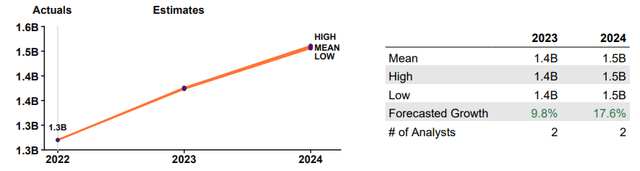
Despite the recent sell-off, DHC’s price momentum is strong, especially compared to its peers.
LSEG Data & Analytics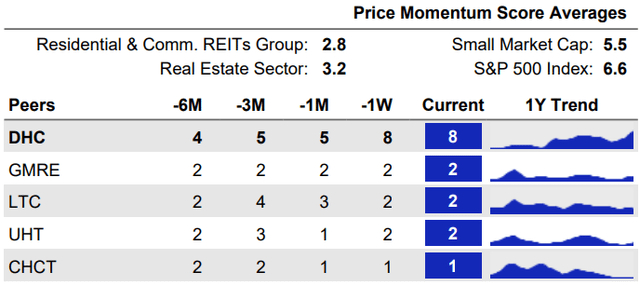
Insider trading indicates some confidence in the company’s future. One of the company’s directors bought over $46 million worth of shares last June.
And then there are the tailwinds of aging population that benefit all healthcare businesses. Expenditures for outpatient services are only going up for the next several years, with 2027 expenditures projected at nearly $1.2 trillion, nearly 20% up from current levels.
DHC investor presentation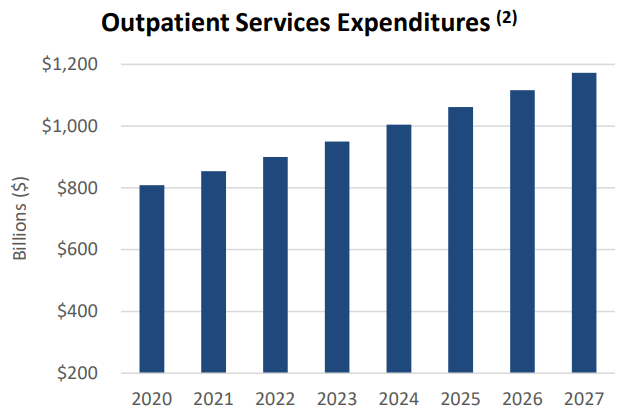
If the company’s SHOP portfolio occupancy can continue to increase, and the company is successful in selling lower-performing assets, there is a chance of righting this ship.
Investor’s bottom line
As the company’s share price fluctuation in 2023 shows, opportunistic investors can sometimes profit handsomely, by speculating in shares of a dying company. But this company is in long-term decline. Are you prepared to say that this is the magic moment when a long-term return to health begins? Why tie up your precious capital in a company like this?
In the meantime, the field is littered with excellent long-term opportunities in REITs. I rate DHC a Sell.
Seeking Alpha Premium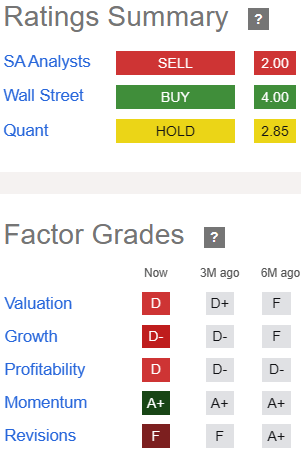
As you can see, this puts me in step with other SA analysts, but out of step with the one Wall Street analyst who sees DHC as a strong buy, and one who sees it as a Hold.
Zacks rates DHC a Sell, as does CFRA. However, Refinitiv rates the company Outperform, with a price target of $4.50, implying 57% upside.
In other words, it’s anybody’s guess. And as always, the opinion that matters most is yours. Because it’s your money.
Credit: Source link