

hachiware/iStock via Getty Images
Braskem (NYSE:BAK) is a petrochemical firm, operating in segments related to different plastic applications in Brazil, the U.S., Europe, and Mexico. Recently, the company has been involved in a major incident in the city of Maceio, in the northeast of Brazil, resulting in legal issues and potential financial impact on the already challenged cash flow.
What Does The Company Produce?
According to corporate data, around 70% of BAK revenues are related to two product lines, polyethylene and polypropylene. The first is applied to films, packaging solutions including general industrial and food packaging, and wires. The product derives from petroleum naphtha, ethane and/or propane. This revenue stream is concentrated in Brazil and Mexico.
The polypropylene business serves house appliance and automobile industrial customers. The production relies on propylene, mostly internally produced as part of the firm’s basic petrochemical segment.
The basic petrochemical business accounts for a bit more than 25% of revenues, with a handful of products extracted from naphtha directed to final products such as acrylic fibers, nylon, plastic bottles, synthetic rubber, and paints.
The last business segment targets vinylic products for the production of pipes, and whitening products for paper, soap, and aluminum players. In this segment, the production relies on naphtha and salt.
Financial Performance
As depicted in Figure 1, the company enjoyed a strong margin period with the inflationary regime that started after the COVID in 2020. In effect, average gross margins jumped from 12.7% in 2019 to 28.5% in the 6 quarters between 3Q20 and 4Q21. Margins were gradually reduced to a level between 2.6% and 5.1% in the quarters with published results in 2023. As a result, the company has experienced losses in its EBT margins, reaching BR$ 6.6 billion in the last 4 quarters reported, and operating income.
Figure 1: Recent Margin Performance (Company Data)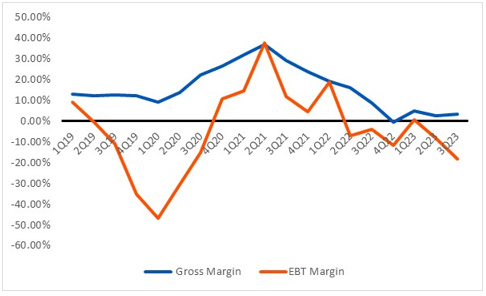
In addition to the reduction in gross margins, the company was also impacted by its financial leverage, which represents a quasi-constant interest expense of BR$ 1.5 billion each quarter, FX volatility, and the financial impact of the incident in Maceio. Following these results, BAK is rated D on Seeking Alpha profitability indicators.
As a result, cash generation is under pressure. Figure 2 illustrates BAK’s cash flow drivers.
Figure 2: Recent Free-Cash-Flow Generation (Company Data)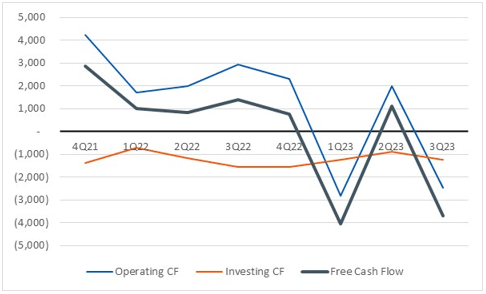
As a result, the company increased its financial exposure to compensate for such a low cash generation. In the last two years, new net debt issued accounted for more than BR$ 10.6 billion and the company cut dividends.
The Incident In Maceio
In December, a rock-salt mine operating since the 70s in Maceio presented instability, affecting 5 different neighborhoods in the city. Maceio has around 1 million inhabitants (16th most populous city in Brazil) and is the capital of the state of Alagoas, a tourist spot in the northeast of the country.
The issue represented an aggravation of a situation that had been verified in the region for some time. In the month, 14 thousand households were evacuated due to a soil collapse that surpassed 2 meters. As an effect, on December 10th, the mine collapsed completely under the waters of a lake. From a legal standpoint, the firm entered into an agreement with federal prosecutors for a BR$ 1.7 billion compensation payment. The issue, nevertheless, is far from resolution, as both the municipality and state authorities are contesting the agreement in federal courts. The potential result of the litigation is unpredictable, mostly in an electoral year (for municipalities) with high-profile politicians asking for a higher indemnity, including hearing sessions in the Senate. The company placed a provision in its books in the 3rd quarter, as explained above, but any new developments may create new financial burden in an already weakened cash flow.
Following the challenged financial performance and the environmental event, BAK’s debt rating was downgraded to BB+ by Fitch. The agency highlights the risk of additional penalties, recent margin performance, and financial leverage. As a result, BAK corporate bonds have suffered relevant credit spread increases, with deterioration in mark-to-market positions. Figure 3 depicts the bonds available for consultation to the general public in the platform of Anbima (Brazilian Financial and Capital Markets Association) highlighting the market reaction to the weakened financial position in its floaters and linkers.
Figure 3: Mark-to-Market Corporate Bonds of Braskem (Anbima Public Information, Responsibility Exemptions Available in Anbima, Highlights by the Author)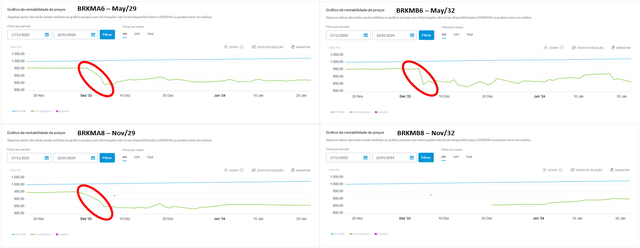
Conclusion
BAK is a leader in the production of polyethylene and polypropylene, with a consistent commercial performance in its markets. The company had, on the other hand, a consistent deterioration in financial performance that challenged cash flow generation. Recent unresolved environmental incidents may impose an additional burden on its financials. As a result, cash flow perspectives for the company are negative. On Seeking Alpha, forward operating cash flow growth is negative and receives a F rating. As such, current fundamentals do not recommend optimism in future market performance for the equity of BAK.
For investors with a short position on the asset, it is crucial to monitor the primary conditions for a potential improvement in the firm’s fundamentals. From an operational point of view, margins can improve if economic growth is stronger, resulting in higher demand for industrial products, or if production in Asia is weaker. From a financial point of view, it is important to monitor potential improvements in operating leverage and other working capital initiatives that may reduce cash stress in 2024.
Credit: Source link