
FG Trade Latin/E+ via Getty Images
Evaluating the Recent Stock Market Sell-Off
The recent stock market sell-off in early January has made some investors nervous about whether the bull market can continue in 2024. We published buy ratings on SPY (NYSEARCA:SPY) and QQQ (NYSEARCA:QQQ) back in October 2023 when there were concerns about a government shutdown, widening deficits, and expensive stock valuations.
At that time, we pointed out a couple of key reasons why we were still confident in the market’s upside potential:
First, the U.S. economy is driven primarily by consumer spending, so the private sector plays a bigger role than the government in driving growth. The economic indicators back in the fall showed that the economy was on track, inflation was under control, and unemployment remained low. So the underlying systems seemed to be working well.
Second, stock valuations seemed justified after evaluating fundamental and forward-looking metrics. Both ETFs performed nicely after our recommendation.
SA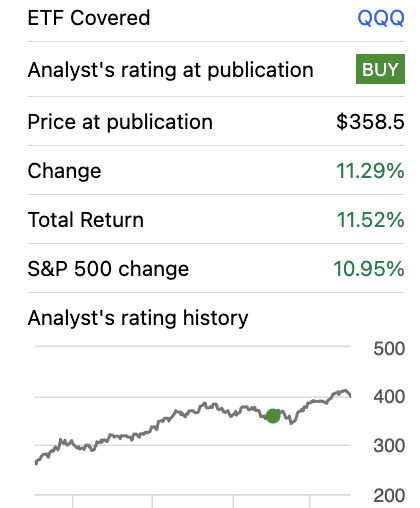
We try to periodically evaluate the major index ETFs each quarter for investors and provide our thoughts as a reference. So in this article, we’ll revisit the framework we used last time and update our outlook heading into 2024.
Key Factors Behind the Recent Sell-Off
It’s clear to us that the recent sell-off is driven by a combination of three key factors:
Short-Term Overbought Conditions
First, the market was overbought in the short term. According to CNN’s Fear & Greed Index, stocks were in extreme greed territory, so a correction seemed likely.
CNN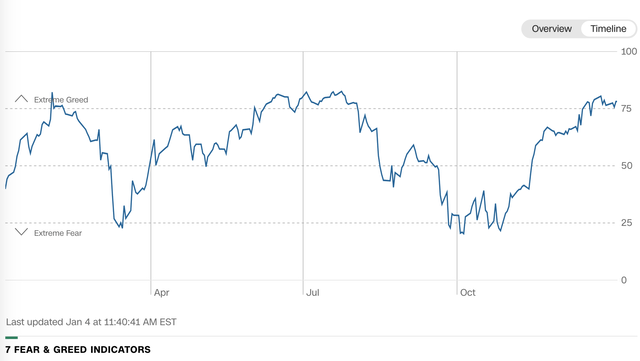
Fed Rate Uncertainty
Second, there’s confusion around whether the Fed will lower rates in 2024. Some Fed members don’t seem to support Chairman Powell’s comments about discussing rate cuts at the December meeting. This has pulled back ETFs like TLT recently and increased volatility in the bond market, as measured by the MOVE index. Since risk-free rates are anchored to bond yields, this can have a trickle-down effect on the stock market.
TLT (SA)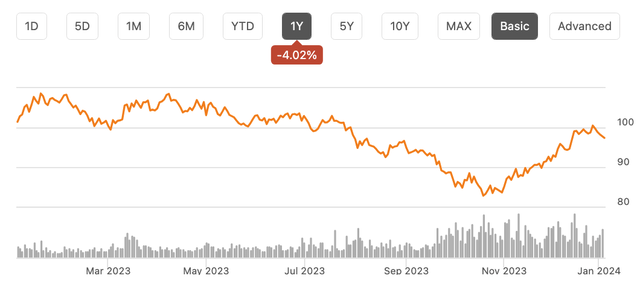
However, looking at the VIX volatility index for the S&P 500, we see stock market volatility hasn’t spiked as much as bond market volatility. This suggests the stock pullback is largely just reflecting uncertainty around bond yields and potential rate cuts, similar to what we saw back in October.
VIX, MOVE (Yahoo Finance)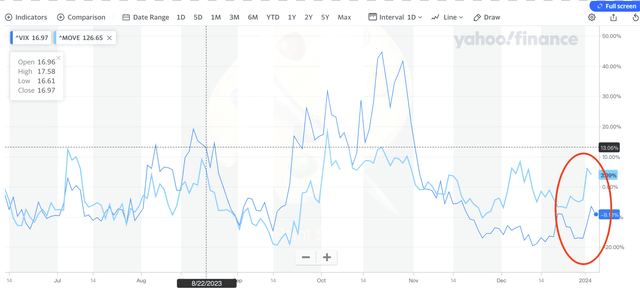
Year-End Rally
Third, the usual year-end rally is often fueled by holiday spending and, importantly, tax-loss harvesting. Investors typically sell losing positions and keep winning ones. So it’s understandable that SPY and QQQ, which were up 22% and 50% respectively in 2023, would see some selling pressure on the first trading day of 2024 as investors trim positions to avoid capital gains tax.
SA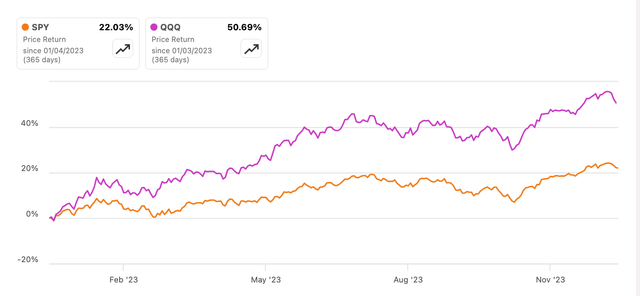
Examining QQQ and SPY Fundamentals
When examining the Q4 and Q3 fundamentals for QQQ and SPY, we believe the recent sell-off was triggered by the three factors mentioned earlier. Let’s take a closer look at each ETF:
For QQQ, the P/E ratio increased from 32.9x to 34.5x, reflecting improved financials. Gross margins rose from 43.2% to 43.4% and ROE climbed from 20.9% to 21.3%. In our previous article, we noted that 11% ROE is a critical threshold we monitor to gauge whether stocks offer an attractive return premium over bonds. Using a CAPM model with a 6% risk premium and 5% risk-free rate, we arrived at that 11% hurdle.
Despite concerns about expensive valuations, we feel very comfortable remaining allocated to stocks because the QQQ companies are still generating stellar 21.3% ROE for investors, well above our threshold.
While backward-looking, these ratios confirm the P/E expansion is supported by fundamental improvements. This makes sense as QQQ is dominated by mega-cap tech firms growing earnings through AI adoption.
QQQ (Market Chameleon)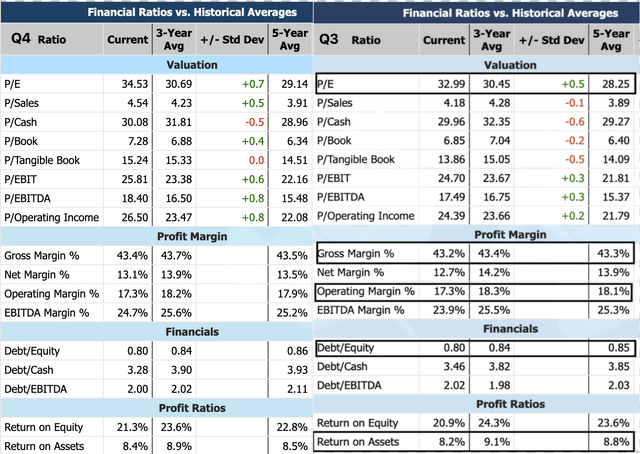
Turning to SPY, we also saw P/E multiples expand from Q3 to Q4. However, fundamentals deteriorated slightly with gross margins down 10bps and operating margins down 20bps. ROE ticked up 10bps to 17.6%, still well above our 11% threshold.
SPY (Market Chameleon)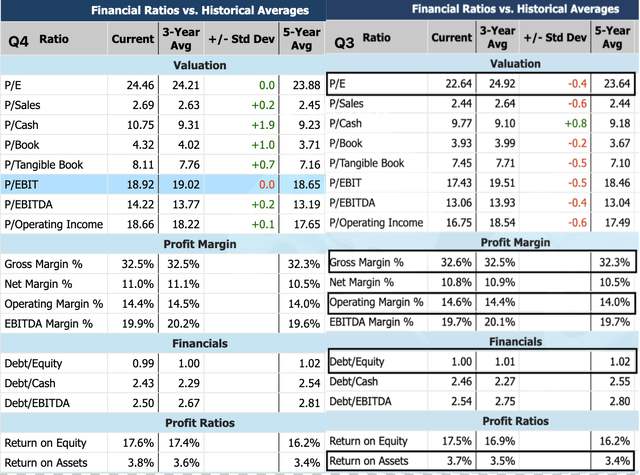
Looking ahead, the current PEG ratio of 1.35x on Dec 28th is around historical medians. We believe the January sell-off likely brought this valuation metric down further. Therefore, we aren’t overly worried about high P/Es at the moment.
yardeni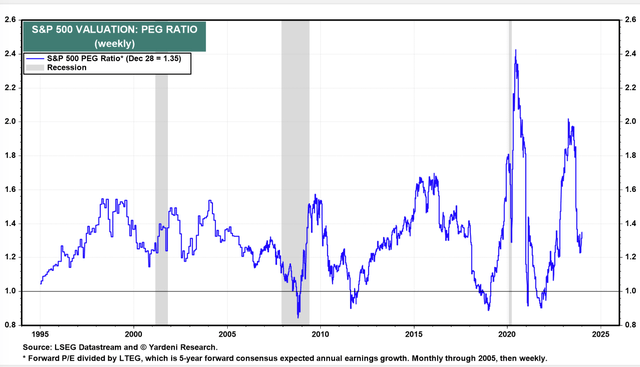
Risk
The Impact of the Red Sea Crisis
The recent crisis in the Red Sea has caused international shipping costs to spike again, as reflected in the higher Baltic Dry Index.
Baltic Exchange Dry Index (Trading economics)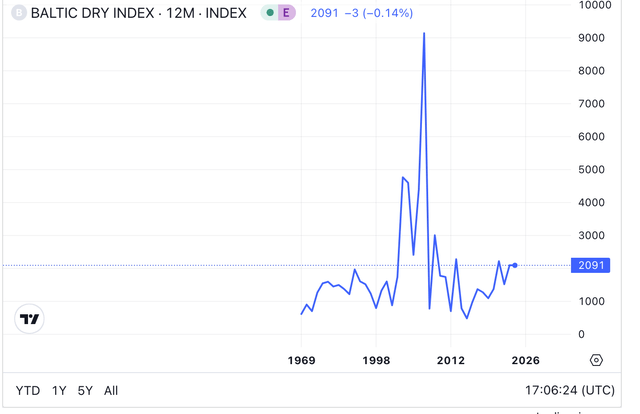
Some investors may worry this could re-ignite inflationary pressures. However, we don’t think this is the start of a major trend. While the Houthi rebels, possibly backed by Iran, could escalate geopolitical tensions in the Middle East. Unlike past oil crises, the US is now the world’s leading oil producer. This major shift in energy production means Middle East conflicts have a more limited impact on the US economy compared to decades ago.
Crude Oil production (Statista)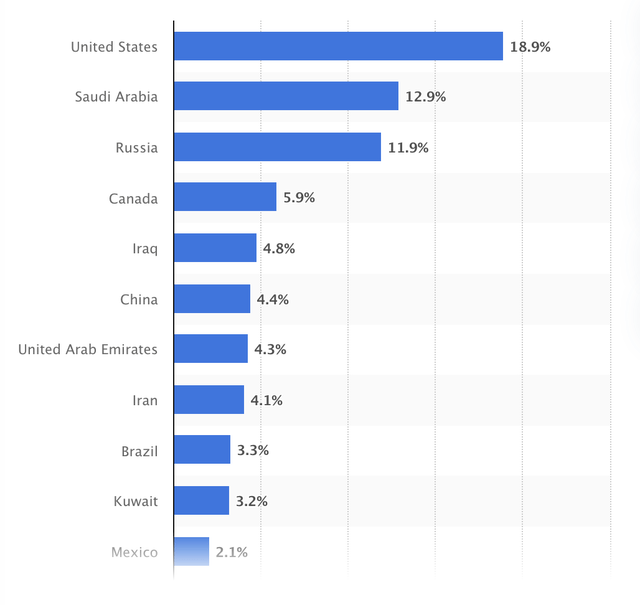
The November meeting between Biden and Xi signaled a desire for the US to take a leadership role in resolving these kinds of regional conflicts. With China and Russia not publicly involved, the turmoil caused by the Houthis is unlikely to inflict more damage than the supply chain shocks of the past few years. So we view this risk as manageable overall.
The Baltic Dry Index may remain elevated in the near term as the situation develops. But we don’t foresee a protracted crisis that will significantly hamper global trade flows or reboot inflationary pressures. Given the geopolitical dynamics, this Red Sea incident appears more like a temporary pullback rather than the start of a major trend reversal.
Assessing Systemic Risk
For investors looking to invest in broad market ETFs like SPY or QQQ, the focus should be on long-term capital appreciation rather than short-term valuation concerns.
These passive investors are buying the market, not individual stocks. As such, systemic risks that could upend the overall market are more important to monitor than monthly oscillations in valuations.
From our perspective, the US doesn’t appear to be losing its dominant position militarily or in terms of private sector competitiveness. Despite some Fed intervention, capitalism continues to drive innovation and growth in companies.
In other words, we don’t currently see any imminent systemic risks on the horizon that could fundamentally alter the long-term investment thesis for owning a broad basket of US stocks.
Valuations may fluctuate in the short run, but SPY and QQQ offer passive exposure to leading American companies across sectors. For buy-and-hold investors, chasing short-term under/overvaluation seems less important than evaluating the overall competitiveness and stability of the US economy.
Conclusion
Even with SPY and QQQ trading at premium valuations, their profitability levels remain significantly above our required return thresholds. So we believe they are still great assets to allocate to in 2024 for long-term investors.
Specifically, investors using these ETFs for passive indexing should view the recent sell-off as an opportunity to put more cash to work. Rather than trying to time the market bottoms and peaks, their focus should be on long-term capital appreciation.
The overly optimistic sentiment that preceded this pullback is more of a short-term risk indicator. It doesn’t change our long-term outlook on owning a basket of leading US stocks.
In summary, despite premium valuations, the fundamentals backing SPY and QQQ still look attractive relative to other asset classes. For passive investors with a multi-year time horizon, this dip represents a chance to allocate at better prices.
Rather than watching daily price action, we encourage investors to take advantage of the volatility to build positions. We remain buyers on further weakness and continue to recommend SPY and QQQ as core portfolio holdings for long-term capital growth.
Credit: Source link