
buzbuzzer/iStock via Getty Images
Regency Centers (NASDAQ:REG) shares rose by 8% in 2023, significantly lagging the S&P 500 while also avoiding declines seen in some real estate stocks. Assuming interest rates do not sharply rise, 2024 should see stronger relative performance. With strong dividend coverage and favorable fundamentals, REG is an attractive investment for income-oriented investors.
Seeking Alpha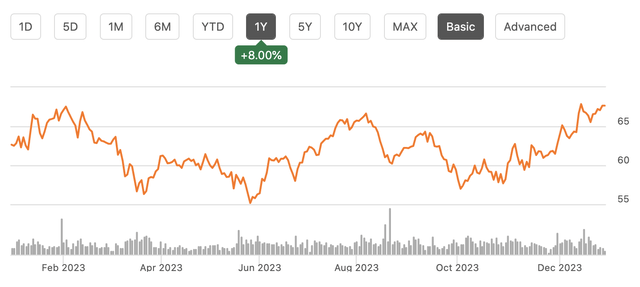
Regency is an outdoor center REIT. The company has over 480 properties, with 22% in the New York City area, 24% in California, and 18% in major Florida metros, providing it strong geographic diversification, across major legacy markets as well as growth markets in the Sun Belt.
Regency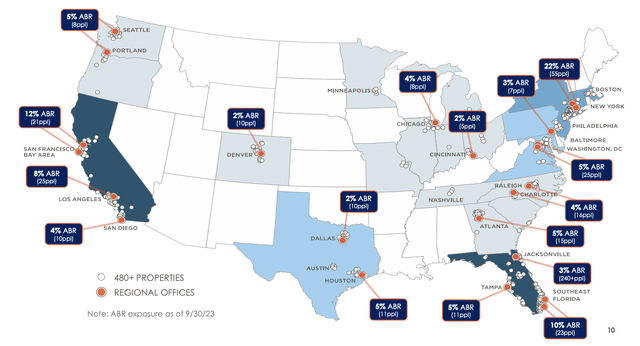
While malls have been the focus of obsolescence concerns given the growth of e-commerce, Regency is relatively immune to this as 80% of its locations are grocery-anchored, and it is a leading partner of Kroger (KR), Publix, and Amazon/Whole Foods (AMZN). Grocery shopping remains very much an in-person activity, and regular trips to the grocery stores provide steady foot traffic to Regency’s centers, supporting smaller shops at their locations. This is why I am generally positive about the grocery-anchored business model. Of course in economic downturns, all retail space faces some headwinds. Fortunately, a soft landing appears likelier with the Federal Reserve set to reduce rates next year.
Regardless, Regency should prove resilient during downturns. This is because its centers are in dense areas with relatively high household incomes of $152k. Most of its surrounding population is also college-educated. Higher-income consumers tend to have more savings and financial resources, and in downturns, college-educated unemployment generally rises less. While spending falls during a recession, Regency’s core customers are likely to cut back less than lower-income consumers.
Regency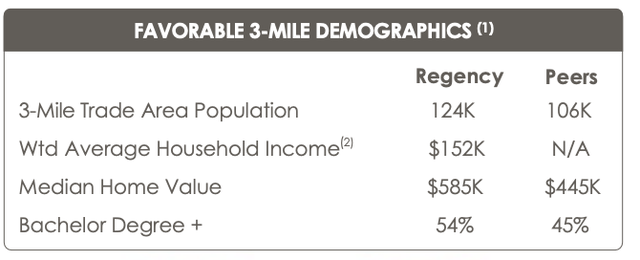
Right now, of course, we are not in a recession, and Regency is performing well. In the company’s third quarter, core operating earnings rose from $0.94 to $0.97 while funds from operations (FFO) rose 1% to $1.02. This was supported by 2.1% same property net operating income (NOI) growth (2.9% excluding COVID recoveries). Interest expense rose by $2.5 million to $39 million, offsetting some of the operating income gains. This should be less of a headwind in 2024. While revenue rose by 9%, property operating expenses rose by 20%, partially due to underlying inflation on items like insurance, as well as one-time M&A integration costs. Its acquisition of UBP is expected to be 1.5% accretive to results in 2024, adding about $0.04-0.05.
For the fear over retail space, Regency is seeing strong demand. The company has a 92.7% total leased rate, down slightly from 93% in 2019. However, its 93.2% shop leased rate is above its 91.5% pre-COVID level and at a record high. Essentially, anchor lease rates are running a bit softer while smaller shops are running higher, Smaller shops pay higher rents than anchors (who pay lower rent since they take more space and should drive foot traffic to support the center), making this a favorable mix shift for revenue.
Of course, empty anchor space is not a good thing, but 92.7% overall occupancy is still quite strong. Moreover, occupancy lease rate rose by 20bps in Q3 even with Bed Bath and Beyond being a 25bp headwind. The Bed Bath bankruptcy is driving much of the lower anchor lease rate today. REG has been successful in aggressively re-leasing these spaces. Most Bed Bath leases have been signed and will be executed in H2 2024. Half have resigned at over 30% of previous lease rates.
As these leases commence, that should be a meaningful source of incremental NOI. Replacing this store with higher-performing brands like TJ Maxx (TJX) should also help lift foot traffic and support small shop performance at those centers. Regency also has 22 Rite Aid locations, accounting for 0.5% of base rents, some of which may close due to its bankruptcy, which could be a modest headwind to 2024 results.
As noted, Regency has released Bed Bath locations at a 30+% spread to existing rates. Overall, the company earned a 9% cash spread on re-leasing with over 20% on new leases. Historically, it has targeted 2% annual steps in leases to cover inflation. Currently though, it is pushing 3% annual escalators on its new shop leases. Higher new leasing rates and stronger escalators speak to the demand for Regency’s footprint. A reason for this is that there is essentially no supply.
Given the bearishness around retail, there has been little construction. We are down about 80% from 2017 levels, which were already low relative to the prior decade. That is a reason why it has been relatively easy to replace Bed Bath and Beyond. For retailers looking to expand, there is not much anchor space available in strong markets, leading them to aggressively pursue these new openings.
Kimco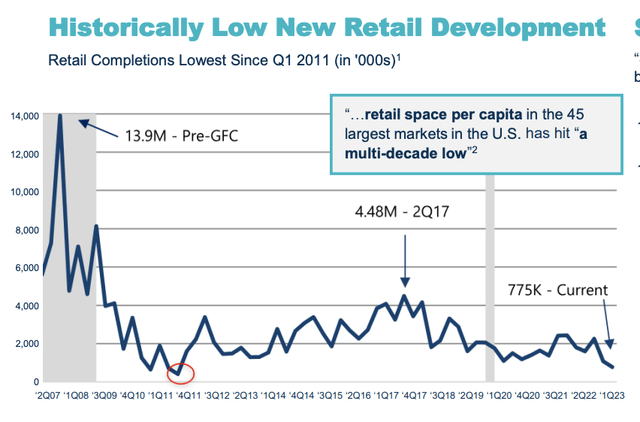
Over the next year, as we see these signed but not commenced leases begin, providing about an $18 million tailwind, we should see Regency generate mid-single digit growth, aided further by inflation escalators. Over time, Regency targets same-property net operating income growth of 2.5-3%. Combined with growth projects, it targets earnings growth of 4-4.5%. Regency retains $160 million in cash flow after its dividend, with which it can spend $300 million on cap-ex and keep leverage flat at 5-5.5x EBITDA. Currently, Regency has $1 billion in development plans over the next five years.
Regency’s balance sheet is also strong with 5x debt to EBITDA at the low end of its 5-5.5x target. It has well-staggered maturities, though with rates now coming down, refinancing is less of a risk than it had been.
Regency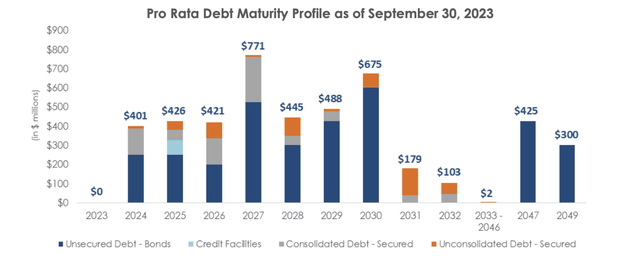
For all of 2023, Regency is guiding to core operating earnings of $3.93-$3.95, which is up 5-6% from 2022 when excluding one-time COVID recovery payments for rent missed in 2020-2021. For next year, as noted, its UBP purchase is about a $0.05 tailwind. Offsetting this, Regency received $4 million in COVID recoveries in 2023, which will not recur in 2024, and it will have $2 million of incremental merger expenses to $7 million. These two factors will be a $0.03-$0.04 headwind, essentially offsetting the M&A gains.
New lease spreads should be about a $0.10 tailwind with annual escalators another $0.09-$0.12 benefit, leaving Regency poised for 5% earnings growth to about $4.15.
That provides over 1.5x coverage of its dividend, which it raised by 3% in November to $0.67. I would expect a mid-single digit increase next year.
With limited supply and a strong geographic position, Regency should be able to continue capturing attractive new lease spreads, which along with annual rent increases provide a base for steady income growth. With a solid balance sheet, this should support ongoing mid-single digit dividend growth. Combined with a starting 4% yield, which provides an attractive, secure income growth mix, making shares an attractive long-term investment.
Credit: Source link