
Arsenii Palivoda
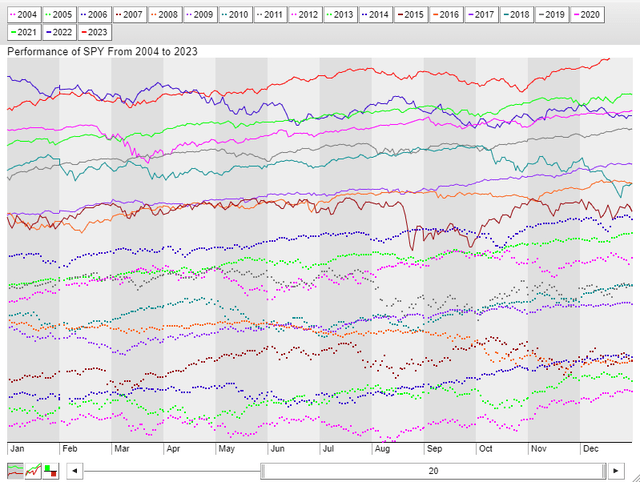
The end of the year is commonly marked by gradually rising stock prices and quiet sessions on the floor of the NYSE. Such is the case so far in 2023 as the vaunted Santa Claus Rally period approaches. The final five trading days on the calendar and the first pair of sessions of 2024 begin this Friday and extend out right before key December employment data hits the tape next month.
While outlier years like 2018 sometimes appear, with the S&P 500 moving up and down in large daily swings, now is usually a time to stand pat with respect to being long volatility. But we are getting closer to the CBOE Volatility Index’s time to shine.
I reiterate my hold rating on the iPath Series B S&P 500 VIX Short-Term Futures ETN (BATS:VXX). I will outline when I believe an opportunity may arise to get long this volatility-focused product. For now, sitting back and enjoying what may be a melt-up in equities could be the probabilistic play.
S&P 500 Yearly Performances: Grinding Higher into Year-End is a Common Theme
Stockcharts.com
According to the issuer, VXX is designed to provide exposure to the S&P 500 VIX Short-Term Futures TM Index Total Return (the “Index”). The ETNs are riskier than ordinary unsecured debt securities and have no principal protection. The ETNs are unsecured debt obligations of the issuer, Barclays Bank PLC, and are not, either directly or indirectly, an obligation of or guaranteed by any third party. Any payment to be made on the ETNs, including any payment at maturity or upon redemption, depends on the ability of Barclays Bank PLC to satisfy its obligations as they come due. An investment in the ETNs involves significant risks, including possible loss of principal, and may not be suitable for all investors.
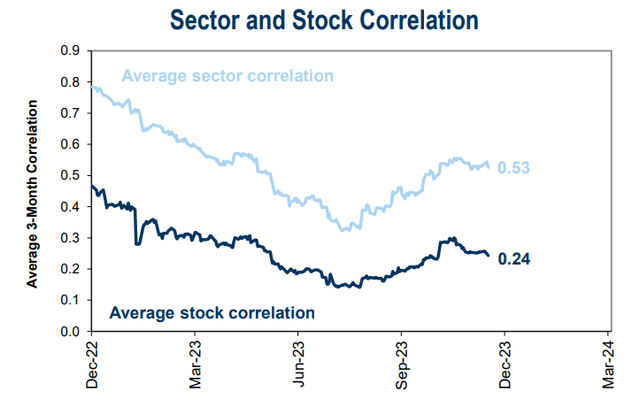
With the disclaimer out of the way, as it stands, correlations among sectors and individual equities are off the lows from last summer but remain generally low, according to Goldman Sachs. When correlations are subdued, volatility often has a challenging time trending higher. This is a market barometer I will be keeping watch on as we head into the more volatile Q1 period.
Equity Market Correlations Up From Q3 Lows
Goldman Sachs
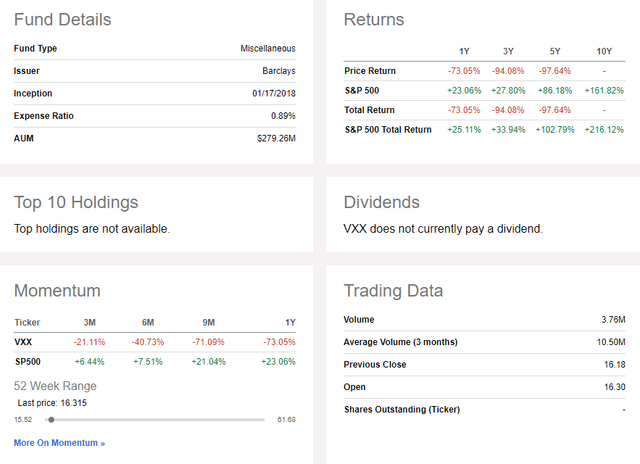
VXX is a small exchange-traded product (ETP) with total assets under management of just $279 million and it does not pay a dividend, as of December 18, 2023. VXX’s momentum has been very weak in the last two months as the stock market has lifted significantly off its October low and as there have been few volatility catalysts over the past eight weeks.
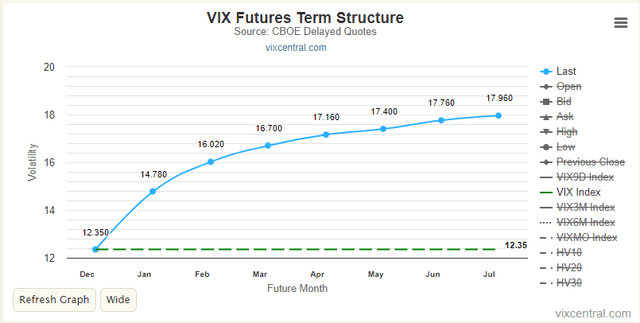
Still, it’s often what investors do not see coming that rattles markets most significantly. The ETP’s annual expense ratio is high at 0.89%, but I caution investors not to own VXX for extended periods due to the threat of negative roll return – that’s a situation in which the issuer must buy futures contracts out weeks or months, then hold them only to see price decay take place, thereby leading to selling the expiring contracts at a relatively low price and buying later-dated, more expensive futures. The image below shows that situation is the case today. When volatility spikes, we sometimes see bullish backwardation in VIX futures.
CBOE VIX Futures: Bearish Contango, Roll Risk for VXX
VIX Central
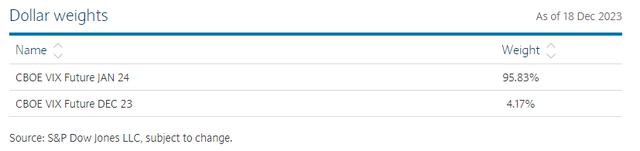
VXX Holdings: A Near-Term Volatility Futures Product
Barclays
Still, VXX is a liquid product with more than 10 million shares traded daily, and its 30-day median bid/ask spread is modest at just six basis points. The fund’s premium to NAV stands tight at +0.13%, though the fund’s tracking error can be high at times, adding to the ETNs’ risk exposure.
VXX: Portfolio Details, Trading Data
Seeking Alpha
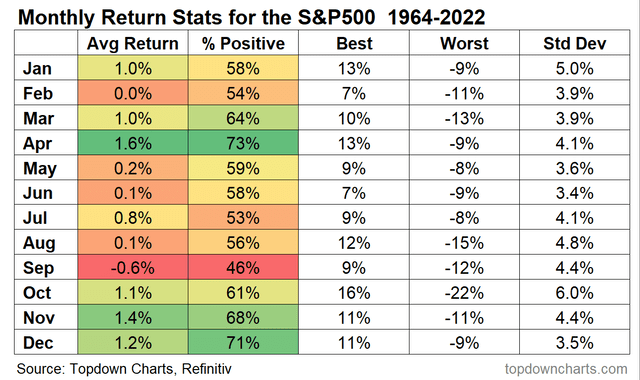
Seasonally, December tends to be a lackluster month for volatility. The S&P 500’s standard deviation for the month has been the softest in data going back to 1964, according to Top Down Chart’s Callum Thomas. But take a look at January – the standard deviation jumps to 5% – the second biggest volatility percentage of the year.
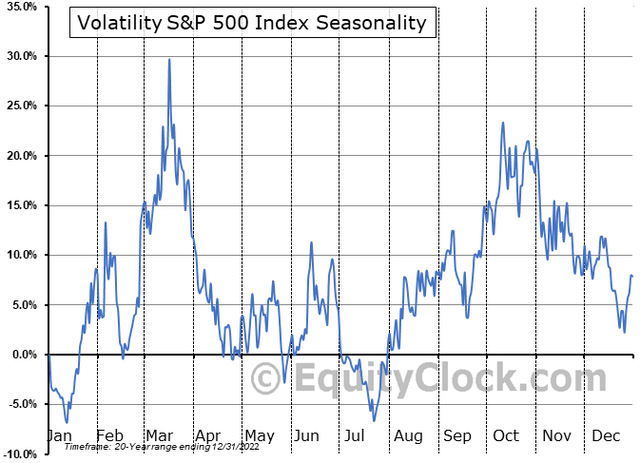
What’s more, equity market returns tend to be relatively poor in February in the data set, which generally helps the return outlook for VXX. Finally, major market lows have been notched in the final month of Q1 (see: 2009, 2020, 2023). Thus, I assert eyeing an early to mid-January entry point on VXX makes sense.
December Doldrums Often Give Way to Early-Year Volatility
Top Down Charts
Mid-January Through Mid-March Is the Best VIX Stretch
Equity Clock
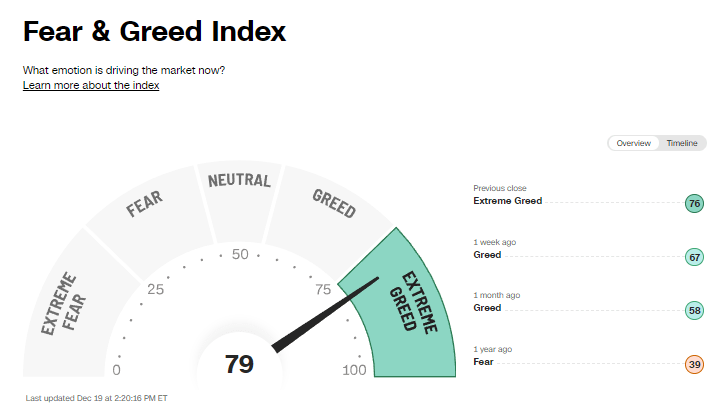
Investment Indicators Point to Complacency
CNN
The Technical Take
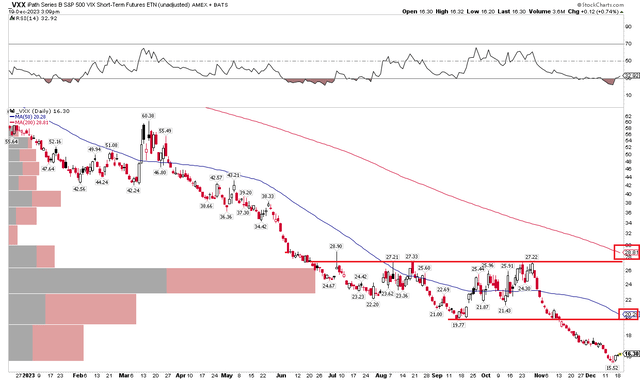
What price levels on VXX are important to monitor as we flip the calendar to 2024? Notice in the chart below that I see a pair of potentially pivotal spots. First, $20 is a line in the sand. Not only was that the low from September, back when I was last neutral on VXX but bullish on volatility from a seasonal perspective, but that’s also where volatility selling accelerated in early November. The SPX’s Q3-Q4 correction led to a peak in VXX at 27.
It would take a rather severe equity market pullback amid new risks to get VXX above 20. If it does rally, though, the next layer of selling pressure may be near where the falling 200-day moving average comes into play, and where the range-highs from late Q2 through October are seen. For now, a volatility tick higher early next year could easily send VXX into the upper teens since there is an air pocket of volume up to the $19.77 price point.
VXX: Eyeing A Q1 2024 Bounce to $20
Stockcharts.com
The Bottom Line
Overall, a bit more patience may be required before getting long VXX, but we are getting closer to a favorable period on the calendar. Thus, I’m a hold on VXX today, and I assert that prospective buyers should eye this fund in a few weeks.
Credit: Source link