
Oli Scarff
We present our note on BP (NYSE:BP), a leading integrated multinational oil and gas company, with a buy rating. We are drawn by BP’s robust upstream pipeline, strong execution, appealing valuation, and capital returns policy, while we remain more cautious on renewables investments. We will provide an overview of the firm and its activities, comment Q3 results, analyze the pipeline and the decarbonization strategy, discuss mid-term targets, management changes, and risks, and value BP’s shares.
A brief overview of BP
BP is a British international energy company. It operates across exploration and production, refining, distribution, marketing, electricity generation, and trading. BP is an oil and gas supermajor and is one of the world’s largest companies by revenue and profits in any industry. BP is listed on the London Stock Exchange, where it is a FTSE 100 index constituent, and has a current market capitalization of ca. GBP78 billion.
Q3 miss
BP had a weak Q3 print, with operating profit and adjusted net income coming in respectively 20% and 18% below company-complied sell-side analyst consensus. The miss was primarily related to weak gas marketing and trading performance. This compares to excellent gas trading results in the first half of FY2023, which is unlikely to be repeated in the current quarter, given the lack of structure in the market (driven by higher storage levels and lower volatility). Moreover, oil production and operation results also came in below expectations due to a negative impact from price lagging. As expected, ca. $0.5 billion of impairment was booked in the US offshore wind portfolio, while options are still being considered for the operation. A 10% dividend increase and $1.5 billion of share buybacks were announced. We believe the miss does not point to fundamental weaknesses as it is related to shorter-term dynamics, and it does not affect our long thesis on BP.
BP Q3 Results Presentation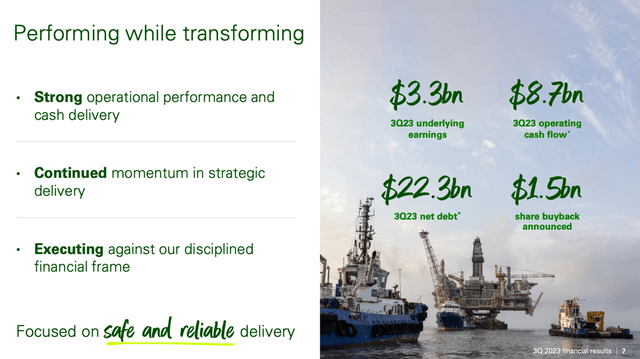
Investor event in Denver
In September, Mr. Bernard Looney resigned as CEO of BP, after failing to disclose details of personal relationships with coworkers to a board investigation, and Mr. Murray Auchincloss, the company’s CFO, took over as interim CEO. Meanwhile, the search for a new CEO continues without a clear frontrunner so far.
In October, the interim CEO hosted his first major investor event in Denver (the company’s third upstream showcase – this time featuring the US onshore oil and gas business), highlighting BP’s commitment to financial and carbon reduction ambitions. It is evident that while the firm’s ambition of transforming into an integrated energy company is unchanged, BP’s hydrocarbons business will be growing well into 2030 and continue beyond that.
The group targets an EBITDA in the range of $46-49 billion in FY2025, unchanged vs. previously announced targets; and a hydrocarbons EBITDA of $41-44 billion and group EBITDA of $53-58 billion by FY2030, or $2 billion higher vs. previous targets, driven mostly by hydrocarbons. BP expects a capex of $14-18 billion per year between 2024 and 2030, capacity for a 4% annual dividend increase with oil at $60/bbl., and capacity for $4 billion of share buybacks per year at $60/bbl. We are reassured by the commitment to hydrocarbons and the more return-focused approach to low-carbon investments.
Attractive pipeline
BP has a top-tier upstream pipeline and expects upstream production to increase to 2.3mboe/day by 2025, vs. 2.25mboe/day the previous year. 9 high margin projects with attractive project economics will be commissioned including Seagull in the UK, Mad Dog phase 2 in the US, etc. adding ca. 200kboe/day in new capacity. In addition, BPX (the US onshore operation) will be adding more than 100kboe/day. BPX should grow well into 2030, increasing production by nearly half vs current levels to nearly 650kboe/d. Additional growth areas include the Gulf of Mexico and the UAE. Overall oil liquids production should grow by a CAGR of 3% into 2027, providing upside in a higher-oil price backdrop.
BP is focused on maintaining a mid-teen to 20% IRR hurdle rate with oil at $60/bbl. for new projects. We would also like to note that BP’s breakeven oil price has fallen by nearly three quarters from its peak, and the group is focused on cost optimization and good capital allocation. Ca. 200kboe/d of lower margin production will be divested to optimize the portfolio.
BP expects its oil and gas mix to be balanced by 2030 backed by robust gas demand. LNG supply should increase from 19 million tons per year in 2022 to 25 million tons in 2025 and 30 million tons in 2030. This is underpinned by equity and merchant projects including Tannugh Train 3, GTA Phase 1, Coral, Calcasieu Pass, etc. We believe the robust project pipeline makes possible continued high cash generation and capital returns while financing BP’s green ambitions and its transformation into an integrated energy player. BP’s attractive pipeline and portfolio optimization efforts are key elements of our long thesis on BP.
BP’s Investor Event Slides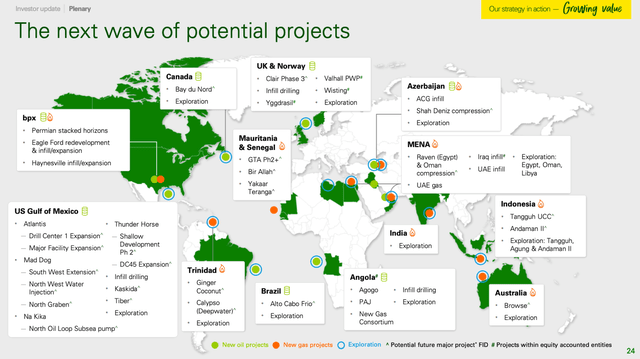
Decarbonization strategy
BP stresses its green ambitions with a focus on renewables, bioenergy, carbon capture and storage technologies, hydrogen, and electric vehicle charging. The firm targets net zero emissions by 2050. BP aims to grow its “green” EBITDA to $3-4 billion by 2025, and to $10-12 billion by 2030, investing $6-8 billion per year by 2025 and $7-9 billion per year by 2030. It aims for higher than 15% IRRs in bioenergy and EV charging, double-digit returns for hydrogen, and 6-8% unlevered returns for renewables (optimized through financing).
We would prefer to see an even stronger focus on green projects’ financial returns rather than numerical targets similar to Shell, and a clear exit strategy from unprofitable ventures like offshore wind in the US. While it is important for BP to accomplish net-zero targets and transition into an integrated energy player, we would prefer the new management to curb green capex and either seek projects with more attractive economics or simply distribute more cash to shareholders.
Valuation, capital returns, and investment recommendation
Similar to other integrated energy companies, we value BP using PE multiples and FCF yields. Our forecasts are largely in line with sell-side consensus and reflect the assumption of oil prices at around $60-70/bbl. and gas prices at $11-14mcf. As with other energy firms, we would like to highlight the sensitivity of our projections to commodity prices. For FY2024e, we project $220 billion of revenue and $44 billion of EBITDA. This also is in line with the company’s guidance. We then project an adjusted net income of $15.5 billion and a Free Cash Flow of $15.8 billion.
This implied a forward PE ratio of 6.5x (before share number changes after buybacks) and an FCFF yield of 14%. We moreover forecast a dividend yield of 6% and total shareholder returns at ca. 10%. BP’s valuation is significantly lower vs. its historical ratios. BP’s 20-year PE ratio average stands at 11x while its 20-year FCFF yield ratio stands at 6%. We find BP’s relative valuation compelling.
Due to capital allocation concerns related to green investments, we value BP at a discount to Shell, at 8x forward PE implying 23% share price upside and a share price of 580p per share. Combined with ca. 10% of capital returns per year, we calculate a mid-term embedded IRR in the low to mid-teens.
BP’s Investor Event Slides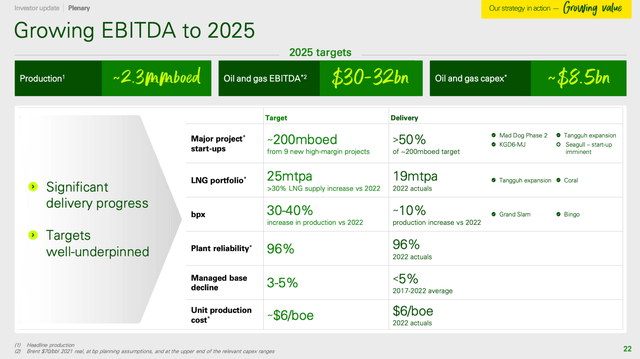
Risks
Risks include but are not limited to deteriorating economic conditions, lower than expected realized oil and gas prices resulting in lower income and earnings (especially lower European gas prices), higher decline rates / lower recovery rates in mature assets leading to lower than expected production, higher than expected costs and capital expenditure leading to lower profitability and lower returns, delays and other issues related to project execution, misallocation of capital including to suboptimal renewables projects in US offshore, lower than expected capital returns, others risks related to the energy transition, political risks, windfall taxes, governance risk, natural disasters, accidents, weather events, etc.
Conclusion
Given the compelling equity story, cheap valuation, and attractive capital returns policy, we recommend buying BP shares.
Credit: Source link