
David Becker
The Company
Founded 187 years ago, Deere & Company (NYSE:DE) is a $107-billion market cap global manufacturer and distributor of various equipment. It operates in 4 segments [“Other revenue” is excluded]:
-
Production and Precision Agriculture [43% of total sales]: Develops agricultural equipment and precision agriculture solutions with a global manufacturing network and training programs.
-
Small Agriculture and Turf [23.7%]: Manufactures lawn and garden equipment, offers turf care solutions and provides customer support programs.
-
Construction and Forestry [23.7%]: Specializes in construction and forestry equipment with design and testing by engineers, along with customer support programs.
-
Financial Services [~7.8%]: Offers financing options, including loans, leases, and insurance products, with a dedicated customer service team.
Based on the most recent quarterly report for fiscal Q3, Deere demonstrated robust performance across its business divisions as far as I can see.
The Production & Precision Ag segment saw a 12% YoY increase in sales and a 38% rise in operating profit, with an expanded operating margin of 26.2%. Strong pricing power and improved sales mix were key factors. During the earning call, the management team was optimistic about a 20% growth in retail sales for this division in FY2023.
In the Small Ag and Turf segment, sales increased by 3% YoY, and EBIT surged by 33%, leading to an improved operating margin of 19.6%, primarily due to higher pricing. A 5% growth in retail sales is expected for FY2023.
The Construction and Forestry division reported a 14% YoY growth in net sales and a substantial 39% increase in operating profit, with an operating margin of 19.1%. Higher pricing and volume drove the performance, and management anticipated a 10%-15% growth in retail sales for FY2023.
Deere’s Financial Services division reported a 36% increase in 3Q revenue, while net income grew by 3%, influenced by less favorable financing spreads. This segment’s net income for FY2023 is expected to be ~$630 million.
Deere’s focus on cost management is evident with a net margin of 18.8% in fiscal 3Q, intending to achieve a mid-cycle full-year net margin of ~20%. The company’s flexible cost structure allows it to adapt effectively to changes in the business cycle.
On a consolidated basis, the company increased earnings per share by 66% thanks to a combination of higher margins and top-line growth:
Deere’s IR materials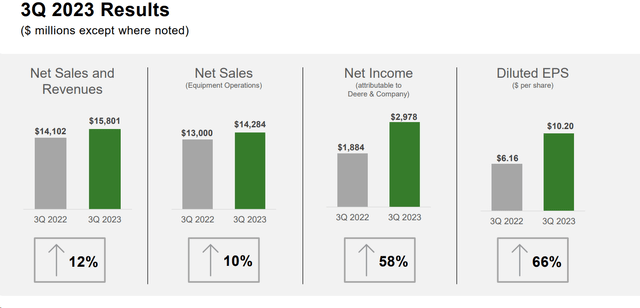
These results far exceeded analysts’ forecasts – Q3’s EPS beat was the largest since early last year:
Seeking Alpha data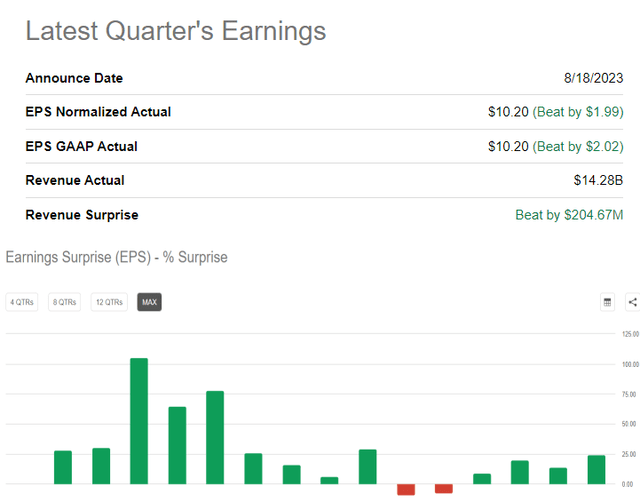
The company’s operations seem to be running smoothly, and strong fundamentals in agriculture and construction equipment markets continue to drive growth. As you can see from management’s FY2023 forecasts, growth is projected to continue across all segments.
Also, inventory levels are expected to remain modest, and used inventory is below historic levels. Early order programs are yielding positive results, especially for sprayers, with favorable technology adoption and strong demand for larger equipment.
From what I understood in the Q&A session on the third quarter earnings call, Deere is looking to increase value per unit by incorporating more technology into its machines, which has been a consistent trend with 3-4% increases above inflation. This trend is expected to continue through 2024, contributing to the unit economics.
They also mentioned the shift towards a service-oriented business model – a great way to reduce margin volatility, driven by cost management, technology integration, and lifecycle solutions to mitigate cyclicality.
The company is also expanding its battery manufacturing capacity, focusing on technology and electrification. They have a battery portfolio and charging technology plans that support electrification in off-highway equipment. The facility is expected to be operational within a year.
I like the direction DE’s management is looking at in developing the business in the current difficult global economic conditions. The company appears to me to be financially stable, having $7.4 billion in cash and marketable securities, with a current ratio of over 1.9, a debt-to-equity ratio of about 0.5, and the ability to cover interest costs more than 7 times in a row through operating profit.
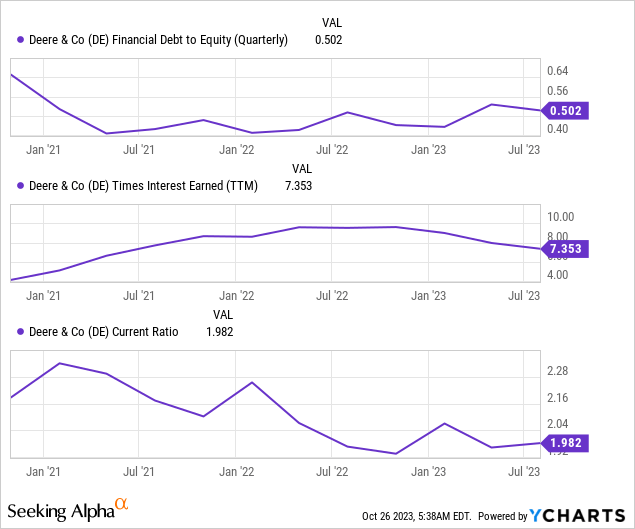
But what about Deere’s valuation?
The Valuation
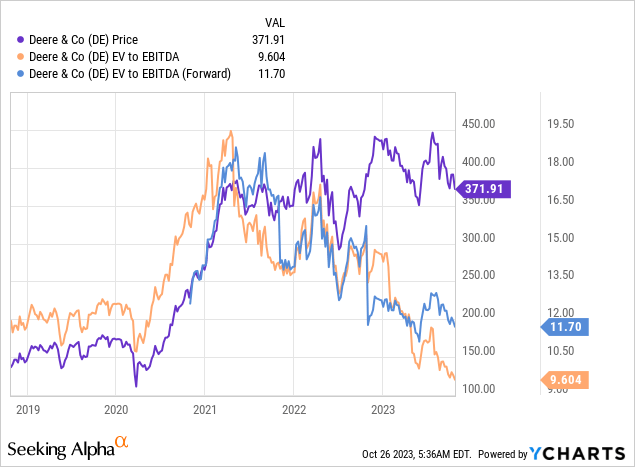
Due to recent difficult market conditions, DE stock has fallen and its multiples have been adjusted as a result. Currently, Deere is trading at ~11.7 times the forward EV/EBITDA ratio, which is 22% higher than the TTM ratio but well below long-term median levels.
Seeking Alpha’s Quant System rates DE stock a “D” in terms of Valuation. However, if we take a closer look, this low valuation grade results mainly from the high price-to-sales and price-to-book ratios:
Seeking Alpha, author’s notes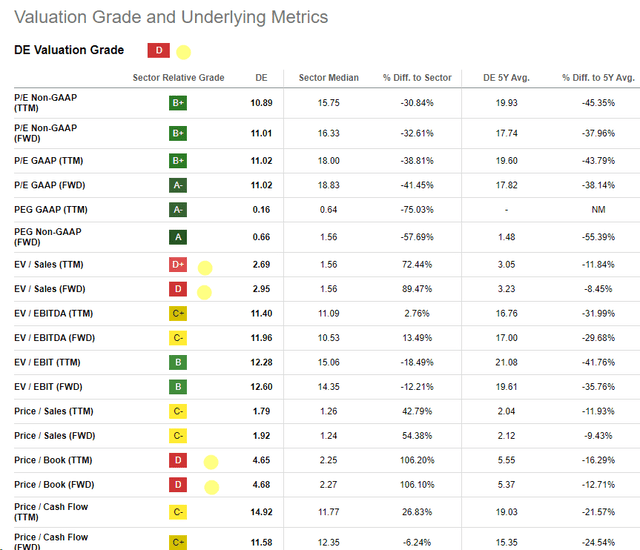
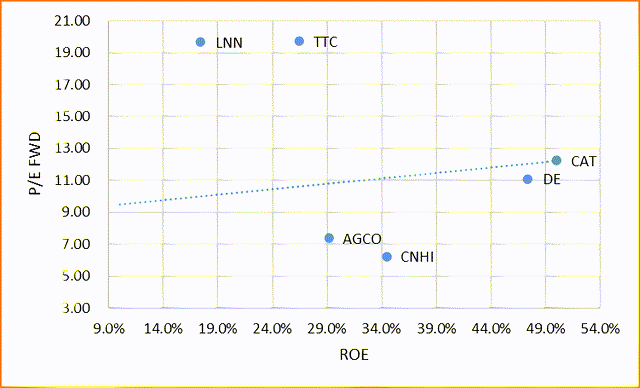
But if we keep in mind that DE is actively trying to modernize and aim for higher margins, I think revenue and book-related valuation ratios should take a back seat. More important are EBITDA, FCF, and earnings-related metrics. And with those, Deere has no problems when we compare them to margin and profitability levels and take into account the peer group’s norms:
Author’s work, based on Seeking Alpha data Author’s work, based on Seeking Alpha data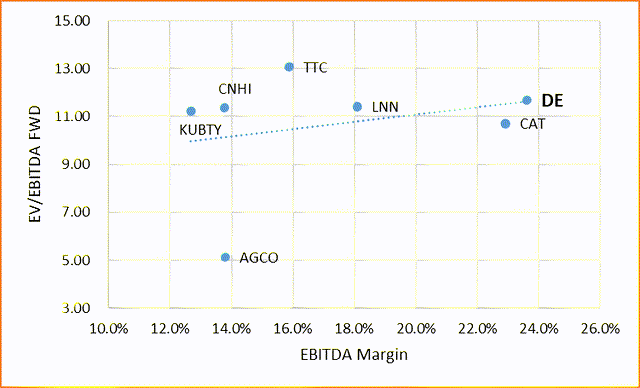
The Bottom Line
I really like the company’s progress over the last few quarters: Margins are growing in parallel with rising prices, which makes the company really strong and resilient in terms of cash flow generation. For fiscal 2023, the company has announced that it plans to generate a net operating cash flow of $10.5-11 billion, which is ~10% of total market capitalization (that looks impressive). Trying to get away from cyclicality and invest in technological solutions should eventually turn Deere into a true FCF machine, in my opinion.
Moreover, despite some high multiples, DE stock has become quite cheap after the recent correction – at least in terms of margins and profitability, DE has virtually no competition with similar multiples.
But of course, investing in Deere & Company stock carries several risks. First off, the company’s business is still quite cyclical, so economic downturns could lead to reduced demand for its products. Fluctuations in commodity prices, as Deere’s customers are primarily in the agricultural and construction industries, can impact demand. Currency risk is present due to Deere’s international operations, as a stronger US dollar may make its products more expensive overseas. Also, competition poses a threat, as rivals introducing more attractive products or services could erode market share.
But despite the existing risks, DE stock is a “Buy” to me even at its current levels.
Thanks for reading!
Credit: Source link