

courtneyk/E+ via Getty Images
Overview
In the world of Real Estate Investment Trusts (REITs), Healthcare REITs have recently faced both challenges and opportunities. Notably, Welltower Inc. (NYSE:WELL) has emerged as a standout performer, both within its sector and as the largest Healthcare REIT with a market capitalization exceeding $42 billion. WELL’s core business revolves around providing capital to senior housing operators, post-acute care providers, and medical office buildings.
My perspective is that WELL is in a strong position to benefit from rising senior housing demand. The older population over 70 years old is growing and has grown to the largest level it has ever been. Senior housing demand is outpacing the supply of units. Combine this with affordability being at the highest level it’s ever been and we can expect WELL to provide future long term returns.
Portfolio & Macro-Outlook
Welltower boasts a diverse real estate portfolio comprised of over 125,000 housing units within 1600 properties. These properties are categorized into three segments: Seniors Housing Operating Portfolio, Triple-net leases, and Outpatient medical facilities. Since Q4 of 2020, WELL has invested a lot of capital back into their business through acquisitions and efforts to increase downside protection.
WELL has deployed over $9B in gross investments that present a stable yield of approximately 8%. Part of the $9B invested consists of 37,000 senior housing units acquired executed at an average investment of $22M per property.
WELL Sept Business Update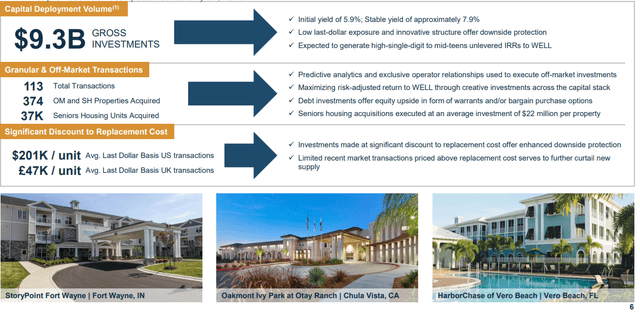
Management has recently revised their guidance for net income attributable to common stockholders, now expecting it to fall within a range of $0.73 to $0.84 per diluted share. Welltower management projects a growth rate spanning from 10% to 13% annually.
This growth can be broken down into several key components. Seniors Housing Operating growth comes at 24.2% while Seniors Housing Triple-net is expected to grow much slower in the range of approximately 1% to 3%. Additionally, Outpatient Medical growth comes in around 3% and Long-Term/Post-Acute Care is predicted to range from approximately 4% to 6%.
WELL Investor Presentation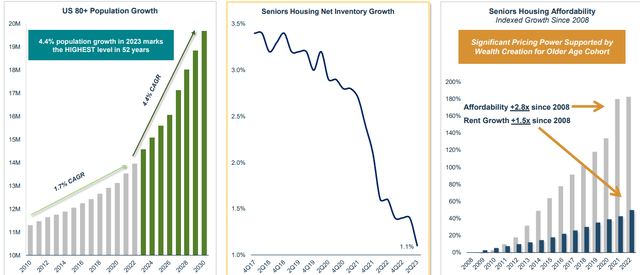
Senior housing demand in the U.S is projected to increase by 40,000 units per year all the way through 2029. This is because the population is getting older and living longer and the demographic of people above the age of 75 years old is the highest that it’s ever been. According to Harrison Street, despite the demand increasing by 40,000 units per year, there will only be 20,000 actual units added to the supply. We can see this reinforced by the chart above which shows the senior housing net inventory growth slowing down to 1%.
I believe that the minimal supply growth in the future provides an opportunity for REITs like WELL to profit from multi-year occupancy gains. As seen from the chart above, affordability has grown to an all time high since 2008. A personal observation is that senior housing has become much nicer now compared to what a lot of us probably remember. Senior housing has generally become much more modernized which things such as fitness centers, pools, lounges, and larger housing units. Higher affordability mixed with much nicer senior properties, sets the stage for a profitable future for WELL. This is especially true when we take into consideration how demand continues to grow alongside these other factors.
Cash Flow & Dividends
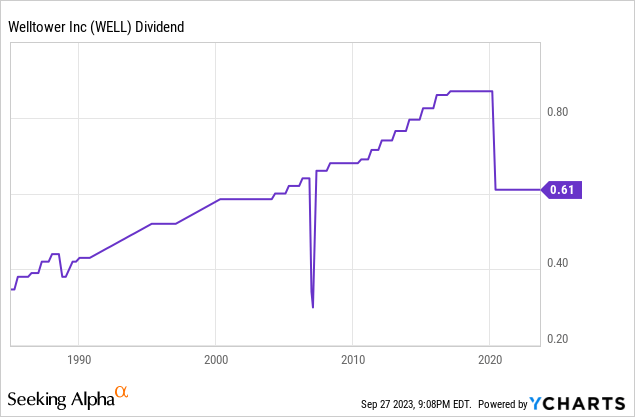
In terms of dividends, WELL’s yield is lower than the average Healthcare REIT, and its dividend growth has been negative because of the previously dividend cuts. Despite this, WELL maintains a comfortable dividend payout ratio which means future distributions are going to be fine. The upfront yield starts relatively low at only 3%.
We can see that the covid pandemic did contribute to the dividend being cut back in 2020. Now that the worst of it is over, I fully expect the announcement of a dividend raise sometime next year in 2024. It would be nice to see the dividend get back to pre-pandemic levels.
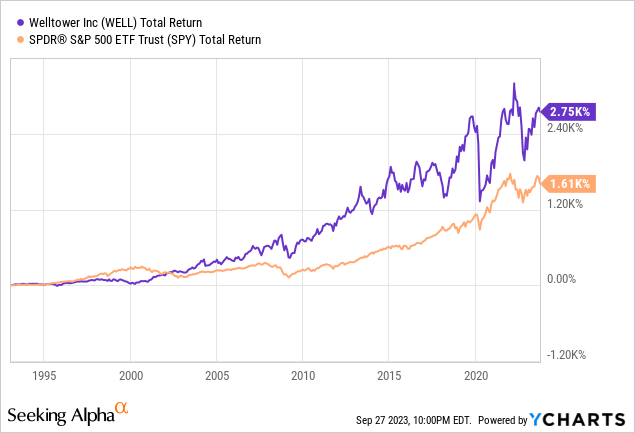
Despite the low upfront yield, WELL has managed to provide exceptional returns and outperformed the S&P500 (SPY) since inception.
It’s probable that this outperformance continues well into the future because WELL has taken steps to significantly deleverage their balance sheet YTD with their net debt to adjusted EBITDA declining by 1.3x – 5.62x. Their liquidity profile remains strong, with a total of $7.6 billion in readily available near-term funds. Liquidity isn’t a concern because no single institution accounts for more than 4.3% of WELL’s total credit facility commitments. Moreover, during the second quarter, WELL successfully secured over $3 billion in attractively priced capital.
WELL Investor Presentation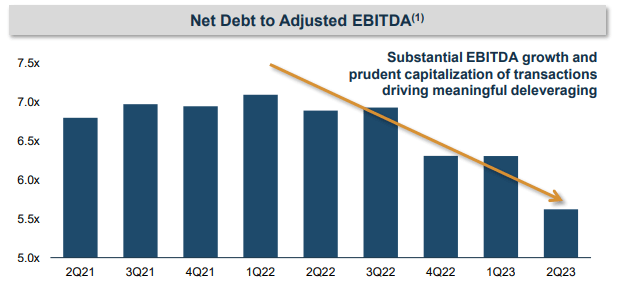
Valuation
We can get a rough fair value estimate by running a discounted cash flow analysis. Using a discount rate of 7% and estimated growth of 6% to account for a conservative outlook, we can come up with a fair trading range estimate. Using the estimated FFO estimate for 2024, we determine that a fair value is $75.44 per share.
At the current price, this means that WELL is trading a bit over fair value by a little over 6%. In comparison, the average price target Wall St consensus shows that there is a potential 14% upside to reach the average price target of $91.28 per share. This is highly possible if WELL hits the growth rate of 10% annually that management is aiming for.
Money Chimp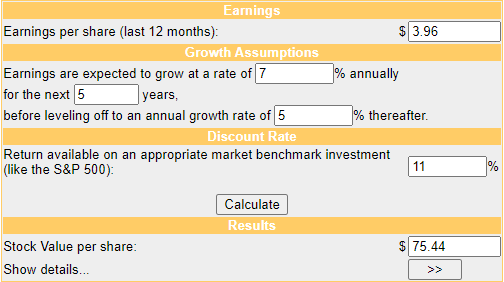
Conclusion
Welltower Inc. stands as a prominent player in the challenging yet promising landscape of Healthcare REITs. With a market capitalization exceeding $42 billion, WELL has established itself as the largest Healthcare REIT, focusing on providing capital to senior housing operators, post-acute care providers, and medical office buildings.
WELL’s strategic moves and investments in its diverse real estate portfolio, encompassing over 125,000 housing units across 1600 properties, reflect a commitment to bolstering its downside protection and yield. Notably, the deployment of over $9 billion in gross investments, yielding approximately 8%, signifies a proactive approach to growth and stability.
The aging U.S. population and limited supply growth present an opportunity for REITs like WELL to capitalize on multi-year occupancy gains. Affordability and improved senior housing amenities further support this positive trajectory.
Credit: Source link