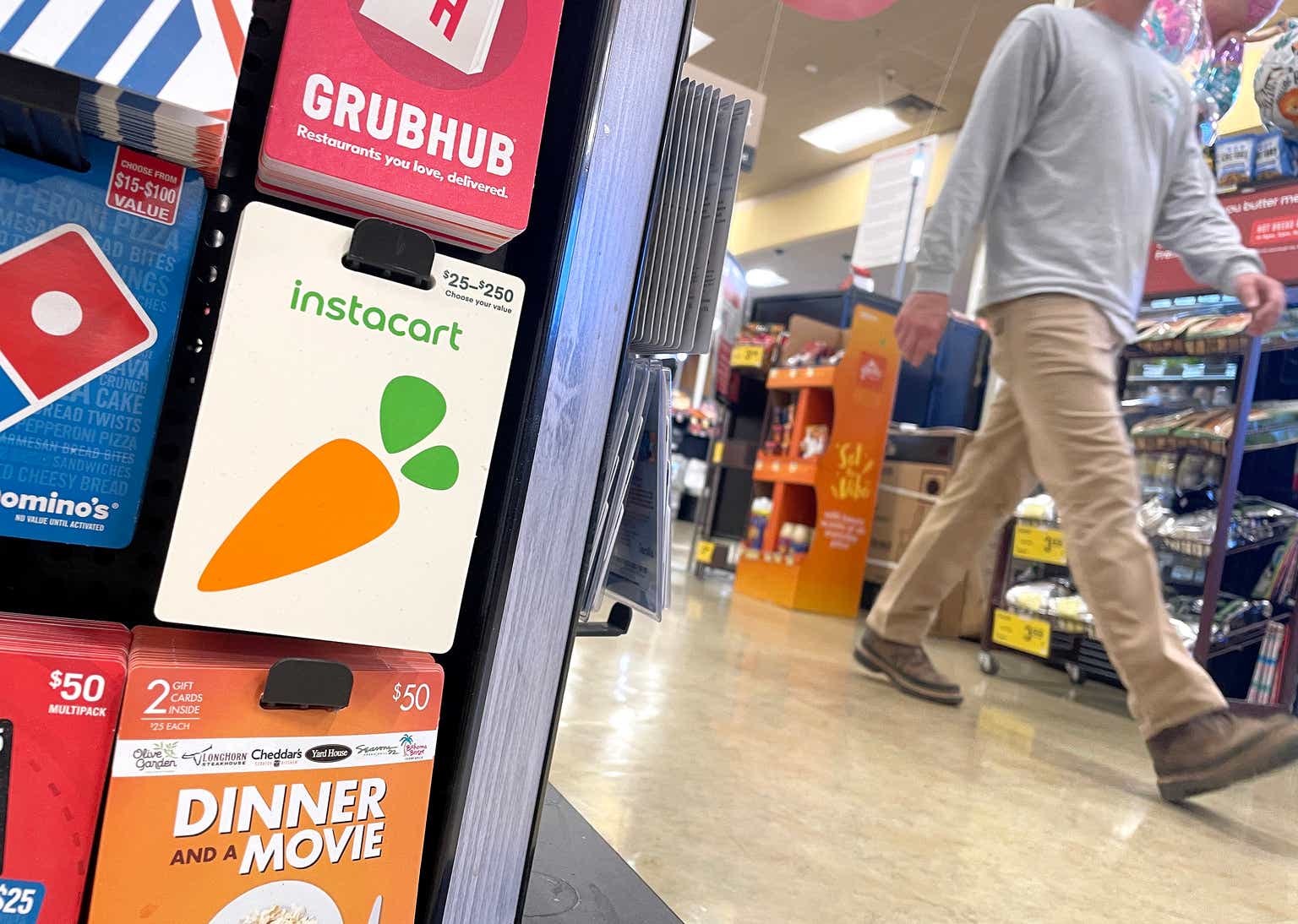

Justin Sullivan/Getty Images News
Summary
Instacart (CART), which operates a popular online grocery fulfillment website, is going public on Tuesday, selling 22 million shares to raise up to $660 million. This implies a fully diluted valuation of up to $10.3 billion at the top of the indicated pricing range of $28 to $30 a share.
The company’s valuation has sunk over the course of several private funding rounds from $39 billion during a $265 million funding raise at the height of the pandemic in March 2021 to $13 billion during the latest round. The increased price range and backing of heavyweight investors such as PepsiCo (PEP), Sequoia Capital, Norges Bank, and Valiant Management suggest high retail demand.
As the pandemic has eased, revenue growth has slowed, causing the company to shift its focus more towards advertising and software sales. The company is a category leader with a first-mover advantage but faces growing competition from the likes of Walmart and Amazon.
Introduction
Maplebear Inc., doing business under the name of Instacart, is a digital grocery fulfillment platform that employs freelancer contractors as personal shoppers to fulfill customers’ grocery orders. The San Francisco based company, which was founded in 2012, is the category leader in the emerging online grocery segment. The company currently partners with more than 1,400 retail partners and over 80,000 store locations, representing around 85% of the US retail grocery market, and processed approximately 263 million orders last year. Affiliated retailers include major grocery chains such as Kroger (KR) /King Soopers, Publix, Safeway, Albertsons (ACI), Aldi, Fry’s, Meijer, Winn Dixie, H-E-B, Costco (COST), and Walmart (WMT) (also a competitor). Each month, the company processes around 7.7 million orders for delivery or pick-up from customers spending an average of $317 monthly.
While grocery is the largest category in retail, with a TAM of $1.1 trillion in the United States, it has been slow to transition to online sales. In 2022, only 12% of grocery shopping took place online, compared to 66% of consumer electronics, 38% of apparel, and 20% of home goods. As this figure increased from just 3% in 2019 to 12% in 2022, much of the recent growth can be attributed to the effects of the pandemic, with people sheltering in place and practicing social distancing.
The company’s revenues primarily come from two different sources: the Instacart Marketplace, which connects customers to their favorite national, regional, and local retailers through the website and the mobile app, and the Instacart Enterprise Platform, which provides retailers with an enterprise suite of e-commerce, fulfillment, advertising, and marketing features. In addition, advertising and software sales have become important sources of revenue, accounting for around 30% of the company’s sales last year.
Instacart has a capable management team, headed by CEO Fidji Simo, the former Head of Facebook at Meta, possessing years of experience from major online retailers, and a seasoned board featuring the CEO and Chairman of the Board of Snowflake along with representatives from leading venture capital firms such as Andreesen Horowitz and Sequoia Capital.
The Bull Case
As an early entrant and current market leader in the online grocery fulfillment business, Instacart enjoys a clear first-mover advantage. The company has an established track record of revenue growth, innovation, and technological leadership. While sales growth has slowed since the go-go days of the pandemic, the numbers for the first half of 2023 suggest that things are finally picking up again, with sales increasing by 31% compared to the same period last year. During the period from 2018 to 2022, the company successfully outperformed the competition, increasing its Gross Transaction Value (GTV) by 80%, compared to 50% for the overall online grocery market and 1% for offline grocery. Moreover, the company’s collaboration with OpenAI to build an “Ask Instacart” feature designed to provide shoppers with personalized recommendations and intelligent shopping cart functionality should not only lead to higher customer satisfaction and repeat purchases, but may excite investors looking for the next big “AI play”.
As a first-mover, exclusively focused on the grocery fulfillment segment, Instacart enjoys a clear competitive advantage. Whenever a potential customer is looking to order groceries online, as the category leader, the company’s website is bound to appear at the top of the Google search results. Moreover, their site is easy to navigate since the entire focus is on grocery fulfillment whereas customers must actively search for the “Amazon Fresh” department (not even available where I live) or click on “Grocery and Essentials” on the Walmart site. This may not sound like a big deal, but as a web designer, I believe that convenience and intuitive navigation are crucial when it comes to the stickiness of a site. As the company received 33.6 million visits last month with visitors spending on average almost 7 minutes each time on the site, they are clearly doing something right.
This is reflected in their recent performance, with their gross profit increasing from 4.2% of GTV in 2020 to 4.9% in 2021 to 6.4% in 2022 while their gross margin expanded from 60% to 67% to 72%, respectively, over the same time period. Meanwhile, the average monthly gross profit per repeat customer increased from $15 in 2020 to $20 in 2021 to $25 in 2022.
Finally, as the IPO is backed by a solid group of lead underwriters (Goldman Sachs and JP Morgan) and several heavyweight investors, including PepsiCo, which agreed to acquire $175 million of non-voting preferred stock in a concurrent private placement, the share price is likely to be buoyed by substantial retail demand in the aftermarket.
The Bear Case
While Instacart may eventually evolve into a category killer, I’m concerned that the category itself may remain a niche market that continues to post underwhelming growth. After all, as the S-1/A shows, prior to the one-off demand induced by the pandemic, this is a segment that took 10 years to triple in revenue. While digital transformation is a real phenomenon, in most other segments, the increasing emergence of online sales has been enabled by greater convenience as well as cost savings. Unfortunately, when it comes to the latter, it’s hard to see any future economies of scale in online grocery fulfillment as there is a labor component that is hard to ignore. Regardless whether the company continues to employ freelance contractors or decides to start hiring its own workforce, this is an added cost that affects ASPs. Thus, shopping for groceries online is rarely going to be cheaper than visiting a brick-and-mortar grocery store and employing your own labor to pick out the groceries.
Moreover, customers may be hesitant to trust an Instacart personal shopper to select certain items such as fresh fruit and vegetables. For this reason, I think the TAM is much smaller than the overall grocery market and will continue to be restricted to certain use cases, such as affluent customers who value the added convenience, rural residents who live far away from the nearest grocery store, people without their own transportation, etc. However, I can see opportunities for international expansion into third-world countries with cheaper labor costs and a growing middle class (e.g., India, the Philippines, Brazil, or Indonesia).
This brings to mind another risk. The company mentions in its S-1 that:
…voters in California voted in favor of…Proposition 22, which created a framework for compensation and benefits for independent contractors working in California with gig economy companies like Instacart. The applicable provisions under Proposition 22, among other things, require us to provide shoppers with a net earnings floor of at least 120% of the minimum wage for a shopper’s engaged time plus an amount per engaged mile….We are also required to provide certain levels of healthcare subsidy payments based on shoppers’ engaged time per week.
If other states enact similar laws, it would most certainly make it more difficult for the company to compete with brick-and-mortar grocery stores.
Moreover, reports have emerged recently suggesting after its business slowed down following the pandemic that the company is finding it more difficult to recruit gig workers . If Instacart’s sales growth were to slow due to macroeconomic or competitive factors, there is a risk that their contracted work force might seek greener pastures elsewhere, eliminating an important competitive advantage – the faster lead time they currently enjoy versus other online grocery retailers.
While the fact that Instacart delivered a profit last year is likely to appeal to more conservative investors, a deep dive into the numbers reveals that this was window dressing. Specifically, if you remove the one-off $357 million benefit from income taxes, you’re left with a much more modest net profit of $71 million and negative trend in EBITDA (from $134 million in 2020 to $34 million in 2021 to -$170 million in 2022). Moreover, the company’s quarterly sales have been flattish since the first quarter of 2022, ranging from $63.8 million to $67.9 million. The same is also true for the GTV numbers, which expanded from $20.7 billion in 2020 to $24.9 billion in 2021 to $28.8 billion in 2022 but have been rather flat on a quarterly basis since Q1 2022.
The company alludes to this slowdown in GTV growth in the S-1, stating that:
we also expect GTV growth to be tempered across our existing and new customer cohorts over the near term. These expected GTV trends are primarily due to the subsiding effects of the COVID-19 pandemic on demand for online grocery, including a return to pre-COVID grocery shopping behaviors, continuing macroeconomic uncertainty (including inflation and recession risks), the cessation of government stimulus (including the termination of certain EBT SNAP benefits in March 2023)…
They go on to note that:
customers have also been purchasing fewer items on average per order and shifting toward lower-price product categories on Instacart.
Another potential red flag in the company’s reported results is the adjusted sales and marketing spend, which has increased from $158 million (10.7% of revenue) in 2020 to $394 million (21.5% of revenue) in 2021 to $660 million (25.9%) in 2022. In my opinion, this seems excessive and leads me to question whether the recent growth is sustainable. Likewise, the dramatic improvement in net operating cash flow from FY 2021 to FY 2022, which was positive last year thanks to $373 million in deferred income taxes, can be brought into question as accounts receivables improved markedly from an outflow of $318 million in 2021 to an outflow of just $21 million in 2023. Since payment is received instantly from the retail Marketplace customers, this dramatic improvement may either be due to timing issues or stricter payment terms imposed on advertisers, software purchasers, or Enterprise Platform customers. It’s a question that I really would have liked to have asked the company and something that bears monitoring in future financial reports.
Finally, there’s the valuation. At the top of the pricing range, the company is valued at a P/S ratio of 3.55 and a trailing P/E of 145 (adjusted for the one-time tax benefit). While on the surface, this doesn’t sound all that bad compared to other category leaders in the online retail segment, it implies a high growth rate going forward. The most equivalent comparison I can come up with, DoorDash, is valued at a slightly higher P/S of 4.08 but delivered nearly 33% revenue growth last year while slower growing competitors, such as Chewy (CHWY), Etsy (ETSY), and Amazon (AMZN), are valued at P/S ratios ranging from 0.8 to 3.0.
Although Instacart did deliver revenue growth of 31% in the first half of 2023 over the prior year, this was down from 39% in FY2022. While quarterly revenues have risen, quarterly GTV growth has been fairly flat over the past two years. In addition, the company cautions that advertising revenue growth may decelerate in the near-term, stating:
while we believe we have multiple levers to be able to grow advertising and other revenue over time as described in the section titled ‘Business—Our Growth Strategies,’ we expect our advertising and other revenue to be negatively impacted over the near term.
In my opinion, in order to justify the premium valuation, revenues will need to continue to grow around 30% year-over-year; otherwise, as soon as the company reports its first quarter of disappointing revenue growth, the wheels are likely to come off this cart.
The Sizzle
A category leader in the online grocery fulfillment market with notable backers and prominent underwriters, Instacart is a familiar name that’s bound to receive a very warm reception from retail investors. In my opinion, the raised price range, perceived turn to profitability, and status as one of the year’s two most highly anticipated IPOs suggest that this cart will be firing on all cylinders as it leaves the starting line. As I can see it gaining momentum until the company reports results that disappoint the momo crowd, there’s likely an opportunity to make a quick buck if you can get it at or near the offering price.
Rating (on a scale of 1-5, where 1 pepper is a supreme fail and 5 peppers is a smashing hit)

rawpixel.com
The Steak
At the offering price, the stock may be priced to perfection. As recent trends in the company’s GTV and average order value (running in a tight range from $106 – $118 million since Q3 2020) suggest that revenue has been increasing simply from a higher take rate, I’m not sure that the company can grow the topline fast enough to justify this valuation. As the company notes that the decline in COVID-influenced orders in the second quarter of 2022 allows for a more normalized year-over-year comparison in Q2 2023, the modest order growth of 3% over the prior year period seems like it may be “the new norm” going forward. Nevertheless, as a category leader exclusively focused on online grocery fulfillment with a stellar management team, I believe Instacart has a durable first-mover advantage and should be capable of fending off competition from larger online retailers such as Amazon and Walmart. Therefore, while I would be hesitant to get in after a big first day pop, I would definitely revisit it 6-12 months after the IPO to look for a better entry point.
Rating (on a scale of 1-5, where 1 pepper is a supreme fail and 5 peppers is a smashing hit)

rawpixel.com
Overall Rating

rawpixel.com
Credit: Source link