

David Becker
As Advanced Micro Devices, Inc. (NASDAQ:AMD) continues to refine and expand its offerings in the AI and datacenter chip segments, it becomes increasingly clear that the company possesses the technological prowess and strategic vision needed to compete in these high-growth markets. However, past experiences suggest that investors tend to consistently underestimate AMD’s potential, and savvy market participants would be wise to closely monitor the company’s progress and consider the possibility that, once again, AMD could surprise the market with its growth and innovation and generate significant returns for the shareholders.
AMD has a history of being overlooked by investors
Throughout its history, AMD has often found itself in the shadow of larger competitors, and this trend continued into the late 2010s. In 2017, AMD was engineering superior products that were steadily chipping away at Intel’s (INTC) market dominance. However, despite its evident technological advancements and growing market share, many investors remained skeptical about AMD’s long-term prospects. The stock was often undervalued and overlooked, with the broader investment community failing to recognize the company’s potential for growth.
wccftech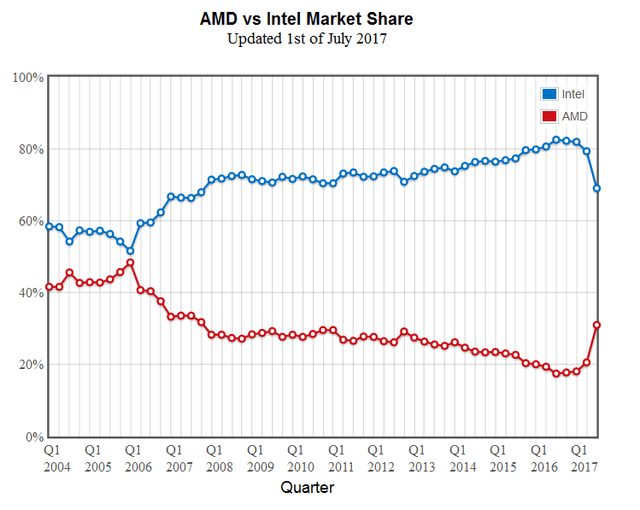
Moving into late 2017, AMD began forging strategic partnerships that held immense revenue potential. These collaborations, especially in the data center and gaming industries, promised substantial earnings growth. Yet, once again, investors seemed reluctant to fully price in these opportunities, keeping AMD’s stock from reaching its true potential.
Towards the end of 2019, AMD held tremendous potential in the semi-custom segment, but investors remained cautious, causing the stock to stagnate through the second half of 2019.
TradingView; notes by the author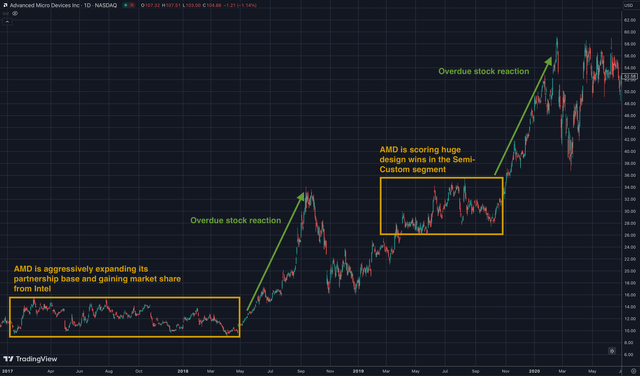
In retrospect, it’s clear that investors who overlooked AMD during these periods missed out on substantial gains, as the company’s stock consistently surged 6-12 months later, outperforming the broader market by a significant margin. These episodes serve as a reminder of the company’s resilience and its capacity to surprise investors when given the chance to shine. As a reminder, AMD has experienced a remarkable 1000% surge in value since its 2017 lows, in stark contrast to the S&P’s 70% growth during the same period.
AMD’s growth recovery should come thanks to datacenter and AI
History seems to be on the verge of repeating itself as Advanced Micro Devices gears up for the next cycle of its AI and datacenter chips. Similar to the past, AMD is in a position to introduce innovative products and technologies with the potential to disrupt the market.
Yet, over the past month, following AMD’s Q2 results, the stock has been trading down due to fears of declining revenue, especially in the datacenter business. Many investors also appear to discount AMD’s AI efforts, giving credit to Nvidia (NVDA) for dominating the entire market.
However, AMD’s revenue trajectory often follows a cyclical pattern that corresponds to its product development cycles. The past two quarters can be seen as a low point in this cycle, and AMD anticipates a robust comeback. In its Q3 guidance, the company has forecasted double-digit growth in the data center segment, primarily driven by the arrival of new products. Historically, AMD has demonstrated its ability to leverage product cycles to stimulate revenue growth, and this upcoming cycle appears to be no exception.
From AMD’s recent earnings call:
If you look at the EPYC Gen 4 family, not only Genoa is ramping quickly, but also Bergamo is starting to ramp in second half. We also have a Genoa-X, which is very focused on technical workload. And also Ciena is coming, which is focused on the telco and cost-sensitive segment. So when you look at the lineup we have, we definitely see second half for our server business will continue to grow and continue to gain share.
Additionally, AMD is making significant strides in the field of AI. The company is set to launch and sell its MI300 AI chips in the fourth quarter, signaling its commitment to this rapidly growing sector. It is claimed that AMD’s AI chips are “nearly as fast as Nvidia’s,” and AMD’s software is “easy to implement.” Given Nvidia’s (NVDA) supply constraints and the immense expected growth in the AI addressable market, which can reach almost $2 trillion by 2030, there is no doubt AMD can significantly increase its revenue, even if the company only manages to gain a slight market share from Nvidia.
AMD’s new chips have the capacity to address the growing demand for data processing power in artificial intelligence and the cloud. However, similar to previous instances, it appears that investors may not be fully appreciating the implications of AMD’s technological advancements. The company’s stock price may not yet reflect the considerable revenue potential that these next-gen chips bring, which could potentially lead to another situation where AMD outperforms market expectations by a significant margin.
So for us, when we look at the market opportunities, it’s actually quite exciting because the PC is coming out of the down cycle and the server market, we do have our unique product cycle driving our revenue growth. And next year, we should get more meaningful significant opportunities on the AI side.
Where can AMD go from here: A DCF analysis
To better understand the stock’s valuation and growth potential, we can use DCF analysis.
My analysis is based on the following key assumptions:
1. The average annual revenue growth over the horizon period of five years is estimated to be around 16.4%, with a 3% decrease in 2023 and 20-25% growth between 2024 and 2027, based on analysts’ earnings estimates and adding a fraction of potential AI-driven growth.
2. EBITDA margin will remain on the level of 25-30% throughout 2027.
3. Then goes the WACC.
The after-tax cost of debt is 2.6% (using 15% tax rate), based on the latest Q-10 filings. The cost of equity capital (20.5%) is calculated using CAPM, with 1.8 beta, 4.3% risk-free rate, which is the current U.S. 10-year bond yield, and 9% market premium. The WACC is, therefore, estimated to be around 20.3%.
Here is the operating and balance sheet data used in the modeling:
The author’s DCF model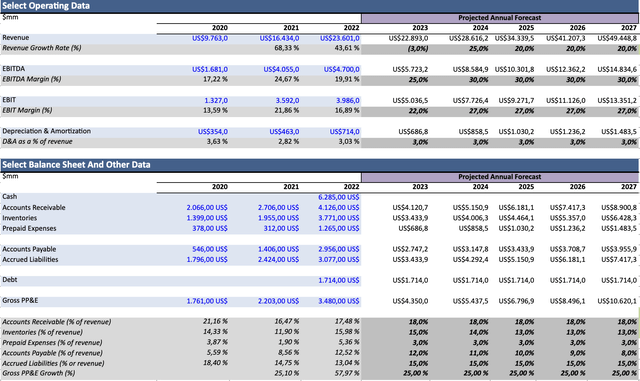
As a result of these calculations, AMD’s fair price range is approximately $128-132, which is about 30% higher than the current stock price.
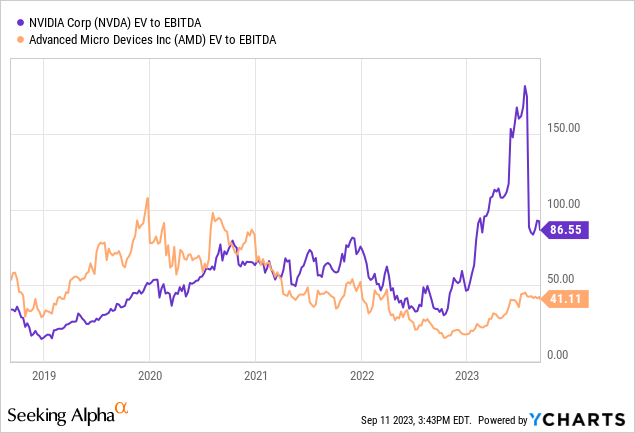
Note that this price range assumes that the EV/EBITDA multiple will decrease significantly to a very conservative range of 24-26 within 4 years. Both Nvidia and AMD have traded at an EV/EBITDA ratio of around 50 over the last 5 years. Therefore, if the stock continues to grow its earnings and maintain a premium multiple, the margin of safety can be even higher.
Key takeaways
AMD has consistently surprised investors by being undervalued and overlooked despite its technological advancements and market share growth. This trend dates back to 2017 when AMD challenged Intel’s dominance but was underestimated by investors. In 2018, strategic partnerships promising revenue growth were not fully priced into the stock, and in late 2019, despite potential in the semi-custom segment, AMD’s stock stagnated. In each case, AMD later outperformed the market significantly, highlighting its ability to exceed expectations.
Now, as AMD gears up for the next cycle of AI and datacenter chips, history appears to repeat. Recent quarters may have been a low point in this cycle, with concerns about declining revenue. However, AMD’s guidance for double-digit growth in the data center segment in Q3 and the launch of its AI chips in Q4 suggest there is a very strong recovery ahead.
Even with conservative assumptions in a discounted cash flow analysis, there is a solid margin of safety of about 30% in the stock. While there are risks, particularly related to AI chip demand, AMD’s history of surprising the market suggests potential for significant growth once again.
Credit: Source link