• bitcoinBitcoin(BTC)$77,112.00-0.21%
  • ethereumEthereum(ETH)$2,515.49-0.27%
  • tetherTether(USDT)$1.000.00%
  • binancecoinBNB(BNB)$722.72-1.46%
  • rippleXRP(XRP)$1.36-0.50%
  • usd-coinUSDC(USDC)$1.000.00%
  • solanaSolana(SOL)$101.10-0.60%
  • tronTRON(TRX)$0.3400040.19%
  • Figure HelocFigure Heloc(FIGR_HELOC)$1.00-1.59%
  • zcashZcash(ZEC)$1,134.76-0.90%
  • HyperliquidHyperliquid(HYPE)$78.64-0.42%
  • dogecoinDogecoin(DOGE)$0.084370-0.26%
  • RainRain(RAIN)$0.0155352.63%
  • moneroMonero(XMR)$532.85-1.82%
  • USDSUSDS(USDS)$1.00-0.02%
  • whitebitWhiteBIT Coin(WBT)$80.11-0.17%
  • chainlinkChainlink(LINK)$11.44-1.06%
  • leo-tokenLEO Token(LEO)$9.06-0.67%
  • cardanoCardano(ADA)$0.207058-0.77%
  • stellarStellar(XLM)$0.179668-0.38%
  • Ethena USDeEthena USDe(USDE)$1.00-0.01%
  • daiDai(DAI)$1.000.00%
  • bitcoin-cashBitcoin Cash(BCH)$225.10-2.66%
  • USD1USD1(USD1)$1.00-0.02%
  • litecoinLitecoin(LTC)$54.110.32%
  • uniswapUniswap(UNI)$6.31-0.28%
  • CantonCanton(CC)$0.097983-0.81%
  • the-open-networkGram (prev. Toncoin)(GRAM)$1.36-1.22%
  • hedera-hashgraphHedera(HBAR)$0.0755571.52%
  • Global DollarGlobal Dollar(USDG)$1.00-0.01%
  • avalanche-2Avalanche(AVAX)$7.39-0.97%
  • shiba-inuShiba Inu(SHIB)$0.0000050.23%
  • nearNEAR Protocol(NEAR)$2.30-2.60%
  • suiSui(SUI)$0.72-1.01%
  • crypto-com-chainCronos(CRO)$0.0589112.57%
  • paypal-usdPayPal USD(PYUSD)$1.00-0.01%
  • BlackRock USD Institutional Digital Liquidity FundBlackRock USD Institutional Digital Liquidity Fund(BUIDL)$1.000.00%
  • tether-goldTether Gold(XAUT)$4,346.61-0.07%
  • MemeCoreMemeCore(M)$1.17-2.49%
  • Circle USYCCircle USYC(USYC)$1.140.00%
  • Ripple USDRipple USD(RLUSD)$1.000.00%
  • okbOKB(OKB)$114.30-0.25%
  • BittensorBittensor(TAO)$236.730.86%
  • Ondo US Dollar YieldOndo US Dollar Yield(USDY)$1.14-0.22%
  • aaveAave(AAVE)$126.430.18%
  • pax-goldPAX Gold(PAXG)$4,354.420.00%
  • AsterAster(ASTER)$0.691.10%
  • mantleMantle(MNT)$0.56-3.12%
  • World Liberty FinancialWorld Liberty Financial(WLFI)$0.0571221.77%
  • polkadotPolkadot(DOT)$1.01-3.48%
TradePoint.io
  • Main
  • AI & Technology
  • Stock Charts
  • Market & News
  • Business
  • Finance Tips
  • Trade Tube
  • Blog
  • Shop
No Result
View All Result
TradePoint.io
No Result
View All Result

Automatic Music Generation Using Deep Learning

September 11, 2023
in AI & Technology
Reading Time: 4 mins read
A A
Automatic Music Generation Using Deep Learning
ShareShareShareShareShare

Historically, music has served as a powerful indicator of human artistic endeavor. Currently, the confluence of traditional musical constructs and computational methodologies is particularly evident. Deep learning, characterized by advanced algorithms and expansive neural networks, is emerging as a potent tool in the domain of music composition. This approach not only automates the generation of melodies and harmonies but also represents a synthesis of human musical insight and computational rigor.

The research community proposed several methods for automatic music generation. Traditional techniques utilize predefined algorithms, while autonomous models, such as RNNs and their advanced variant LSTMs, learn from past notations to produce new ones. Another innovative approach is Generative Adversarial Networks (GANs), where two neural networks work together to compare and create musical data. WaveNet, introduced by Google DeepMind, offers a unique perspective by processing raw audio waves. Despite these advancements, the challenge lies in crafting music that combines technical correctness with auditory appeal.

In this context, a research team from India published a recent paper to create music that people genuinely enjoy. It emphasizes a novel approach where the primary expectation is to produce something other than professional-grade compositions. Instead, the focus is on recognizing musical patterns to craft decent, melodious, enduring, and aurally pleasant melodies.

Concretely, The research team proposed a method based on a multi-layer LSTM model and focused on the ABC notation, an efficient ASCII musical representation. This method utilizes a dataset amalgamating tunes from two instruments and five composers, processed using integer encoding and one-hot encoding techniques. In the architecture, the LSTM functions as the backbone. It’s supplemented by a dropout layer to curb overfitting and a time-distributed dense layer to process timestep outputs. In addition, the architecture employs the SoftMax classifier to produce probabilities for each musical note, with the Adaptive Moment Estimation (Adam) optimizer refining the learning process. Post-training, the LSTM iteratively uses these probabilities to generate novel musical sequences.

To evaluate the proposed approach’s efficacy, the model was trained over 150 epochs, achieving a significant 95% training accuracy. The progression showed a notable increase in accuracy from an initial 73% at 20 epochs, with a marked improvement from the 40th epoch onwards. In-depth music analyses were conducted on the model’s output. Autocorrelation identified consistent patterns, suggesting the music had structured repetition. The Power Spectral Density (PSD) highlighted dominant variations in specific frequency ranges, with the produced music having a relaxing frequency of 565.38 Hz. Noise reduction techniques were employed, specifically using the Butterworth low-pass filter, effectively minimizing noise interference and ensuring high-quality music output. Based on the metrics and analyses, the model’s performance was commendable, producing quality and structured music with minimal noise.

In conclusion, the authors successfully developed a model capable of autonomously composing melodious music using a multi-layer LSTM network. This model could recall details from previous datasets, allowing it to generate polyphonic music with an impressive accuracy of 95%. The research emphasized the potential of deep learning in music generation and its influence on individuals. Future endeavors might include advanced techniques to predict emotional undertones in music through audio pattern analysis, aiming to refine the interaction between AI and humans by seamlessly incorporating music-generation technologies into daily life.


Check out the Paper. All Credit For This Research Goes To the Researchers on This Project. Also, don’t forget to join our 30k+ ML SubReddit, 40k+ Facebook Community, Discord Channel, and Email Newsletter, where we share the latest AI research news, cool AI projects, and more.

If you like our work, you will love our newsletter..


YOU MAY ALSO LIKE

Implementation of Machine Learning Workflows with NVIDIA cuML, RAPIDS, GPU Benchmarking, Explainability, Clustering, and Model Inference

Hyundai Motor Group Puts Data Flywheel Into Full Operation – Unite.AI

Mahmoud is a PhD researcher in machine learning. He also holds a
bachelor’s degree in physical science and a master’s degree in
telecommunications and networking systems. His current areas of
research concern computer vision, stock market prediction and deep
learning. He produced several scientific articles about person re-
identification and the study of the robustness and stability of deep
networks.


🚀 The end of project management by humans (Sponsored)

Credit: Source link

ShareTweetSendSharePin

Related Posts

Implementation of Machine Learning Workflows with NVIDIA cuML, RAPIDS, GPU Benchmarking, Explainability, Clustering, and Model Inference
AI & Technology

Implementation of Machine Learning Workflows with NVIDIA cuML, RAPIDS, GPU Benchmarking, Explainability, Clustering, and Model Inference

September 13, 2026
Hyundai Motor Group Puts Data Flywheel Into Full Operation – Unite.AI
AI & Technology

Hyundai Motor Group Puts Data Flywheel Into Full Operation – Unite.AI

September 13, 2026
What Is The Difference Between A Dead Pixel And A Stuck Pixel?
AI & Technology

What Is The Difference Between A Dead Pixel And A Stuck Pixel?

September 13, 2026
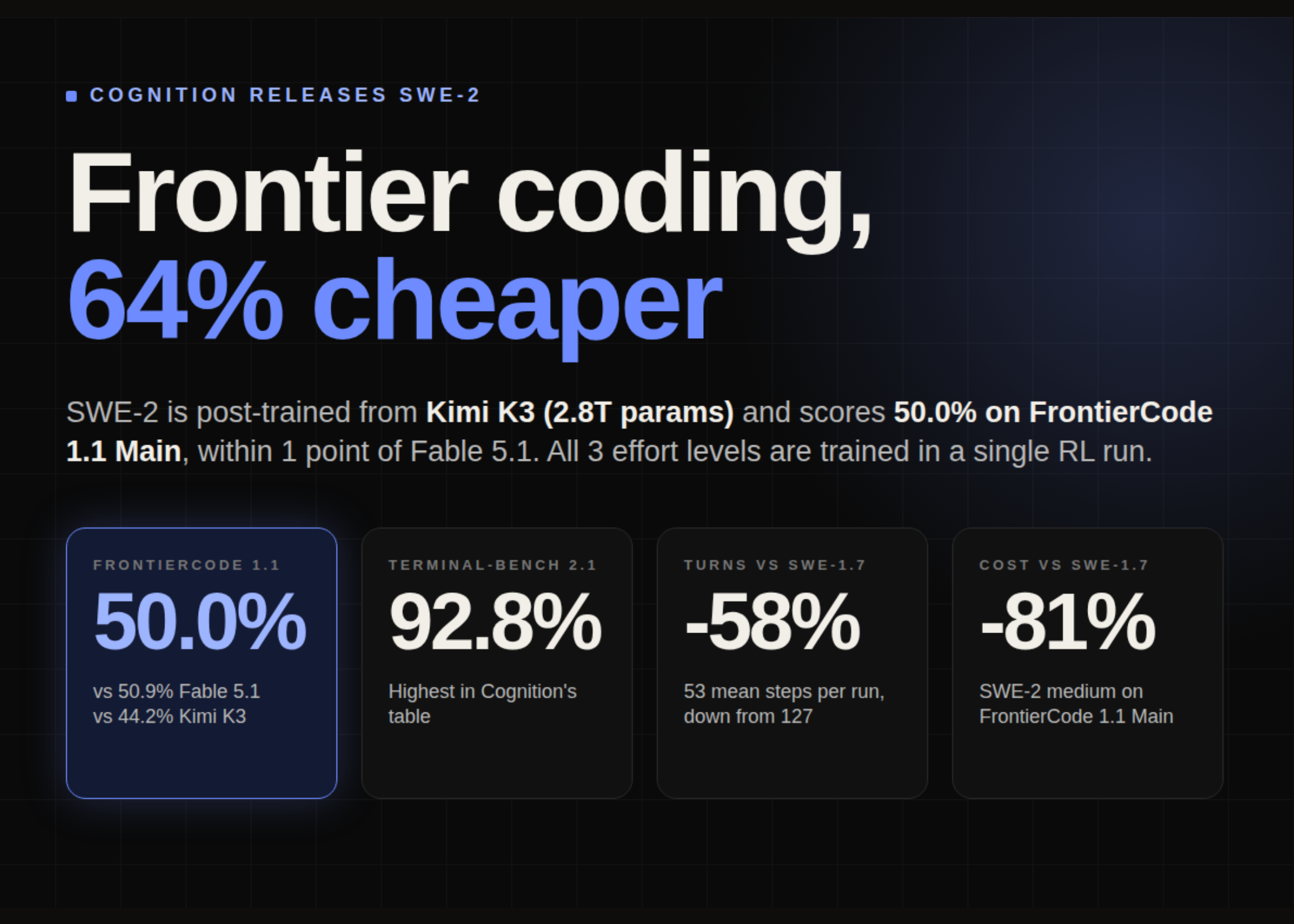
Cognition Releases SWE-2: A Kimi K3 Post-Trained Coding Model That Matches Fable 5.1 on FrontierCode at 64% Lower Cost
AI & Technology

Cognition Releases SWE-2: A Kimi K3 Post-Trained Coding Model That Matches Fable 5.1 on FrontierCode at 64% Lower Cost

September 12, 2026
Next Post
Elon Musk Sells Flamethrowers Online to Fund Tunnels

Elon Musk Sells Flamethrowers Online to Fund Tunnels

Leave a Reply Cancel reply

Your email address will not be published. Required fields are marked *

Search

No Result
View All Result
Your Employer’s Life Insurance Coverage Is Probably Not Enough

Your Employer’s Life Insurance Coverage Is Probably Not Enough

September 11, 2026
Iran-backed rebels in Yemen tried using Anthropic’s Claude to build guided missiles, alarming report finds

Iran-backed rebels in Yemen tried using Anthropic’s Claude to build guided missiles, alarming report finds

September 11, 2026
Your 401k Contribution Limit Resets Every January

Your 401k Contribution Limit Resets Every January

September 8, 2026

About

Learn more

Our Services

Legal

Privacy Policy

Terms of Use

Bloggers

Learn more

Article Links

Contact

Advertise

Ask us anything

©2020- TradePoint.io - All rights reserved!

Tradepoint.io, being just a publishing and technology platform, is not a registered broker-dealer or investment adviser. So we do not provide investment advice. Rather, brokerage services are provided to clients of Tradepoint.io by independent SEC-registered broker-dealers and members of FINRA/SIPC. Every form of investing carries some risk and past performance is not a guarantee of future results. “Tradepoint.io“, “Instant Investing” and “My Trading Tools” are registered trademarks of Apperbuild, LLC.

This website is operated by Apperbuild, LLC. We have no link to any brokerage firm and we do not provide investment advice. Every information and resource we provide is solely for the education of our readers. © 2020 Apperbuild, LLC. All rights reserved.

No Result
View All Result
  • Main
  • AI & Technology
  • Stock Charts
  • Market & News
  • Business
  • Finance Tips
  • Trade Tube
  • Blog
  • Shop

© 2023 - TradePoint.io - All Rights Reserved!