
JuSun
The US’ extreme external and government liabilities that have built up over decades pose a major threat to the dollar as a store of value. While rising interest rates are positive for the dollar in terms of attracting much needed portfolio flows, they also threaten to expose the unsustainable nature of the US’ external and government debt burdens. The Fed will soon be forced to take action to reduce real borrowing costs to prevent the need for unpopular government spending cuts. This is likely to drive the dollar significantly lower to the extent required to restore balance to its external accounts.
The Laws Of Currency Equilibrium
There are two key drivers that govern currency markets and reflect the role of currencies as a means of payment and a store of value: purchasing power parity (PPP) and real interest rates. Purchasing power parity is the idea that over the long term currency markets adjust to changes in relative inflation rates so that export competitiveness is maintained over time. If this were not the case, a country with high inflation would find its exports declining relative to imports, resulting in an unsustainable accumulation of external liabilities.
From a shorter-term perspective, if a currency has high interest rates relative to inflation (compared with its peers) it will tend to trade at premium to fair value when measured in terms of purchasing power parity. The reason being that investors will be more willing to invest in a currency that promises to pay a higher real return. This means that a country with a large persistent current account deficit will generally have to have high real interest rates to entice countries to lend to it.
In the case of the US dollar, its global reserve currency status has created an artificial demand as foreign central banks hold dollars, typically in the form of US Treasuries, as a means of preventing currency appreciation against the dollar to maintain export competitiveness. Had it not been for this reserve currency status, the US dollar would have had to weaken sufficiently for its exports to rise and/or imports decline or would have had to have significantly higher real interest rates to compensate investors for lending to the highly indebted country.
Exorbitant Privilege Has Been Exhausted
The US dollar’s global reserve currency status has allowed the country to run persistent current account deficits since the 1980s, something which has been referred to at the dollar’s exorbitant privilege. By being able to purchase imports with its own currency, the US economy has benefitted immensely, gaining access to real goods and services from overseas in exchange for IOUs, allowing US citizens to live far beyond their means. In the process, however, net international liabilities (the difference between external assets and liabilities, reflecting the accumulation of current account deficits) have ballooned to over 60% of GDP and over 5x exports.
US Net International Investment Position, % of GDP (Bloomberg)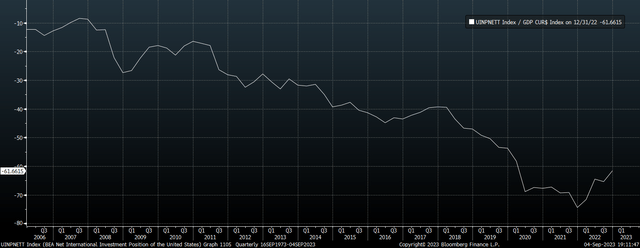
While the buildup of US external liabilities has been a concern among economists for decades, it has been sustainable as foreign governments have until recently been willing to hold US debt liabilities at very low interest rates. This allowed the US to run a primary income surplus as it earned a higher return on its overseas assets than it paid on its liabilities. However, with the Fed hiking rates aggressively, this primary surplus is now in jeopardy and is likely to turn to deficit this year. While higher real interest rates are positive for the dollar in terms of attracting portfolio inflows, the high level of existing liabilities means dollar outflows for debt servicing are also rising.
The US Fiscal Position Will Necessitate Lower Real Interest Rates
The US’ poor external balance sheet would be far less of a concern if not for the equally weak fiscal position. Despite gross government debt already being at 120% government debt to GDP and unemployment being near record lows, the government continues to run huge primary budget deficits, equivalent to almost 5% in Q3. Even with the average interest rate on these liabilities remaining around 3%, this high debt load has seen Treasury interest costs rise exponentially, reaching 3.6% of GDP and almost 20% of Federal tax receipts.
Treasury Interest Payments, % of Total Debt and % of GDP (Bloomberg)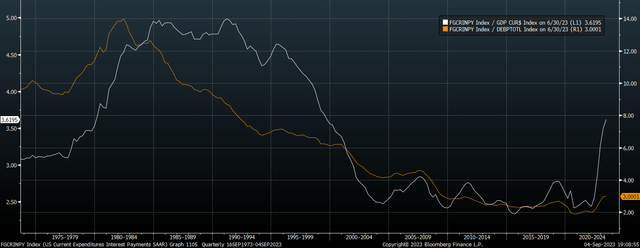
If we factor in a slight rise in the unemployment rate over the coming years and rising social security payments from an ageing population, this primary deficit should be expected to rise further. Even if by some heroic act of fiscal prudence the primary balance remains at 5% of GDP, the impact of higher interest rates will cause an exponential rise in interest payments. As I explained ‘TIP: Yield Curve Control To Drive Real Yields Back Below Zero‘, in a free market where central banks could not intervene, both foreign and domestic investors would require higher yields to hold additional US debt. This would further drive up borrowing costs to the point where aggressive spending cuts would be required to prevent a self-reinforcing debt crisis. However, as the Federal Reserve controls interest rates, it is far more likely that policymakers will opt for interest rate caps as the most palatable way of transferring savings from the private sector. As we saw during WW2 and as we are seeing in Japan today, when debt levels get so large that interest costs threaten to trigger a self-reinforcing rise in yields, central banks step in.
Bloomberg, Author’s calculations
However, to keep bond yields in check, central banks must create increasing amounts of base money to buy the bond, driving up inflation and driving down the real yield on bonds. To pay for War spending in the 1940s, the 10-year bond yield was fixed at 2.5% even as inflation rose to as high as 20%. A repeat of such financial repression today would likely drive a collapse in demand for the US dollar as a store of wealth. With both foreign and domestic investors likely to dump dollars in favor of currencies with more attractive real yields, the dollar is likely to fall to the extent required for the US to begin paying down its huge external debt, which will require significant declines.
The Collapse In The Yen Shows What’s In Store For The Dollar
The performance of the Japanese yen over recent years shows the extent to which a currency can trade below its fair value in PPP terms if real interest rates are capped below their peers. The yen is now trading almost 50% below its fair value in PPP terms despite the fact that the country boasts huge net external assets and a current account surplus. The ability of Japan’s large export market to benefit from currency weakness has prevented the weak currency from forcing down imports, allowing the economy to muddle through despite its currency shock. With US exports amounting to just 10% of GDP, and manufacturing capacity hollowed out from its addiction to cheap imports, it will be difficult for exports to rise sufficiently to restore balance to its currency account, with falling imports a much more likely scenario. The dollar therefore faces a potentially dramatic overshoot lower over the coming years.
Yen vs Fair Value (Bloomberg)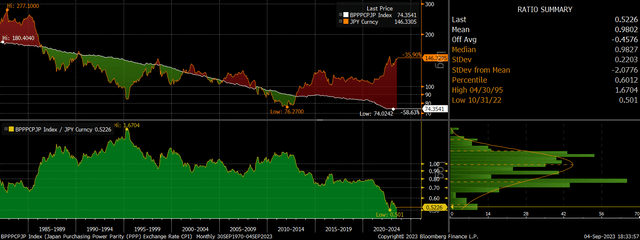
In terms of the currencies that stand to benefit from a dollar bear market, undervalued currencies with strong external and fiscal positions are likely to benefit most. Emerging Asian currencies look attractive on this basis following their recent weakness, as does the Norwegian krone, which is now 30% undervalued in PPP terms despite its 30% current account surplus. I also think the Japanese yen should benefit despite the country’s poor fiscal position as real yield differentials between the US and Japan head back into Japan’s favor, allowing the currency to appreciate from extreme undervalued levels.
Credit: Source link