

Cloud maybefalse/iStock Unreleased via Getty Images
Around four years back, I wrote an article on Alibaba : Significant Upside Left For Long Investors and argued that Alibaba (NYSE:BABA) has huge long-term potential. A lot has changed since then, both from the company front and the overall China growth scenario. In my view, Alibaba stock was a real victim of the US and China trade war and political rhetoric.
If we look at Alibaba now from a fresh perspective, it appears the growth is coming back again and, in this article, I am going to dig deeper and explain why Alibaba long-term Bull case is still intact.
Investment Thesis:
Alibaba stock has the potential to rise by 30% up to $125 per share in the next 2 yrs. I anticipate this promising adjustment to consensus estimates coming soon, driven by:
Taobao/Tmall: Taobao and Tmall are core e-commerce platforms for Alibaba. Investment in these platforms is likely focused on enhancing the user interface, personalization, and overall shopping experience. It may also involve expanding product offerings or entering new markets.
International Commerce (AIDC): Alibaba’s international commerce efforts, often associated with AliExpress and other global ventures, are poised for growth. Investments here may involve expanding into new geographic regions, optimizing logistics and supply chains, and tailoring offerings to local markets.
Cloud Services: Alibaba Cloud has been a significant growth driver for the company. Investments in cloud likely target infrastructure expansion, service improvements, and the development of new cloud-based products and solutions.
To ensure this 30% opportunity makes real sense, following 4 key questions every long-term Alibaba investor needs to ask themselves and reflect:
1. Will core commerce continue to expand?
I expect 6-8% Customer Management revenue growth in the next three years, starting in FY24. Alibaba’s online retail sales growth will slow to high-single digits, with a slight loss of market share. Overall revenue growth is estimated at around 11%, primarily driven by growth outside China’s e-commerce sector.
2. Which businesses have the potential to generate material shareholder value apart from core e-commerce?
The most valuable segments within Alibaba are Alibaba Cloud and International Commerce. I anticipate that Alibaba’s newly revealed restructuring strategy will enhance shareholder value by reducing its control and potentially deconsolidating certain businesses. Additionally, the recent regulatory approval for Ant Group’s fine from the People’s Bank of China (PBOC) sets the stage for a potential future IPO.
3. Can margin expand long-term?
EBITA has already rebounded with growth in FY23. My projection indicates an estimated growth of 21% in FY24, accompanied by a margin of 19.2%, before stabilizing in the mid-18% range in the long term. Specifically, I expect Taobao/Tmall adjusted EBITA to experience modest growth in the low-single digits, supported by improved margins across all other business segments.
4. Can Alibaba continue to improve monetization & value delivered to retailers/advertisers?
Yes. Alibaba has taken significant steps in improving the value provided to merchants and advertisers beyond the initial transactions, for example:
- improved mobile monetization initiatives
- desktop paid-search ranking algorithms
- desktop search personalization improvements
- shifting focus from Gross Merchandize Value to Revenue
- advertiser bidding system to tap the best bidder
In the ever-evolving landscape of e-commerce giants, Alibaba Group has once again caught the attention of investors with a remarkable resurgence in revenue growth. After a brief calm, the company has bounced back into the spotlight by achieving double-digit year-over-year (YoY) revenue growth for the first time since the second quarter of fiscal year 2022. What lies behind this resurgence?
Let’s dissect the key drivers that have reignited Alibaba’s growth engine.
1. A Whiff of Economic Recovery
One of the pillars supporting Alibaba’s resurgence is the broader macroeconomic recovery. As economies regain their footing, consumers find themselves with more disposable income, translating into increased spending across online platforms like Alibaba. This economic tailwind has undoubtedly contributed to the company’s impressive revenue figures.
2. Taobao’s Triumph
But it’s not just macroeconomic forces at play here. Alibaba’s renewed vigor can be attributed in part to a revamped strategy for one of its crown jewels – Taobao. The platform, long hailed as a cornerstone of Alibaba’s success, is experiencing a fresh wave of success. The company’s new Taobao strategy appears to have struck a chord with users and merchants alike, breathing new life into this e-commerce powerhouse.
3. Glocalization – A Winning Formula
In an increasingly interconnected world, Alibaba’s efforts to focus on localization in international e-commerce markets have not gone unnoticed. The term “glocalization” seems apt here, as the company tailors its services to suit the unique preferences and demands of customers in various regions. This strategic localization effort is paying off, boosting Alibaba’s international revenue streams.
4. Sustaining Double-Digit Growth
What’s particularly noteworthy is the confidence Alibaba exudes in its ability to sustain this newfound double-digit revenue growth. This is a testament to the company’s long-term vision and its belief that it can continue to thrive even in the face of potential challenges.
5. Margin Magic
Beyond the top-line growth, Alibaba has managed to perform a bit of magic with its margins. The passage mentions that its margin performance has exceeded expectations. In a world where cost pressures are ever-present, Alibaba’s ability to maintain or even enhance its profit margins is a clear sign of astute cost management and operational efficiency.
6. Customer Management Revenues (CMR)
Digging deeper, we can see that Alibaba’s Customer Management Revenues (CMR) have surged by an impressive 10.0% YoY. These revenues encompass a suite of services that assist merchants in managing their businesses on Alibaba’s platforms. The fact that more merchants are embracing these services is a promising indicator of Alibaba’s growing ecosystem.
Company Financials Jun 2023 – Earning Report 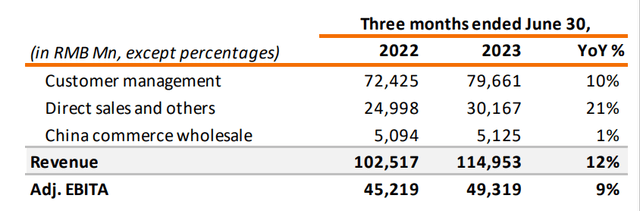
7. A Global Growth Spurt
Turning our gaze towards the global stage, Alibaba’s international retail business is making waves. Its revenues have surged by a staggering 60% YoY, significantly outperforming the expectations of analysts. This growth story spans across platforms such as AliExpress, Lazada, and Trendy, underscoring Alibaba’s prowess in international expansion.
Alibaba Earning Report – June 2023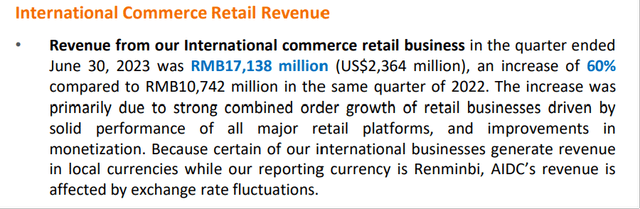
8. Competing with Confidence
In an environment characterized by a slow and uneven macroeconomic recovery, Alibaba stands out for its ability to bridge the gap with competitors. The company has made significant strides in terms of user experience, product selection, and overall growth strategy. It’s a testament to Alibaba’s adaptability and its determination to remain a formidable player in the global e-commerce arena.
E-commerce competition could become more intense
Trudy Dai, the CEO of Taobao/Tmall, has unveiled her three-year vision to transform Taobao into a consumer lifestyle app enriched with more content and an enhanced product selection, with a particular emphasis on providing value for money. The company is committed to investing in initiatives aimed at boosting user engagement, including increased integration with Weixin/WeChat, as well as attracting merchants, particularly smaller ones, and key opinion leaders (KOLs) or influencers. While management is optimistic that these efforts will drive growth, I anticipate that profit margins may remain flat or experience a decline over the next 1-2 years. In the short term, there is an optimistic outlook on improving macroeconomic trends, as indicated in company statements.
Valuation:
I expect Customer Management revenue growth is expected to accelerate to 8.5% in FY24, rebounding from the -7.8% figure in FY23. However, in the long term, I expect growth to settle within the range of 6-8%. For Alibaba, adjusted EBITA growth is expected to decelerate to 8.5% in FY24, down from the 13.4% growth witnessed in FY23.
My Price Target of $125 per share is driven by a combination of discounted cash flow (DCF) analysis and Sum-of-the-parts analysis, implies a valuation of 15 times the estimated FY24E earnings and a multiple of 7 times enterprise value to EBITDA.
Investors are also increasingly giving more weight to the Sum of the Parts (SOTP) valuation methodology below, particularly as Alibaba advances in its restructuring efforts. This shift in focus reflects the recognition of the company’s evolving structure and the potential for value creation in its distinct business segments.
| Alibaba: Sum-of-the-parts analysis |
| US($M) | Value | Alibaba Stakes | Value to Alibaba | Value Per Share | Value % | |
| China E-commerce | 188,082 | 100% | 188,082 | 71 | 57% | |
| International E-Commence | 16,532 | 100% | 16,532 | 6 | 5% | |
| Local Consumer Service | 10,773 | 72% | 7,757 | 3 | 2% | |
| Cainiao Logistics | 16,123 | 63% | 10,157 | 4 | 3% | |
| Alibaba Cloud | 58,960 | 100% | 58,960 | 22 | 18% | |
| Digital Media and Entertainment | 2,488 | 100% | 2,488 | 1 | 1% | |
| Innovation Initiatives | 911 | 100% | 911 | 0 | 0% | |
| Ant Group | 51,000 | 33% | 16,830 | 6 | 5% | |
| All others | 28,120 | 11 | 9% | |||
| Total Value | 329,837 | 125 | 100% | |||
| Adjusted Outstanding Share (M) | 2,649 | |||||
Chart made by author using company data and estimate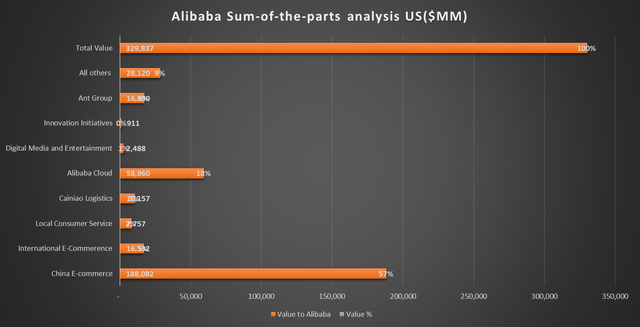
Seeking Alpha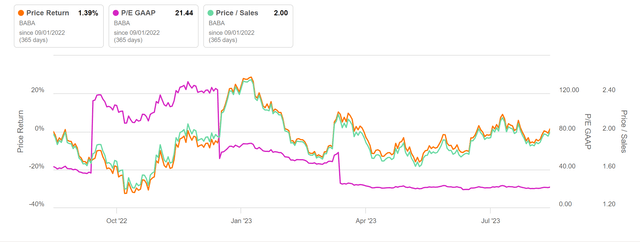
Conclusion:
Alibaba Group’s recent resurgence in revenue growth is a testament to its adaptability and strategic acumen. Fueled by economic recovery, innovative strategies, and a focus on global expansion, the company has rekindled its growth engine. The ability to sustain this momentum, coupled with improved profit margins and enhanced competitiveness, paints a promising picture for Alibaba’s future. Investors are taking notice, as evidenced by the upward revision of the Price Target, signaling a renewed confidence in the company’s prospects. Alibaba’s journey continues, and it appears that the best may be yet to come.
Risk Statement:
I believe the key risks for Alibaba are: 1) regulation changes; in particular, to data usage and online content; 2) Chinese and global macroeconomic headwinds; 3) competitive pressure from traditional offline retailers; 4) the interruption of information technology and systems; 5) negative press; for example, due to fake goods on Alibaba’s platforms; 6) data privacy and security concerns; 7) short-term profitability pressure from long-term investments; 8) execution and management complexities resulting from its multiple platforms; 9) heavy reliance on third-party sellers to provide product selection; 10) corporate governance – significant voting control by the Alibaba Partnership; This price target is based on DCF methodology, supported by a SOTP analysis.
Credit: Source link