

David Gyung
BrightSpire Capital, Inc. (NYSE:BRSP) is a mortgage real estate investment trust (mREIT) offering an attractive dividend yield of around 12%. The mREIT has traded at a substantial discount primarily driven by concerns over its exposure to the office market. This underperformance has been quite common among mREITs with substantial exposure to the office market sector as these mREITs have reported elevated losses in the sector and increased loan loss provisioning. Nevertheless, in the case of BrightSpire there are some early signs of a turnaround in the risk of this portfolio which could contribute to a rerating of the stock in the longer term.
Portfolio and asset quality
Several mREITs have been reporting a rise in the risk rating of its portfolio as seen in my recent article on TPG RE Finance. This has been particularly true for the office market where the risk of default has become elevated in light of declining values and the rise in debt service costs. Seeking Alpha analyst David Ksir explained this dynamic well by noting that while lenders with floating rate portfolios benefit from rising rates, there is a party on the other side of that transaction who must pay these elevated rates on their loans. The greater the interest rate, the more pronounced the possibility that the borrower might fail to meet their payments, particularly when real estate values in the office sector have experienced a substantial decline. He correctly explains that eventually, a borrower might opt to relinquish control of the property that was used as security creating a greater risk of default.
BrightSpire has a fairly substantial exposure to the office market with around 32% of its portfolio being loans in this sector. In recent quarters this segment has also contributed substantially to an increase in loan loss provisioning with the mREIT reporting several consecutive quarterly increases in loan loss provisioning for this segment. In the second quarter of 2023 the mREIT again reported an increase in current expected credit losses (CECL) reserves partially driven by an increase in provisioning in the office sector.
While the focus has been on the office sector, recent loan migrations from the lower risk category 3 to the higher risk category 4 have in fact largely been driven by multifamily loans. In its most recent earnings call management noted that
In the meantime, this quarter, we have identified and downgraded 3 multifamily loans from a 3 to a 4 to reflect specific circumstances of the property and/or the sponsor level.
This signals heightened concern from management over these borrowers’ ability to continue servicing their loans in the upcoming quarters. However, these borrowers’ payments all remain current and management’s concern seems to arise from the effect of inflation on tenants’ ability to continue making their rental payments. Management noted that while increased rents in the multifamily portfolio have been beneficial, its portfolio has-
not been immune from the rapid rise in inflation and corresponding interest rate increases. In some cases, the positive impact of higher rental rates is being muted by rising operating expenses such as utilities, payroll and insurance. Additionally, in some select instances, we have seen increases in bad debt, primarily due to legacy tenant-friendly COVID policies in certain jurisdictions.
Therefore, while the office portfolio might have attracted the most attention from investors in recent quarters, it is worth monitoring the multifamily portfolio quite closely in the months ahead. Despite these concerns, the bulk of the mREITs portfolio remains in risk category 3, which is the category assigned to loans at the time of origination and when the underlying performance remains in line with expectations. Risk category 3 currently makes up more than 80% of BrightSpire’s portfolio as depicted in the chart below.
BRSP Portfolio By Risk Category (%) (Author created based on company filings)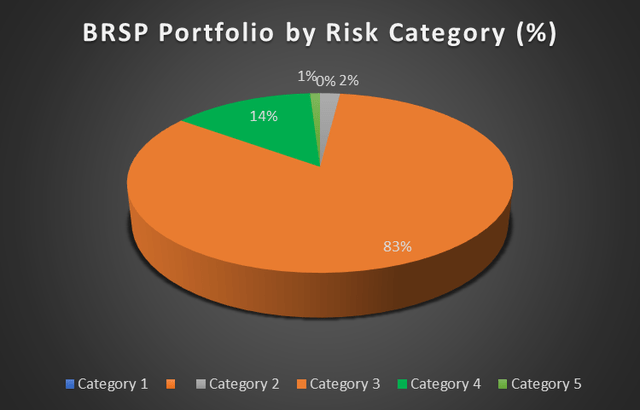
Promisingly BrightSpire also reported the first decline in the weighted average risk rating of its portfolio in several quarters. In the second quarter of 2023 the mREIT reported a weighted average risk rating of 3.1 compared to 3.2 in the previous quarter. While a single quarter would not be suggestive of a trend, it could well be an early signal of a more sustained improvement in the risk weighting of BrightSpire’s portfolio.
A further decline in the number of loans classified in risk category 4 also seems likely to occur as management expects one of the largest hotel loans in this segment to be repaid. Management has noted that:
With respect to the San Jose hotel property. Last quarter, we noted that a sales process was underway for the hotel Annex tower comprised of 264 rooms. During the quarter, a buyer was selected and terms have been agreed to. The borrower anticipates the sale and corresponding pay down of our loan to occur in the third quarter
However, management has also indicated an expectation that some other loans in risk category 4 could be downgraded to risk category 5. Therefore, while there are early signs of an improvement in the risk portfolio and the expected repayment of a significant hotel loan could contribute to the reduction in loans classified in higher risk categories, there are some anticipated downgrades to the riskiest category.
Earnings and the safety of the dividend
BrightSpire offers a dividend yield of around 12.2%, which is the second lowest of the mREITs considered in the peer comp chart below. Nevertheless, it is quite an attractive dividend yield and the sustainability thereof will be a key factor to consider when considering an investment in the mREIT.
mREITs Dividend Yield (%) (Author created based on data from Seeking Alpha)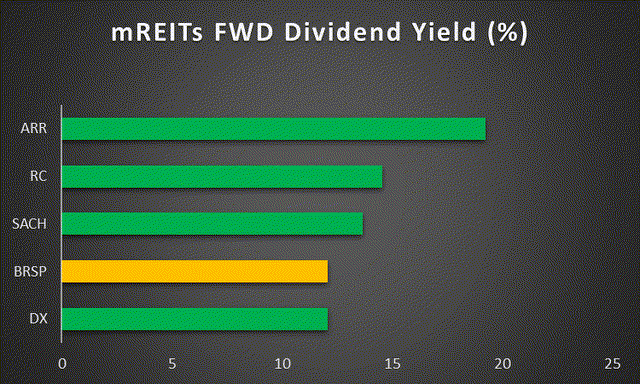
As previously indicated, increased loan loss provisioning has had a significant impact on BrightSpire’s earnings. In the second quarter of 2023 the mREIT reported a GAAP net loss of $0.06 per share primarily driven by $29 million in loan loss reserves added in the quarter. Nevertheless, BrightSpire’s dividend was still covered by its adjusted distributable earnings of $0.25 per share. This also represents a decline in adjustable distributable earnings from $0.27 per share in the first quarter of 2023 primarily driven by loan repayments and loans placed on nonaccrual status.
These losses were partially offset by increases in interest rates. In upcoming quarters, lower loan loss provisioning could materially contribute to an increase in earnings. However, in my view, there is also a need for the redeployment of capital to secure long-term distributable earnings growth. At present management is likely to remain cautious in redeploying capital as the risk environment remains uncertain. This caution certainly seems warranted in the immediate future, but it is hoped that there will be better opportunities for the redeployment of investment funds soon.
I am of the view that BrightSpire’s current dividend seems safe for the time being given that it is adequately covered by adjusted distributable earnings.
Valuation
BrightSpire is currently trading at fairly substantial discount to book value of around 35%. This also represents the largest discount to book value of any of the mREITs considered in the peer comp charts below. This substantial discount seems to be driven in large part by concerns over the office portfolio. As previously indicated, these concerns are not unwarranted as this portfolio has seen a substantial rise in its risk profile.
mREITs Price to Book Value (Author created based on data from EquityRT)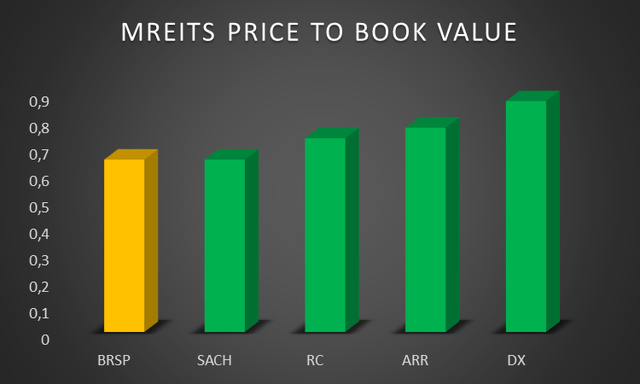
However, the current discount does at first glance appear to be somewhat overblown given that it is substantial enough to cover the entire office portfolio. Nevertheless, BrightSpire rarely trades near book value and like most mREITs seems unlikely to. In my view, the extent to which the market is presently discounting the mREIT is best compared to its historical average discount. On this basis, BrightSpire is not trading at a substantial discount to its 5-year average discount to book value of around 32%.
This leads me to conclude that despite the substantial discount, the stock is not severely undervalued on a historical basis. Nevertheless, an improved credit outlook and reduced loan loss provisioning in quarters ahead could contribute to some form of rerating albeit that such rerating would not, in my view, see the stock trading at or near book value.
Conclusion
BrightSpire trades at a notable discount, largely due to concerns over its exposure to the office market. Although this trend has affected several mREITs with similar office market exposure, signs of a potential turnaround in the risk profile of BrightSpire’s portfolio could lead to a reevaluation of the stock in the long run. Promisingly, BrightSpire has shown an early decline in its portfolio’s weighted average risk rating, signaling a potential shift to improved credit quality. The expected repayment of a substantial hotel loan is further anticipated to contribute to the reduction in higher-risk loans. However, this must be balanced with the expectation of some further downgrades of loans to the riskiest category.
When considering earnings and dividend safety, BrightSpire’s attractive dividend yield appears sustainable, with dividend coverage supported by adjusted distributable earnings. Loan loss provisioning has impacted earnings, but future quarters could see lower provisions, positively influencing earnings. Nevertheless, the discount to book value is not that much higher than its 5-year average discount to book value, leading me to consider BrightSpire stock a hold.
Credit: Source link